
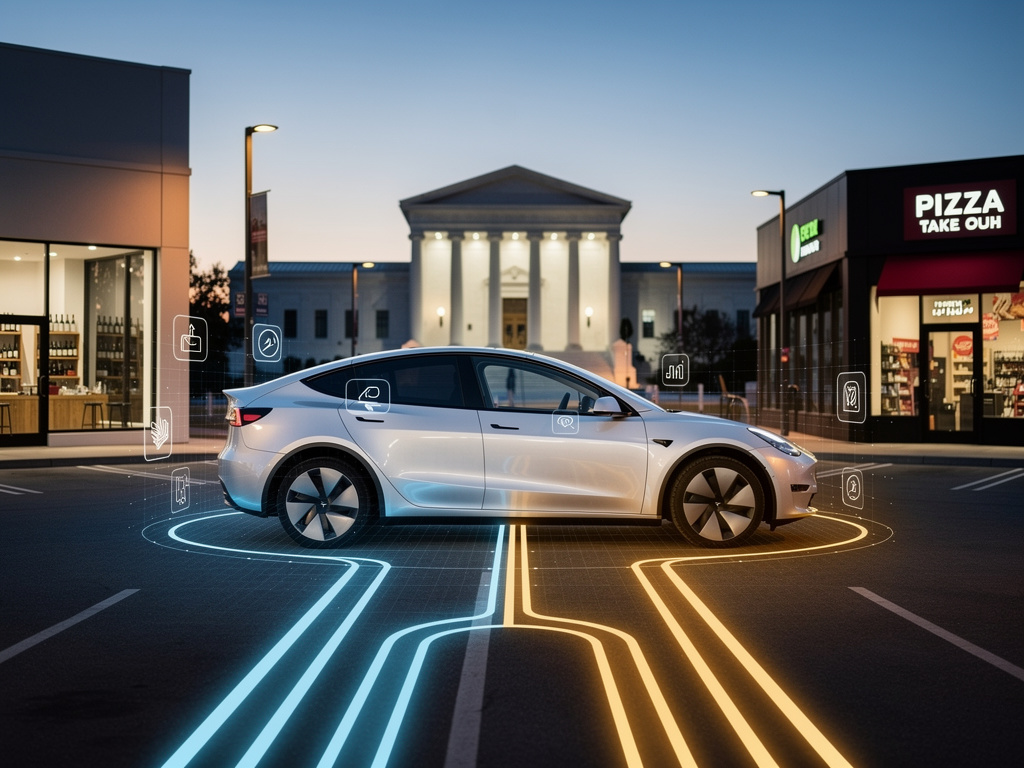
A Tesla owner in Redmond, Washington, recently sent his Model Y on a solo mission: pick up wine and pizza from a local shop, no human aboard. The car, running Tesla’s Full Self-Driving (Supervised) software version 13.2, pulled out of the driveway, drove to the store, and waited in the parking lot while staff loaded the order. Then it drove itself home.
No driver. No passenger. Just a car, a prepaid order, and a bet that the software wouldn’t fail.
The stunt, first reported by Futurism, was shared on social media by the Tesla owner, who posted video of the trip and called it a demonstration of what FSD can already do. The footage shows the vehicle handling intersections, navigating a parking lot, and returning home — all without human intervention. It’s the kind of content that generates enormous engagement in Tesla fan communities and equal parts alarm among safety advocates.
And it raises a question that regulators, insurers, and the auto industry have been circling for years: What happens when autonomous vehicle technology is good enough to tempt consumers into using it in ways that are explicitly unauthorized?
The Gap Between Capability and Legality
Tesla’s FSD (Supervised) is sold as a Level 2 advanced driver-assistance system. That classification matters. Under the SAE International framework that regulators and the industry rely on, Level 2 means the human driver must remain attentive and ready to take control at all times. The “Supervised” label isn’t decorative — it’s a legal and regulatory requirement. Tesla’s own documentation states that a licensed driver must be in the driver’s seat with hands on the wheel.
Sending a car driverless to pick up pizza violates that requirement in the most literal way possible.
Yet the Redmond trip apparently went off without incident. The car didn’t crash. It didn’t run a red light. It picked up the goods and came back. For Tesla enthusiasts, this is proof of concept — evidence that FSD is closer to true autonomy than critics acknowledge. For regulators, it’s a nightmare scenario: a consumer using a product in a dangerous, unauthorized manner and being rewarded with a successful outcome that encourages others to do the same.
Washington state law requires a licensed human operator to be in control of a vehicle on public roads. There is no exemption for Tesla’s FSD software. The National Highway Traffic Safety Administration has opened multiple investigations into Tesla’s Autopilot and FSD systems over the years, and the agency has been clear that no vehicle currently sold to consumers in the United States is approved for driverless operation on public roads without specific permits — permits Tesla does not hold in Washington or most other states.
The distinction between what the technology can do and what it’s allowed to do has never been sharper.
Waymo operates truly driverless robotaxis in San Francisco, Phoenix, and Los Angeles, but it does so under rigorous state and local permits, with dedicated operational domains, remote human oversight, and vehicles purpose-built for autonomous operation. Tesla’s approach is fundamentally different: sell the software to consumers, let them use it on any road, and rely on the “Supervised” label to manage liability. When a consumer strips out the supervision part, the legal and ethical framework collapses.
This isn’t the first time Tesla owners have tested the boundaries. Videos of people riding in the back seat, sleeping behind the wheel, or sending their cars on solo trips have circulated for years. In 2021, a fatal crash in Texas involved a Tesla that investigators said had no one in the driver’s seat, though Tesla disputed the finding. The pattern is consistent: the software’s increasing competence emboldens users to push past its intended use.
Elon Musk’s Autonomy Ambitions and the Regulatory Friction Ahead
Tesla CEO Elon Musk has promised fully autonomous driving for years. At the company’s robotaxi unveiling event in October 2024, he presented the Cybercab — a vehicle with no steering wheel or pedals, designed from the ground up for driverless operation. Musk said he expected production to begin by 2026. He’s also claimed that Tesla’s existing fleet of millions of vehicles could be converted into a revenue-generating robotaxi network via over-the-air software updates, a vision he’s promoted since at least 2019.
But the gap between Musk’s timeline and regulatory reality remains vast. No state has granted Tesla blanket approval to operate its consumer vehicles as unsupervised autonomous cars. California, which has the most developed autonomous vehicle regulatory framework in the country, requires companies to obtain specific permits from the Department of Motor Vehicles before testing or deploying driverless vehicles. Tesla has not obtained such a permit for FSD.
The Federal government hasn’t moved much faster. NHTSA has the authority to regulate vehicle safety but has largely deferred to states on the rules governing autonomous vehicle operation on public roads. A comprehensive federal framework for autonomous vehicles has been stalled in Congress for years. The result is a patchwork of state regulations, some permissive, some restrictive, and a massive gray area that consumers like the Redmond Tesla owner are exploiting.
Meanwhile, Tesla’s FSD software continues to improve. Version 13.2, the build used in the wine-and-pizza run, represents significant progress over earlier iterations. Tesla has shifted its FSD architecture to an end-to-end neural network approach, replacing much of the rules-based code that governed earlier versions. The system now processes raw camera inputs and produces driving outputs with less hand-coded logic in between. Users and independent testers have noted smoother driving behavior, better handling of complex intersections, and fewer phantom braking events.
But “better” is not “safe enough to operate without a driver.” And the plural of anecdote is not data. A single successful driverless pizza run doesn’t validate the system’s readiness for unsupervised deployment any more than a single plane landing on autopilot validates removing pilots from cockpits.
The insurance implications alone are staggering. If an unoccupied Tesla running FSD strikes a pedestrian, who is liable? The owner who sent the car out illegally? Tesla, whose software enabled the trip? The answer likely depends on the state, the specific circumstances, and years of litigation. Most auto insurance policies require a human operator. A claim arising from a driverless trip could be denied outright, leaving the vehicle owner personally exposed to catastrophic liability.
There’s also the question of alcohol. The Redmond trip involved picking up wine. In many jurisdictions, the person receiving an alcohol delivery must present valid identification and be of legal drinking age. An unoccupied vehicle can’t verify ID. The store in this case apparently loaded the order without that check — or the owner had pre-arranged the transaction in a way that sidestepped it. Either way, it highlights how the existing commercial and regulatory infrastructure assumes a human is present.
So where does this leave the industry? Tesla is betting that the technology will outrun the regulation — that FSD will become so demonstrably safe that lawmakers will have no choice but to permit it. Musk has said as much publicly. But the history of automotive regulation suggests otherwise. Seatbelt laws, airbag mandates, emissions standards — all took decades to implement, even when the safety case was overwhelming. Autonomous driving involves far more complex tradeoffs: liability allocation, labor displacement, cybersecurity, urban planning, and public trust.
Competitors are watching closely. Waymo, backed by Alphabet, has taken the slow-and-steady approach: limited geographies, extensive testing, regulatory cooperation. Cruise, General Motors’ autonomous vehicle unit, pulled its fleet off the roads in late 2023 after a pedestrian dragging incident in San Francisco exposed gaps in its safety protocols and its communication with regulators. It has since scaled back dramatically. The contrast with Tesla’s consumer-driven, move-fast approach couldn’t be starker.
The Redmond pizza run will likely fade from the news cycle quickly. But the underlying tension it exposes will not. Tesla is selling software that is increasingly capable of driving without human input, to millions of consumers, while labeling it as a system that requires constant human supervision. Every successful unauthorized driverless trip makes the next one more likely. And every one of those trips is a roll of the dice on public roads shared with pedestrians, cyclists, and other drivers who didn’t consent to the experiment.
The technology is moving. The law isn’t keeping pace. And somewhere in Washington state, a Model Y is sitting in a driveway, loaded with wine and pizza, waiting for its next assignment.


 WebProNews is an iEntry Publication