
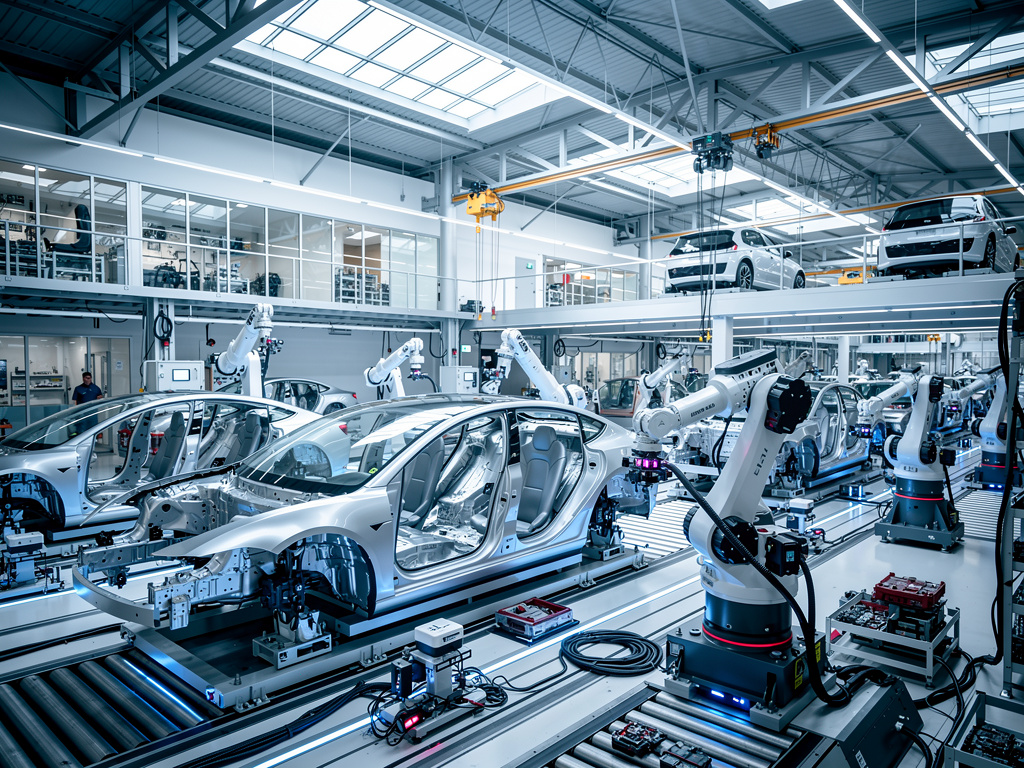
Tesla Inc. is charting a bold course at its flagship Fremont, California, factory, shifting production lines from aging luxury vehicles to humanoid robots while planning to expand its workforce, Chief Executive Elon Musk revealed during the company’s fourth-quarter earnings call on January 28, 2026. Unlike tech peers slashing jobs amid artificial intelligence advances, Musk emphasized no layoffs and potential headcount growth at the facility, which currently employs over 20,000 workers.
“Tesla is in hiring mode at California factory,” Musk stated, according to MarketWatch. This comes as Tesla winds down Model S and Model X production next quarter, repurposing the space for a million-unit annual Optimus robot line. The move underscores Musk’s vision of robotics eclipsing cars as Tesla’s core business.
Fremont’s Production Overhaul
The Fremont plant, Tesla’s highest-output vehicle factory in North America, will maintain Model 3 and Model Y output through efficiencies while converting S/X lines, Musk explained. “We expect to wind down S and X production next quarter. Basically, stop production next quarter,” he said on the call, as reported by CNBC. The Gen 3 Optimus, Tesla’s first mass-production robot design, aims for a late-2026 ramp-up, capable of learning via human observation.
This transformation arrives amid Tesla’s first annual revenue decline, with 2025 sales dropping 3% year-over-year, yet Q4 earnings per share beat estimates at $0.50 versus $0.45 expected. Gross margins improved to 20% from 16%, buoyed by cost controls, per Yahoo Finance.
No Layoffs in Robot Era
Musk explicitly ruled out staff cuts, contrasting with Amazon.com Inc. and others trimming amid AI shifts. “Tesla does not have layoff plans,” he affirmed, expecting Fremont headcount to rise over time to support Optimus scaling, according to Ticker Report. Fremont’s workforce, around 22,000 as of recent data, will pivot without disruption.
The decision defies industry trends where AI displaces labor. “There’s a lot of companies laying off people due to AI, but we expect to hire more people despite robot deployment,” Musk noted, via Shacknews. Tesla’s strategy bets on humans overseeing complex robot integration.
Optimus Ambitions Take Shape
Optimus production won’t surge until late 2026 due to supply chain hurdles, Musk cautioned. “Because it is a completely new supply chain, there’s really nothing from the existing supply chain that exists in Optimus,” he told investors, per CNBC. The Fremont conversion targets 1 million units yearly, positioning the plant as a robotics hub.
Tesla plans a Gen 3 Optimus unveiling this quarter, with mass sales eyed for 2027. Musk envisions robots for factory tasks to household chores, potentially eclipsing vehicle revenue. This aligns with $20 billion-plus capital expenditures in 2026 for AI, autonomy, and manufacturing, CFO Vaibhav Taneja disclosed.
Financial Pressures Fuel Pivot
Tesla’s 2025 net income plunged 46% to $3.8 billion, its lowest since the pandemic, driven by softening EV demand and Model S/X sales lag. The luxury models, launched in 2012 and 2015, yielded to volume leaders Model 3 and Y. “It’s time to basically bring the Model S and X programs to an end with an honorable discharge,” Musk said wistfully, as covered by CBS San Francisco.
Investor focus has shifted to robotaxis and Optimus, propping shares near records despite auto woes. Tesla’s $2 billion xAI investment, Musk’s AI venture, integrates Grok AI into vehicles and robots, per earnings disclosures.
Fremont’s Historical Backbone
Acquired from Toyota in 2010, Fremont birthed Tesla’s mass-market EVs, peaking at 50% capacity expansion goals by 2021. It navigated COVID controversies, including Musk’s defiance of lockdowns, yet emerged as North America’s top plant. Recent leasing of 100,000 square feet nearby signals broader growth for Cybercab and Megapacks, X posts note.
California incentives, like a 2013 $34.7 million tax break, fueled early ramps. Now, as EVs mature, Fremont evolves into an AI-physical nexus, blending auto expertise with robotics.
Workforce Expansion Outlook
Headcount growth counters 2024’s 10% global cuts to 127,000 employees. Fremont’s 20,000-plus staff face no immediate risks, with Musk forecasting increases for Optimus demands. “Tesla expects to boost headcount at the Fremont facility… and to significantly increase output,” San Francisco Business Times quoted.
Challenges persist: OSHA violations historically tripled peers’, and union tensions linger. Yet, Musk’s hiring pledge signals optimism amid geopolitical supply risks prompting domestic chip fabs.
Risks and Road Ahead
Optimus timelines echo past delays, with Musk admitting “agonizingly slow” initial ramps. Vehicle deliveries project 8.2% growth to 1.77 million in 2026, but competition and Musk’s political distractions weigh. Robotaxi rollouts in Austin and beyond test autonomy claims.
For Model S/X owners, service continues, but Musk urged: “Now is the time to order it.” Fremont’s reinvention positions Tesla beyond autos, betting humans and robots will power its next era.


 WebProNews is an iEntry Publication