
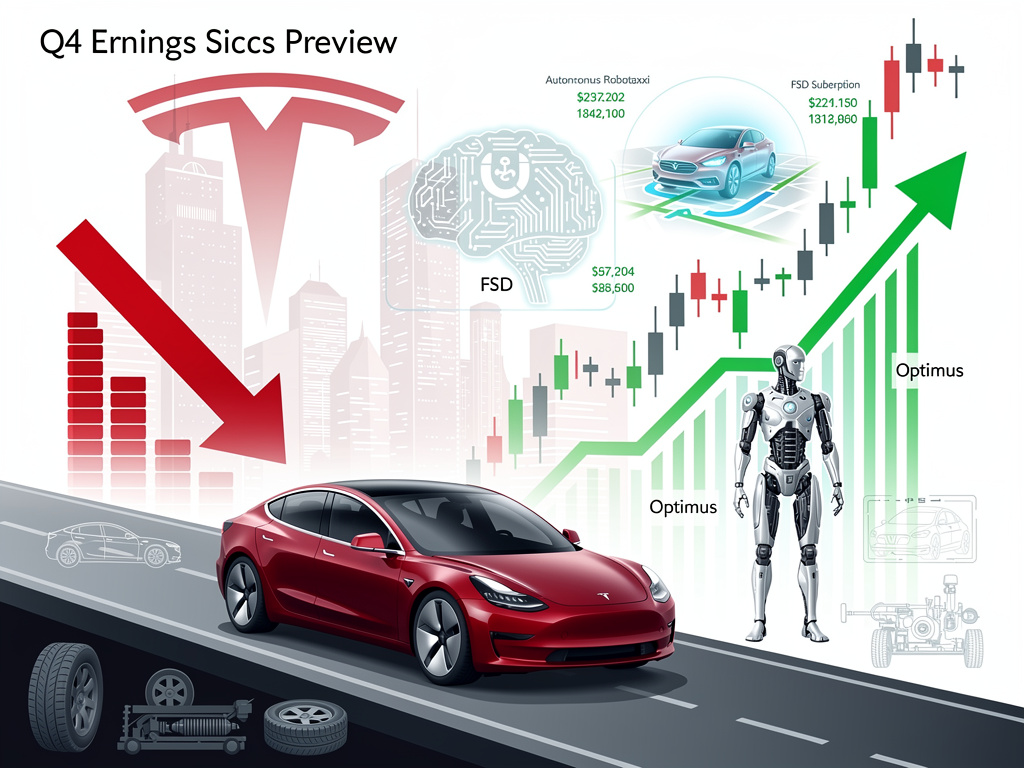
Tesla Inc. heads into its fourth-quarter earnings report on Wednesday after the market close, with Wall Street bracing for numbers that analysts across the board describe as disappointing. Consensus estimates peg revenue at $24.5 billion, down roughly 4% from last year, while adjusted earnings per share are forecast at 44 cents, a 40% plunge, according to Tesla’s own compilation of 19 analysts shared on X. Deliveries of 418,227 vehicles marked a 16% year-over-year drop and the second straight annual decline to 1.64 million units, trailing BYD’s 2.26 million battery-electric vehicles.
The automotive segment faces intense pressure, with gross margins excluding regulatory credits expected to hit a three-quarter low of 14.3%, per Visible Alpha data cited by Reuters. Price cuts, the U.S. EV tax credit’s expiration, and competition from Chinese rivals eroded profitability, even as energy storage deployments soared to a record 14.2 GWh in the quarter and 46.7 GWh for the year.
EV Sales Slide Signals Broader Challenges
Europe saw Tesla’s sales crater 27.8% to 235,322 units, per Electrek figures referenced in multiple previews, amid backlash tied to CEO Elon Musk’s political activities. In the U.S., the tax credit loss hit demand hard, while China intensified the price war. “The numbers will be ugly. Deliveries down, margins compressed, EPS falling 40%,” IMD business school professor Howard Yu told USA Today.
Yet energy storage emerged as a bright spot, potentially offsetting some automotive weakness with double-digit growth. Capital expenditures are projected to climb to nearly $3 billion, up from $2.8 billion, fueling investments in AI and autonomy, as noted in Sherwood News.
Investors’ Business Daily highlighted Musk’s upcoming conference call as pivotal, with eyes on robotaxi updates, in its piece “Tesla Earnings Are Due. What To Expect From Elon Musk’s Big Call” (Investor’s Business Daily). Autonomy Bets Drive $1.5 Trillion Valuation
Much of Tesla’s $1.49 trillion market cap hinges on Musk’s vision for self-driving tech and humanoid robots, shrugging off near-term fundamentals. “Investors are largely looking past the near-term fundamentals. Market sentiment is being driven by Tesla’s broader autonomy ambitions,” Hargreaves Lansdown analyst Matt Britzman told Reuters. Last week, Musk announced safety-driver-free robotaxis in Austin, a milestone Wedbush’s Dan Ives called an “important first step.”
Full Self-Driving subscriptions stand at 12% fleet adoption, far from the 10 million needed for Musk’s compensation milestone, but a shift to subscription-only post-February 14 could boost recurring revenue, per IG International analysis. Robotaxi service launched limited in Austin and the Bay Area with about 200 vehicles, missing end-2025 unsupervised public rollout targets.
Barron’s warned of “ugly” results in “Tesla Stock Falls. Why Its Earnings Will Be ‘Ugly.’” (Barron’s), projecting 43 cents EPS on $24.6 billion sales. Cybercab production starts April but at an “agonizingly slow” initial rate, Musk cautioned on social media, with expansion to eight-to-ten cities eyed.
Optimus Emerges as Wildcard Catalyst
Optimus, Musk’s “infinite money glitch,” could address labor shortages and global poverty, he claimed on the Q3 call. Production timelines slipped to late 2026, but Fremont pilots aim for 1 million units annually, with Giga Texas scaling to 10 million by 2027, according to TradingKey. Barclays’ Dan Levy noted any shift beyond prototype could spark excitement.
Options traders price a 6.3% swing post-earnings, reflecting uncertainty, Yahoo Finance reported. Stifel deemed Q4 deliveries “neutral,” reiterating Buy with $508 target on FSD and robotaxi promise. Truist cut its target to $439 but held Hold after the 418,000 delivery miss was “better than feared.”
MarketWatch previewed a capital-intensive 2026 in “Tesla has a big year ahead. It’ll be very expensive,” emphasizing AI compute and fleet scale over per-unit profits. Shay Boloor of Futurum Equities told Reuters Tesla trades margins for installed base to monetize via software later.
Musk’s Call to Shape 2026 Outlook
Guidance will scrutinize 2026 deliveries amid U.S. tax credit absence and global rivalry—Musk warned of “a few rough quarters.” Analysts forecast $104 billion revenue and $2.03 EPS next year, powered by Cybercab, Optimus, and FSD approvals in China and Europe potentially next month, per Musk at Davos.
FSD pricing starts at $99 monthly but may rise as refinement advances, USA Today noted. Musk’s $1 trillion package ties to 10 million subscriptions. On X, Wedbush’s Ives upped bull case to $800, eyeing $2 trillion capstone as AI thesis accelerates.
GLJ Research’s Gordon Johnson adjusted targets to $25.28 Sell, citing discounts and mix shifts. Tesla’s Q4 tests if automotive pain justifies AI sacrifices, with Musk positioned to pivot narrative to robotaxis, Optimus, and energy as growth engines amid cooling EV demand.


 WebProNews is an iEntry Publication