
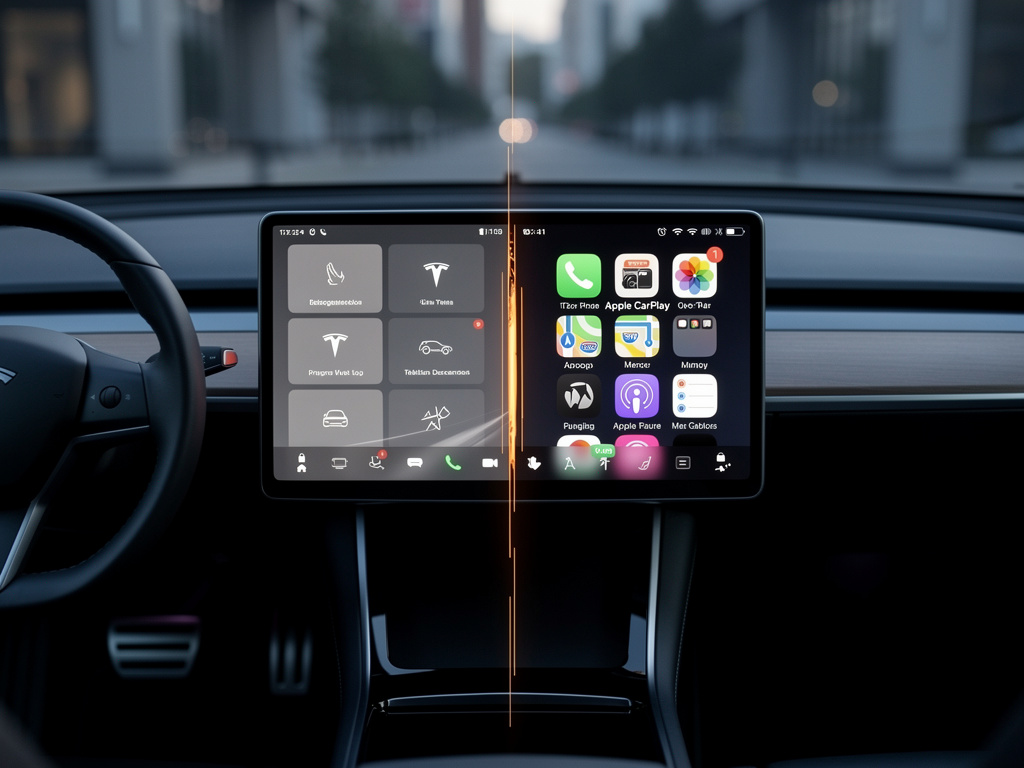
Tesla’s unexpected pivot toward supporting Apple CarPlay represents one of the automotive industry’s most significant about-faces in recent memory, yet the implementation remains frustratingly elusive for customers eagerly awaiting the feature. According to reporting from 9to5Mac, the electric vehicle manufacturer continues to work on CarPlay integration, but the timeline and technical specifications remain shrouded in uncertainty, leaving industry observers questioning whether Tesla’s proprietary software ecosystem can successfully accommodate Apple’s platform without compromising the company’s core differentiators.
The integration challenge extends far beyond simple software compatibility. Tesla’s vehicles feature a fundamentally different human-machine interface architecture compared to traditional automakers, with nearly all vehicle functions controlled through a central touchscreen rather than physical buttons and knobs. This design philosophy has defined Tesla’s brand identity since the Model S launch, creating a cohesive software experience that Elon Musk has historically defended as superior to third-party solutions. The decision to support CarPlay therefore represents not merely a technical undertaking but a philosophical shift that could reshape how Tesla positions itself in an increasingly competitive electric vehicle market.
Industry analysts suggest the delay stems from Tesla’s need to reconcile CarPlay’s interface requirements with its existing vehicle control systems. Unlike conventional vehicles where CarPlay operates as an overlay on the infotainment system, Tesla’s architecture integrates climate controls, vehicle settings, and navigation into a unified interface. Separating these functions to accommodate Apple’s platform requires extensive software reengineering, potentially explaining why the feature remains in development despite the initial announcement generating significant consumer interest and media coverage.
The Competitive Pressure Behind Tesla’s Strategic Shift
The automotive market has evolved dramatically since Tesla first dismissed CarPlay as unnecessary. Legacy automakers and new electric vehicle entrants have embraced smartphone integration as a baseline expectation, with General Motors even reversing its decision to eliminate CarPlay after facing customer backlash. This industry-wide standardization has created a competitive disadvantage for Tesla, particularly among buyers who prioritize seamless integration with their existing Apple ecosystem over Tesla’s native applications.
Consumer demand data reveals the extent of this pressure. Surveys conducted by automotive research firms consistently show smartphone integration ranking among the top five purchase considerations for new vehicle buyers, with Apple users particularly vocal about CarPlay’s importance. Tesla’s resistance to this feature has become a frequently cited reason for purchase hesitation, even among environmentally conscious consumers otherwise aligned with the company’s mission. The financial implications of losing potential customers to competitors offering CarPlay support likely influenced Tesla’s strategic recalculation.
Technical Architecture and Implementation Hurdles
The engineering challenges Tesla faces differ substantially from those encountered by traditional automakers implementing CarPlay. Conventional vehicles typically dedicate a separate processor and display area to infotainment functions, allowing CarPlay to operate independently from critical vehicle systems. Tesla’s integrated approach means the same hardware and software stack controls everything from entertainment to autopilot functions, requiring careful partitioning to ensure CarPlay integration doesn’t compromise vehicle safety or performance.
Software architecture experts note that Tesla must address several technical considerations simultaneously. The company’s over-the-air update system, which has become a signature feature allowing continuous vehicle improvement, must accommodate CarPlay without creating conflicts during software updates. Additionally, Tesla’s custom Linux-based operating system requires adaptation to support Apple’s proprietary protocols, a process complicated by Apple’s strict certification requirements and Tesla’s preference for maintaining control over its software stack.
The display resolution and aspect ratio of Tesla’s screens present another complication. The company’s vehicles feature unconventional screen orientations, particularly the portrait-oriented displays in Model S and Model X vehicles. CarPlay was designed primarily for landscape-oriented screens common in traditional vehicles, requiring either interface adaptation or compromises in how the system displays information. This technical mismatch may necessitate custom development work with Apple, potentially explaining the extended development timeline.
The Broader Implications for Tesla’s Software Strategy
Tesla’s CarPlay integration represents a broader question about the company’s software strategy and competitive positioning. The electric vehicle manufacturer has invested billions in developing proprietary navigation, entertainment, and voice assistant capabilities, viewing software as a key differentiator in an industry where hardware advantages prove increasingly difficult to maintain. Allowing CarPlay into Tesla vehicles could undermine the value proposition of these investments, particularly if customers default to Apple’s solutions over Tesla’s native offerings.
The decision also affects Tesla’s data collection capabilities and customer relationship management. The company’s integrated software ecosystem provides valuable insights into driver behavior, preferences, and usage patterns that inform product development and service offerings. CarPlay integration could reduce Tesla’s visibility into how customers interact with their vehicles, potentially limiting the company’s ability to refine its products based on real-world usage data. This consideration likely factors into the cautious approach Tesla has taken toward implementation.
Industry Precedents and Lessons from Competitors
Tesla’s situation mirrors challenges faced by other technology-forward automakers attempting to balance proprietary systems with customer expectations for smartphone integration. Rivian, the electric vehicle startup, launched with both CarPlay and Android Auto support despite developing sophisticated native software, recognizing that customer choice enhances rather than diminishes the ownership experience. Similarly, Lucid Motors integrated smartphone mirroring from launch, understanding that luxury buyers expect comprehensive connectivity options regardless of the vehicle’s native capabilities.
The General Motors experience provides particularly relevant insights. The automotive giant announced plans to eliminate CarPlay and Android Auto from future electric vehicles, citing the benefits of a unified software experience and direct customer relationships. However, intense customer backlash and dealer resistance forced a reversal, demonstrating that even established automakers cannot unilaterally remove features that customers consider essential. Tesla’s decision to add CarPlay support suggests the company learned from GM’s miscalculation, recognizing that customer preferences ultimately supersede manufacturer preferences in feature availability.
Customer Expectations and Market Positioning
The delay in CarPlay implementation has created a challenging communications situation for Tesla. Early adopters who purchased vehicles based on promises of future CarPlay support face uncertainty about when, or if, their vehicles will receive the feature. This situation echoes previous controversies around Tesla’s Full Self-Driving capability, where promised features arrived years later than initially suggested or required hardware upgrades not available for earlier vehicles. The pattern risks eroding customer trust and complicating Tesla’s relationship with its most loyal supporters.
Market positioning considerations add another dimension to Tesla’s CarPlay calculus. The company has historically positioned itself as a technology leader that sets industry standards rather than following them. Supporting CarPlay could be perceived as an admission that Tesla’s native software falls short of customer expectations, potentially damaging the premium brand image the company has cultivated. Conversely, continued resistance to a feature that competitors offer as standard risks positioning Tesla as stubborn and out of touch with customer needs, particularly as the electric vehicle market becomes increasingly competitive.
The ongoing development of CarPlay support at Tesla illuminates the complex intersection of technical capability, strategic positioning, and customer expectations in the modern automotive industry. As electric vehicles transition from niche products to mainstream transportation, manufacturers face increasing pressure to accommodate established technology ecosystems while maintaining their unique value propositions. Tesla’s handling of CarPlay integration will likely influence how other automakers approach similar decisions, establishing precedents for balancing innovation with interoperability in an industry undergoing fundamental transformation. The ultimate success or failure of this integration may determine whether Tesla’s software-first approach remains viable as the automotive industry continues its evolution toward becoming a technology sector in its own right.


 WebProNews is an iEntry Publication