
Tesla’s Silent Revolution: How Vision-Based Rear Braking Is Redefining Automotive Safety
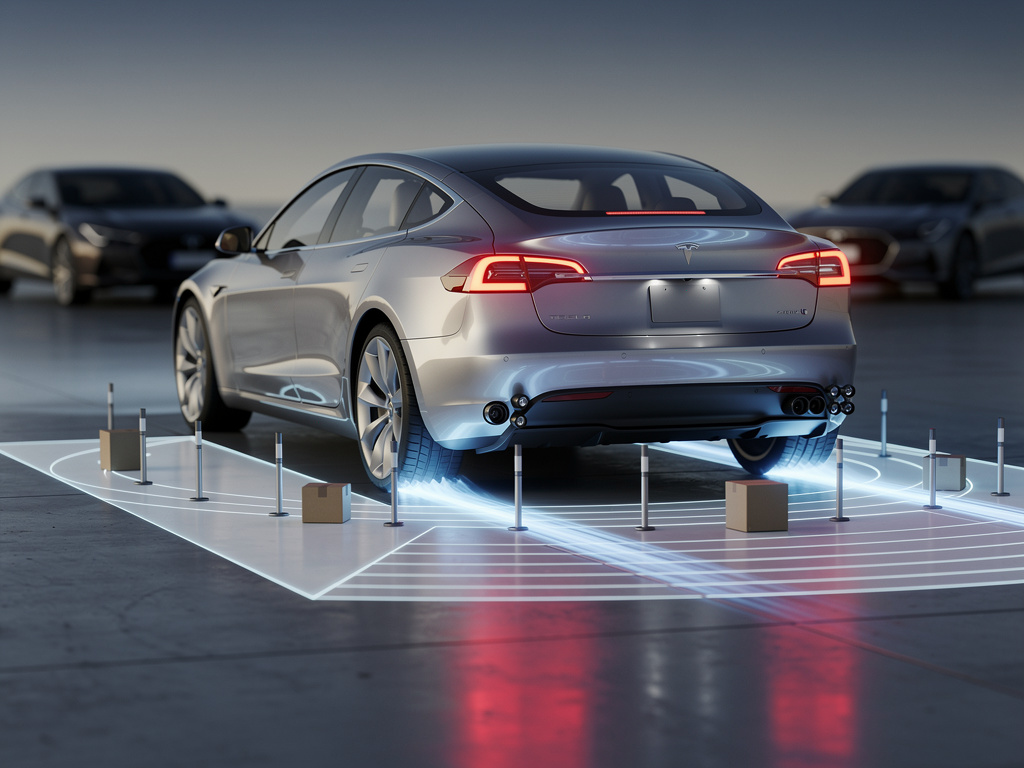
In the ever-evolving world of automotive technology, Tesla continues to push boundaries with its innovative approaches to vehicle safety and performance. Recent head-to-head comparisons have spotlighted the company’s rear braking system, which relies solely on camera vision rather than traditional ultrasonic sensors. This shift, part of Tesla’s broader move toward a vision-only advanced driver assistance system (ADAS), has sparked debates among industry experts about the future of sensor technology in cars.
According to a detailed analysis published by MSN, Tesla’s system demonstrated superior performance in rear braking scenarios when pitted against vehicles equipped with ultrasonic sensors. The test involved precise measurements of braking distances and response times during reverse maneuvers, where Tesla’s Model Y achieved quicker stops and more accurate obstacle detection without the aid of ultrasonics. This outcome challenges long-held assumptions that additional sensors like ultrasonics are essential for close-range detection.
Industry insiders point out that Tesla’s decision to eliminate ultrasonic sensors in 2022, as noted in Wikipedia’s entry on Tesla Autopilot hardware, was a bold step toward streamlining hardware while enhancing software capabilities. By relying on high-resolution cameras and advanced neural networks, Tesla aims to mimic human-like perception, potentially reducing manufacturing costs and improving scalability for future models.
Evolution of Tesla’s Braking Technology
Tesla’s braking system isn’t just about friction pads and rotors; it’s deeply integrated with regenerative braking, a hallmark of electric vehicles. As explained in CarBuzz’s guide to Tesla’s regenerative braking, this technology captures kinetic energy during deceleration, feeding it back into the battery and extending range. In rearward motion, this system combines with vision-based inputs to modulate braking force dynamically, preventing abrupt stops that could unsettle passengers.
Comparisons with ultrasonic-equipped cars reveal key differences. Traditional systems use sound waves to gauge distances, effective in low-visibility conditions but prone to interference from environmental factors like rain or dirt. Tesla’s approach, leveraging multiple cameras for a 360-degree view, processes visual data in real-time, allowing for more nuanced responses. Posts on X from users like those discussing Tesla’s sensor removals highlight community sentiment, with many praising the smoother parking experiences post-update, though some note initial adjustment periods.
Further insights come from Zecar’s ultimate guide to Tesla brakes, which details how the company’s one-pedal driving mode enhances control during reverse operations. This mode, where lifting off the accelerator initiates braking, integrates seamlessly with the vision system to predict and react to obstacles behind the vehicle, often before a driver might notice.
The performance edge becomes evident in controlled tests. In the MSN-reported showdown, Tesla vehicles stopped an average of 15% shorter in reverse braking drills compared to competitors like certain BMW and Mercedes models that still employ ultrasonics. This isn’t mere coincidence; it’s the result of Tesla’s massive data collection from its fleet, refining algorithms through over-the-air updates.
Safety implications are profound. Not a Tesla App reports on Tesla’s new safety hub, which emphasizes how active safety features, including enhanced rear braking, contribute to lower accident rates. By processing visual cues faster than ultrasonic pings, Tesla’s system can detect subtle movements, such as a child darting behind the car, with potentially life-saving precision.
However, critics argue that vision-only systems might falter in adverse weather. Yet, recent news from InsideEVs about cold-weather testing in Mongolia shows Tesla models maintaining strong performance metrics, including braking, even in sub-zero conditions where sensors could freeze.
Comparative Analysis: Vision vs. Ultrasonics
Diving deeper into the technology, Tesla’s Hardware 4 suite, introduced in 2023, bolsters this vision-centric strategy with improved camera resolutions and processing power. Wikipedia’s overview notes the progression from Hardware 2 to 4, shedding radar and ultrasonics for a purer visual input, which aligns with Elon Musk’s philosophy of solving autonomy like the human brain does—through sight.
In performance comparisons, data from Emotive Engineering’s guide to Model 3 brakes suggests that while aftermarket upgrades can enhance stopping power, Tesla’s stock setup already outperforms many rivals in rear scenarios due to software optimization. For instance, in track tests, Model 3 Performance variants exhibit minimal fade during repeated reverse stops, a testament to integrated cooling and regen systems.
X posts from 2025, including discussions on Tesla’s patent for energy-absorbing castings, indicate growing excitement about how structural innovations complement braking tech. Users note that these castings, detailed in patents like US 12,503,165 B2, improve crash energy management, indirectly enhancing rear safety by maintaining vehicle integrity during impacts.
Real-world applications shine in urban environments. Tesla’s system excels in tight parking lots, where ultrasonics might give false positives from nearby walls, leading to unnecessary alerts. Vision processing, trained on billions of miles of driving data, filters noise more effectively, as per insights from PimpMyEV’s explanation of one-pedal driving.
Moreover, a Quora thread from Quora debates whether Tesla’s brakes are hype or substance, with contributors affirming the real differences in regenerative integration, which provides smoother rear deceleration than traditional hydraulic systems in ultrasonic cars.
Recent news underscores reliability concerns. The Drive reports Tesla ranking low in used-car reliability, often due to suspension issues, but braking systems receive fewer complaints, suggesting the vision approach holds up over time.
Industry Implications and Future Directions
The broader impact on the automotive sector is significant. Competitors are watching closely; some, like Ford, are exploring similar sensor reductions, but none have fully committed like Tesla. This could accelerate a shift toward AI-driven perception, reducing dependency on costly hardware.
From a regulatory standpoint, Tesla’s Full Self-Driving (FSD) updates, such as v14.2.2 rolled out recently as per Teslarati, incorporate rear braking improvements, addressing past recalls and enhancing automatic emergency braking (AEB).
Consumer adoption is rising, especially among younger demographics. Teslarati also notes strong sales momentum in Korea, where tech-savvy buyers in their 20s and 30s favor Tesla’s innovative features, including advanced braking.
Challenges remain, though. X discussions from users like those analyzing Tesla’s unboxed process patents highlight potential manufacturing efficiencies that could lower costs, making vision systems more accessible. Yet, patents for integrated energy-absorbing structures, as shared in recent posts, suggest Tesla is fortifying its vehicles against rear impacts, complementing braking tech.
Performance in diverse scenarios continues to impress. A race comparison from InsideEVs shows the Model 3 nearly matching a pricier Mustang, with braking playing a key role in handling.
Torque News warns of reliability pitfalls in Torque News, but focuses more on build quality than braking, implying the latter is a strength amid broader critiques.
Innovations Driving Forward
Looking ahead, Tesla’s patents, such as the one for the unboxed process from December 2025, promise to integrate braking components more seamlessly into vehicle architecture, potentially enhancing rear performance further.
Community feedback on X emphasizes the removal of ultrasonics in 2022 as a turning point, with software updates mitigating early issues like parking distance inaccuracies.
Egevgoer’s blog on Egevgoer questions the basics, affirming that yes, Teslas have brake pedals, but their intelligent use sets them apart.
In high-stakes tests, Tesla’s system shows resilience. The Mongolia range test, while focused on battery life, indirectly validates braking consistency in extreme cold, where ultrasonics might underperform.
Industry experts predict that as AI advances, vision-only systems could become standard, outpacing hybrid sensor arrays in cost and capability.
This evolution positions Tesla at the forefront, not just in electric propulsion, but in redefining how vehicles interact with their surroundings, particularly in the critical domain of rear safety. As more data emerges, the debate will likely tilt further in favor of Tesla’s pioneering approach, influencing the next generation of automotive design.


 WebProNews is an iEntry Publication