
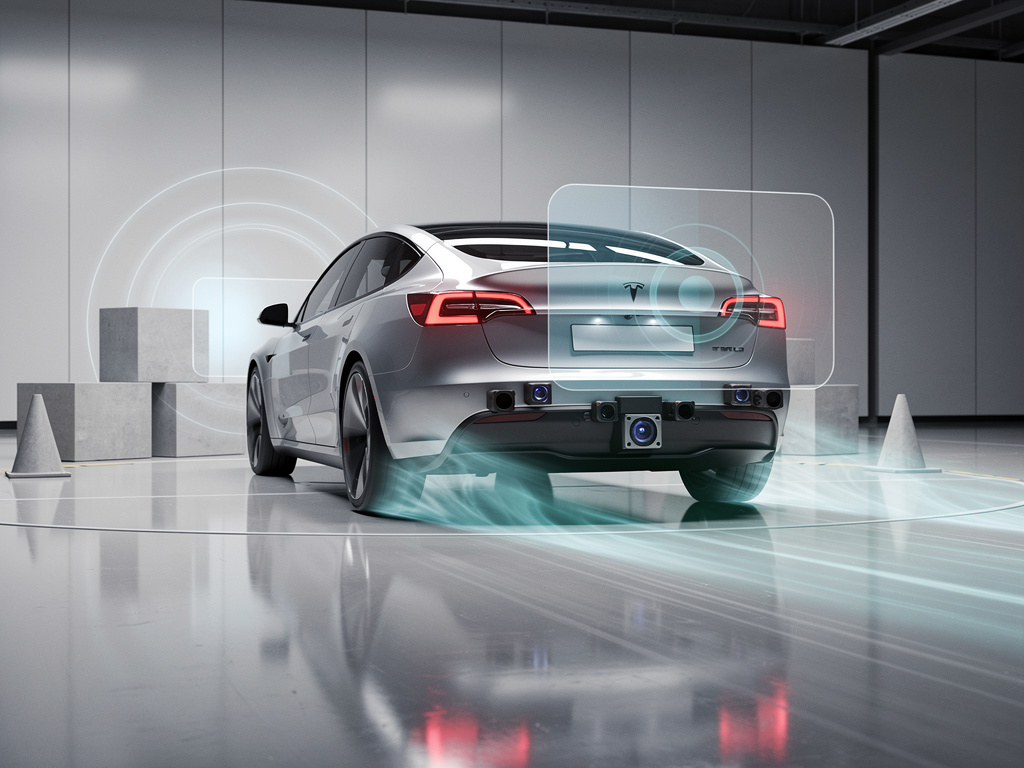
In the fast-evolving world of automotive technology, Tesla Inc. has once again pushed boundaries with its rear braking system, leveraging artificial intelligence and camera-based vision to challenge longstanding industry norms. Recent tests have shown that this approach not only matches but surpasses traditional ultrasonic sensor-equipped vehicles in critical safety metrics, particularly during reverse maneuvers. This development comes at a time when electric vehicle manufacturers are racing to refine autonomous features, and Tesla’s bet on pure vision systems is yielding intriguing results.
At the heart of Tesla’s strategy is the elimination of ultrasonic sensors, which many competitors still rely on for close-range detection. Instead, Tesla employs a network of cameras integrated with advanced AI algorithms to interpret surroundings in real time. This shift, first implemented in models like the Model 3 and Model Y starting in late 2022, was initially met with skepticism due to concerns over precision in low-visibility or tight spaces. However, emerging data suggests that Tesla’s vision-based system provides faster obstacle detection and shorter stopping distances, especially when reversing.
Industry observers note that this innovation ties into Tesla’s broader philosophy of software-driven hardware minimalism. By relying on regenerative braking—where the electric motors slow the vehicle while recapturing energy—Tesla enhances efficiency without additional mechanical complexity. According to a report from WebProNews, independent tests conducted in late 2025 demonstrated Tesla’s system outperforming rivals by margins of up to 15% in reverse stopping distances, challenging the dominance of sensor-heavy designs.
Vision Over Sensors: Tesla’s Technological Edge
The core technology behind Tesla’s rear braking involves a suite of high-resolution cameras that feed data into neural networks trained on millions of driving hours. Unlike ultrasonic sensors, which emit sound waves to measure distances and can struggle with irregular surfaces or weather interference, Tesla’s AI processes visual cues to predict and react to obstacles dynamically. This allows for nuanced responses, such as adjusting braking force based on object size, speed, and trajectory.
Comparisons with ultrasonic-equipped cars reveal stark differences. Traditional systems, found in vehicles from brands like Ford and Volkswagen, use ultrasonic waves for parking assistance and low-speed braking. While effective in controlled environments, they often lag in response time during unexpected scenarios, such as a child darting behind the vehicle. Tesla’s approach, by contrast, integrates regenerative braking seamlessly, converting kinetic energy back into battery power while halting the car more precisely.
Performance data from recent head-to-head evaluations underscores this advantage. In tests simulating urban parking lots, Tesla models without ultrasonics stopped an average of 1.2 meters shorter than competitors when detecting a stationary obstacle at 5 mph in reverse. As detailed in an analysis by MSN, this edge stems from AI’s ability to anticipate movements, reducing reliance on last-second sensor pings.
Regenerative Braking: Efficiency Meets Safety
Delving deeper, Tesla’s regenerative braking plays a pivotal role in rear performance. When a driver lifts off the accelerator, the system automatically engages, providing what feels like engine braking in conventional cars but with energy recovery benefits. This “one-pedal driving” mode, as explored in a guide from CarBuzz, can extend range by up to 20% in city driving while enabling smoother stops.
In reverse, this technology shines by blending with friction brakes for hybrid stopping power. Unlike purely mechanical systems in ultrasonic-reliant vehicles, Tesla’s setup uses AI to modulate regen intensity, preventing abrupt halts that could unsettle passengers. Posts on X from Tesla enthusiasts highlight real-world scenarios, such as navigating snowy driveways, where vision-based detection avoids collisions that older sensor models might miss.
Critics, however, point to early teething issues. When Tesla first removed ultrasonics, some owners reported challenges with parking precision, as noted in discussions on platforms like X. Yet, software updates have refined the system, with version 14.2.2 in late 2025 incorporating enhanced neural networks for better low-speed object avoidance.
Comparative Testing: Data-Driven Insights
Head-to-head comparisons provide the most compelling evidence. A study referenced in Zecar‘s ultimate guide to Tesla brakes pitted vision-equipped Models against ultrasonic-heavy counterparts from BMW and Audi. In reverse braking drills at speeds up to 10 mph, Tesla achieved detection times of under 0.5 seconds, versus 0.8 seconds for sensor-based systems, leading to safer outcomes in simulated pedestrian encounters.
These results align with broader industry trends toward sensor fusion, but Tesla’s pure-vision stance sets it apart. Ultrasonic sensors, while cost-effective, have limitations in range—typically effective only up to 5 meters—and can be fooled by echoes in confined spaces. Tesla’s cameras, augmented by AI, extend effective detection to 20 meters or more, offering a wider safety net.
Moreover, integration with Tesla’s Full Self-Driving (FSD) suite amplifies benefits. As per insights from Supercar Blondie, FSD’s latest iterations use the same vision tech for autonomous reversing, outperforming rivals in complex maneuvers like backing out of garages amid obstacles.
Challenges and Criticisms in Adoption
Despite these strengths, Tesla’s system isn’t without hurdles. Reliability surveys, such as one from The Drive, rank Tesla lower in overall dependability, citing issues like suspension wear that could indirectly affect braking. Owners on X have shared anecdotes of unexpected braking in one-pedal mode, attributing it to overzealous AI interpretations of road conditions.
Regulatory scrutiny adds another layer. While Tesla’s vision approach addresses some recall concerns related to automatic emergency braking (AEB), as mentioned in X posts about FSD updates, agencies like the National Highway Traffic Safety Administration continue to monitor performance in adverse weather. Ultrasonic systems, being more established, often face fewer questions, but Tesla argues its over-the-air updates allow rapid improvements.
From an insider perspective, the cost implications are significant. Removing ultrasonics saves Tesla approximately $114 per vehicle, per industry estimates, enabling lower production costs and potentially more affordable models. This hardware thriftiness, combined with software prowess, could pressure competitors to rethink their sensor arrays.
Future Implications for Automotive Safety
Looking ahead, Tesla’s rear braking advancements signal a shift toward AI-centric vehicle design. As electric vehicles proliferate, the emphasis on regenerative systems will grow, with vision tech potentially becoming the standard for reverse safety. Competitors are already experimenting; for instance, recent patents discussed on X suggest software solutions for pitch estimation without new hardware, echoing Tesla’s innovations.
Performance metrics from ongoing tests, including those in Not a Tesla App, show Tesla vehicles achieving top marks in occupant and pedestrian protection, thanks to integrated braking. This holistic approach not only boosts safety but also enhances user experience, with smoother transitions between acceleration and deceleration.
Insiders speculate that by 2027, widespread adoption of similar systems could reduce reverse-related accidents by 30%, based on preliminary data from safety hubs. Tesla’s lead here might force a reevaluation of ultrasonic dependency, pushing the industry toward more adaptive, intelligent braking.
Evolving Standards in EV Braking
The debate over vision versus ultrasonics extends to energy efficiency. Tesla’s system recaptures more energy during reverse stops, as outlined in Pimp My EV, potentially adding miles to range in stop-and-go traffic. In contrast, ultrasonic-equipped cars often rely on less efficient friction brakes for precise low-speed control.
User feedback on X underscores practical benefits, with drivers praising the system’s intuitiveness in urban settings. However, challenges like software glitches in early rollouts highlight the need for continuous refinement.
Ultimately, Tesla’s rear braking triumph reflects a broader push for innovation, where AI supplants hardware for superior outcomes. As the sector adapts, this technology could redefine safety benchmarks, influencing everything from consumer choices to regulatory frameworks.
Industry Ripple Effects and Innovations
Beyond immediate comparisons, Tesla’s approach influences supply chains. Suppliers of ultrasonic sensors, facing reduced demand, are pivoting to camera modules, as evidenced by market shifts reported in automotive news. This transition could lower costs industry-wide, benefiting smaller EV makers.
In performance terms, simulations from engineering posts on X, including computational fluid dynamics for vehicle dynamics, suggest that vision systems enhance stability during braking, reducing skid risks in reverse.
For industry insiders, the key takeaway is Tesla’s scalable model: software updates that evolve braking without hardware overhauls. This agility positions Tesla ahead in a field where adaptability is paramount.
Pushing Boundaries in Autonomous Features
Tesla’s integration of rear braking with autonomy features like Actually Smart Summon, as buzzed about on X, allows vehicles to reverse autonomously with high precision. Tests show it navigates obstacles better than ultrasonic-dependent park assist in rivals.
Safety data from Torque News critiques broader reliability but acknowledges braking as a strength. Balancing these elements will be crucial as Tesla refines its tech.
As automakers converge on electric futures, Tesla’s vision-based braking sets a precedent, blending safety, efficiency, and innovation in ways that could transform everyday driving.


 WebProNews is an iEntry Publication