
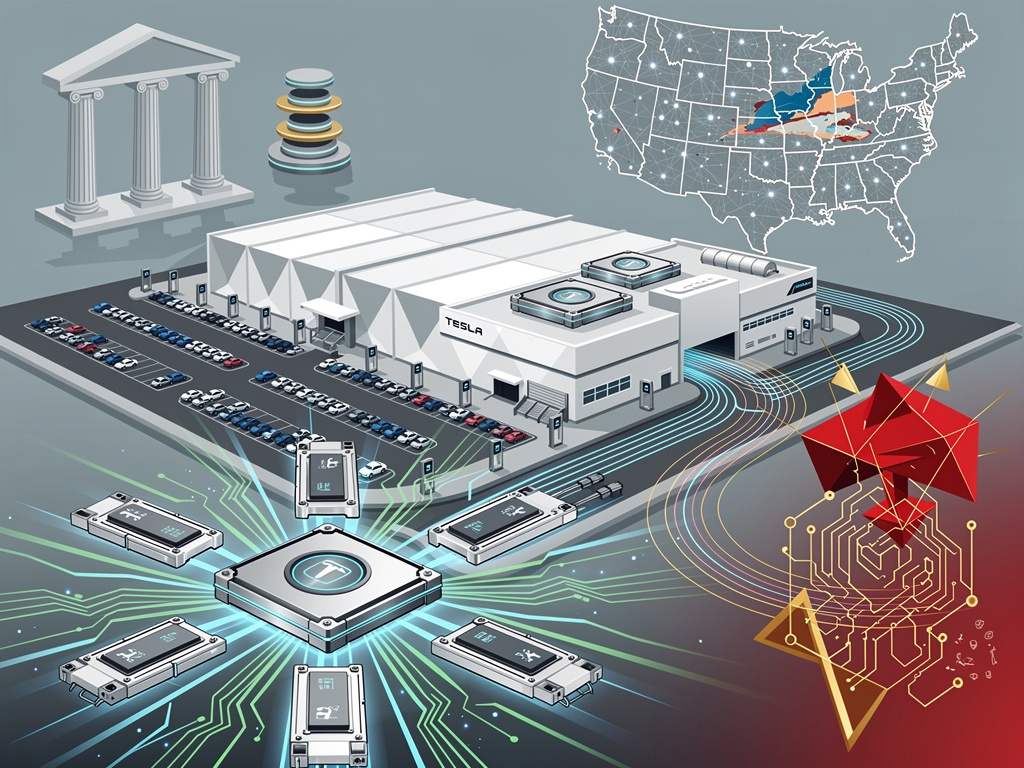
Tesla just committed $4.3 billion to Michigan. Not to build cars — to build the batteries that go inside them.
The electric vehicle maker announced a massive deal to construct a new lithium iron phosphate (LFP) battery cell manufacturing facility in cooperation with battery giant CATL, according to MSN. The project, which is expected to bring thousands of jobs to the state, represents one of the largest single manufacturing investments in Michigan’s recent history. And it arrives at a moment when the American auto industry is grappling with fundamental questions about where its future will be built — and by whom.
The factory is slated to produce LFP battery cells, a chemistry Tesla has increasingly favored for its standard-range vehicles. LFP cells don’t use nickel or cobalt, two materials that are expensive, geopolitically fraught, and environmentally damaging to extract. They’re cheaper. They last longer in terms of cycle life. And while they carry less energy per kilogram than nickel-based alternatives, the gap has narrowed enough that Tesla sees them as the right solution for mass-market models.
This is a strategic pivot with enormous implications.
For years, Tesla relied almost exclusively on nickel-cobalt-aluminum (NCA) and nickel-cobalt-manganese (NCM) chemistries supplied primarily by Panasonic and, later, by LG Energy Solution and CATL. The shift toward LFP — which CATL pioneered at scale in China — signals that Tesla is willing to sacrifice some range at the top end in exchange for lower costs and faster production ramp-ups. CEO Elon Musk has said repeatedly that affordability is the single biggest barrier to mass EV adoption. Cheaper batteries are the most direct path to cheaper cars.
The Michigan facility also carries heavy political symbolism. Tesla has historically maintained an adversarial relationship with the state, which for years banned the company from selling vehicles directly to consumers through its own stores. Michigan was the last major auto state to lift that restriction, doing so only in 2022. Now Tesla is pouring billions into the state’s industrial base — a move that aligns the company’s interests with those of Michigan’s political establishment in a way that would have seemed unthinkable five years ago.
Governor Gretchen Whitmer has been vocal about attracting EV manufacturing investment to Michigan, framing it as a way to preserve the state’s identity as the center of American automotive production even as the industry undergoes its most significant technological transition in a century. The Tesla-CATL project fits neatly into that narrative. Thousands of construction jobs during the build-out phase, followed by thousands of permanent manufacturing positions once the plant is operational. For a state that watched its industrial base erode for decades, these are not small numbers.
But the CATL connection is where things get complicated.
Contemporary Amperex Technology Co. Limited, better known as CATL, is headquartered in Ningde, China. It is the world’s largest battery manufacturer by a wide margin, supplying cells to virtually every major automaker on the planet. Its dominance in LFP technology is nearly absolute. No Western company comes close to matching its scale, cost efficiency, or manufacturing know-how in this particular chemistry.
That dominance has made CATL a lightning rod in Washington. Lawmakers from both parties have raised concerns about the national security implications of relying on Chinese battery technology for America’s electric vehicle fleet. Senator Marco Rubio and others have pushed legislation that would restrict the use of CATL batteries in vehicles that qualify for federal EV tax credits under the Inflation Reduction Act. The concern isn’t just about supply chain dependency — it’s about data, intellectual property, and the strategic risk of allowing a Chinese company to embed itself in critical American infrastructure.
Tesla’s arrangement with CATL for the Michigan plant has been structured carefully to address some of these concerns. Tesla will own the factory. Tesla will operate it. CATL is providing the technology and manufacturing expertise through a licensing agreement, but the facility itself will be an American operation with American workers. This structure mirrors the approach Ford attempted with a similar CATL-linked battery plant in Marshall, Michigan — a project that faced intense political backlash and was ultimately scaled back significantly.
The Ford experience is instructive. In early 2023, Ford announced a $3.5 billion plan to build an LFP battery plant in Marshall using CATL technology. Republicans attacked the deal as a giveaway to China. Former President Donald Trump called it a betrayal of American workers. Ford eventually reduced the project’s scope, cutting planned investment roughly in half and reducing the number of jobs it would create. The political toxicity of the CATL association proved more potent than the economic benefits.
Tesla appears to be betting it can thread this needle more effectively than Ford did. Part of that confidence may stem from Musk’s own political positioning. His relationship with the Trump wing of the Republican Party — complicated as it is — gives him a degree of cover that Ford’s leadership doesn’t enjoy. And the sheer scale of the investment, $4.3 billion, makes it harder for politicians to oppose without appearing to be against job creation in a state that desperately wants them.
Still, the risks are real. The Inflation Reduction Act’s battery component and critical mineral sourcing requirements are tightening over time. Starting in 2025, vehicles containing battery components manufactured by a “foreign entity of concern” — a category that includes Chinese companies like CATL — will be ineligible for the full $7,500 federal tax credit. How the Treasury Department interprets CATL’s role in the Michigan plant could determine whether Tesla vehicles built with those cells qualify for the subsidy. That’s not a trivial question. It’s potentially worth thousands of dollars per vehicle sold.
The broader context here is a full-scale race among automakers and battery manufacturers to build out domestic cell production capacity. The United States currently produces a small fraction of the lithium-ion batteries it needs to meet projected EV demand. China dominates global battery manufacturing, controlling roughly 75% of cell production capacity worldwide. South Korea and Japan account for most of the rest. America is a distant fourth.
Closing that gap requires exactly the kind of massive capital investment Tesla is making in Michigan. But it also requires technology transfer — and that’s where the tension with China becomes unavoidable. American companies don’t yet have the expertise to manufacture LFP cells at scale with the cost efficiency that CATL achieves. They need CATL’s help. But accepting that help means accepting a degree of technological dependence on a geopolitical rival.
Tesla isn’t the only company wrestling with this dilemma. General Motors has partnered with Samsung SDI and LG Energy Solution for its Ultium battery plants. Hyundai is building a massive facility in Georgia with SK On. Toyota is investing billions in a North Carolina battery plant. Every major automaker is scrambling to secure domestic battery supply, and nearly all of them are doing so in partnership with Asian manufacturers. The question isn’t whether America will rely on foreign battery expertise in the near term — it will. The question is how quickly domestic capabilities can mature to the point where that reliance diminishes.
For Michigan specifically, the Tesla investment arrives at a pivotal moment. The state’s traditional automakers — GM, Ford, and Stellantis — are all navigating painful transitions that have involved layoffs, plant closures, and uncertainty about which facilities will survive the shift to electric powertrains. The UAW’s historic 2023 strike extracted significant concessions from the Detroit Three, but it also highlighted the fragility of the existing manufacturing base. New investment from a company like Tesla, which has no legacy ICE operations to wind down, represents a different kind of economic anchor — one built entirely around the future rather than the past.
The jobs question deserves scrutiny, though. Battery manufacturing is less labor-intensive than vehicle assembly. A battery plant employing 2,500 workers might produce cells worth billions of dollars annually, but that’s far fewer jobs per dollar of output than a traditional auto plant. The nature of the work is different, too — more chemical processing, more automation, fewer of the manual assembly tasks that historically provided middle-class wages to workers without college degrees. Whether the Michigan battery plant jobs will be unionized remains an open question. Tesla has aggressively resisted unionization at all of its U.S. facilities, and there’s no indication that will change here.
The financial calculus for Tesla is straightforward. Batteries represent roughly 30-40% of the total cost of an electric vehicle. Producing them in-house, at scale, in the United States, gives Tesla several advantages simultaneously: lower per-unit costs, reduced exposure to supply chain disruptions, eligibility for IRA subsidies, and tighter quality control. The company already manufactures some battery cells at its facilities in Nevada and Texas, but the Michigan plant would significantly expand that capacity and, critically, would focus on the LFP chemistry that Tesla plans to use in its most affordable vehicles.
And affordability is the whole game right now. Tesla’s average selling price has declined over the past two years as Musk has pursued volume growth over margin preservation. The much-anticipated “affordable Tesla” — a model expected to start below $30,000 — will almost certainly use LFP cells. Building those cells domestically, at a cost competitive with Chinese imports, is arguably the single most important manufacturing challenge Tesla faces over the next five years.
The $4.3 billion figure also reflects the sheer capital intensity of battery manufacturing. Building a gigafactory-scale battery plant requires enormous upfront investment in equipment, cleanrooms, electrode coating lines, cell assembly systems, and formation and aging infrastructure. The payback period is long. But once operational, these plants generate enormous value — both in terms of the cells they produce and the strategic optionality they provide. A company with sufficient domestic battery capacity can move faster on new vehicle programs, respond more nimbly to shifts in consumer demand, and insulate itself from the kind of supply shocks that hobbled the entire auto industry during the semiconductor crisis of 2021-2022.
So what does this mean for the competitive picture? Tesla’s Michigan investment widens its lead over most domestic competitors in terms of vertical integration. GM’s Ultium joint ventures are progressing but have encountered significant technical and ramp-up challenges. Ford has scaled back its battery ambitions. Stellantis is further behind still. Among legacy automakers, only Hyundai-Kia — through its partnerships with SK On and Samsung SDI — appears to be keeping pace with Tesla’s battery supply build-out in North America.
The Chinese competition, of course, is a different story entirely. BYD, which surpassed Tesla in global EV sales for several quarters, manufactures its own Blade Battery LFP cells at a cost that Western producers can’t yet match. CATL supplies half the world. EVE Energy, CALB, and Gotion are all expanding aggressively. China’s battery industry benefits from decades of government support, a mature domestic supply chain for raw materials processing, and a manufacturing workforce with deep experience in cell production. Replicating those advantages in the United States will take years and tens of billions of dollars in cumulative investment.
The Michigan deal is one piece of that puzzle. A big piece. But just one.
For the workers who will eventually fill those factory floors, the immediate reality is more tangible than geopolitical strategy. It’s a paycheck. It’s a career in an industry that’s growing rather than shrinking. Michigan has been waiting for this kind of investment for a long time — a signal that the state’s manufacturing future isn’t just about maintaining what exists, but about building something new.
Whether that future includes a comfortable coexistence with Chinese technology partners or an eventual decoupling remains one of the defining industrial policy questions of the decade. Tesla, characteristically, isn’t waiting for Washington to settle the debate. It’s building.


 WebProNews is an iEntry Publication