
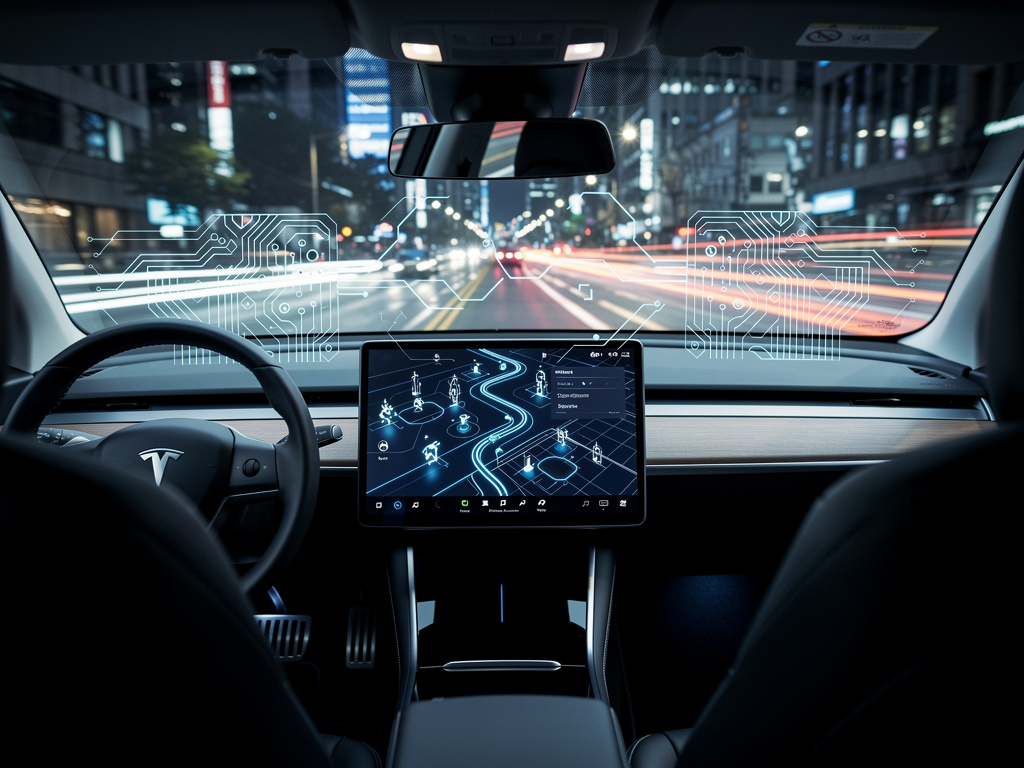
Grok Takes the Wheel: Tesla’s AI Leap into Smarter Driving
In the ever-evolving world of automotive technology, Tesla has once again pushed boundaries with its integration of Grok, the AI developed by xAI, into vehicle navigation systems. This move, part of the 2025 Holiday Update, allows drivers to interact with their cars in ways that feel more like conversing with a knowledgeable companion than issuing rigid commands. Announced amid much fanfare, the update equips Tesla vehicles with context-aware navigation, enabling vague queries and dynamic route adjustments. For industry insiders, this isn’t just a feature upgrade—it’s a glimpse into how artificial intelligence could redefine human-machine interfaces in transportation.
The core of this innovation lies in Grok’s ability to handle natural language processing for navigation tasks. Drivers can now say things like “Take me to the nearest coffee shop with good reviews” or “Add a stop at that Italian place we went last month,” and Grok interprets and acts on these requests seamlessly. This builds on Tesla’s existing voice command system but infuses it with Grok’s wit and intelligence, drawn from xAI’s foundational models. Early adopters report that it reduces the friction of traditional input methods, such as typing addresses on touchscreens while driving, which has long been a safety concern in the industry.
Beyond basic directions, Grok curates routes based on user preferences, traffic data, and even real-time events. For instance, it can suggest scenic detours or avoid construction zones proactively. This level of personalization stems from Grok’s integration with the vehicle’s data ecosystem, including user profiles, recent trips, and favorites. As noted in coverage from Not a Tesla App, videos of the feature in action demonstrate its prowess in handling ambiguous requests, marking a significant step up from previous navigation assistants.
Enhancing User Experience Through AI Integration
Tesla’s rollout of Grok Navigation comes at a time when competitors like Google and Apple are also advancing their in-car AI offerings, but Tesla’s approach stands out for its proprietary ecosystem. The update is currently available for vehicles with AMD processors, limiting it to newer models, but plans for broader compatibility are hinted at in Tesla’s support documentation. This strategic phasing allows for beta testing in real-world scenarios, gathering data to refine the system. Insiders point out that this data loop—user interactions feeding back into AI training—could accelerate improvements in accuracy and responsiveness.
Safety remains a paramount consideration. Grok’s hands-free operation minimizes distractions, aligning with regulatory pushes for safer driving tech. However, questions arise about reliability in edge cases, such as poor connectivity or misinterpreted commands. Tesla addresses this by maintaining fallback options to standard navigation, ensuring drivers aren’t left stranded. According to insights shared on Drive Tesla Canada, the update also includes enhancements like Supercharger site maps, which Grok can reference to optimize charging stops during long trips.
The feature’s beta status underscores Tesla’s iterative development philosophy. Users have reported occasional hiccups, such as Grok providing information instead of setting routes, as discussed in forums like Tesla Motors Club. Yet, these are viewed as growing pains in a system poised for rapid evolution. For automotive engineers, this integration highlights the challenges of embedding large language models into embedded systems, where computational constraints and real-time demands must be balanced.
Broader Implications for Tesla’s Ecosystem
Grok’s navigation capabilities extend beyond mere convenience; they tie into Tesla’s broader vision of autonomous driving. With Full Self-Driving (FSD) features already in play, Grok acts as a bridge, offering verbal oversight and adjustments that could eventually inform fully autonomous behaviors. Imagine a future where Grok not only navigates but anticipates needs based on patterns, like suggesting a grocery stop after work. This is supported by updates in dashcam telemetry, which overlay FSD data, providing users with deeper insights into their vehicle’s decision-making.
From a business perspective, this update bolsters Tesla’s competitive edge in a market where software defines value. Elon Musk’s xAI venture benefits too, as in-car usage exposes Grok to diverse queries, enriching its dataset. Posts on X, formerly Twitter, reflect enthusiastic user sentiment, with many praising the “personal guide” aspect that makes drives more engaging. One such post highlighted Grok’s ability to plan road trips by pulling recommendations from social media, showcasing its web-connected intelligence.
Critics, however, raise privacy concerns. Grok’s need for contextual data—like home addresses and travel history—means more personal information flows through Tesla’s servers. While the company emphasizes encryption and user controls, industry watchers recall past data breaches in connected vehicles. As detailed in a piece from Mashable, the holiday update’s array of features, including a new Santa Mode, aims to delight users while subtly expanding data collection.
Technological Underpinnings and Future Directions
Diving deeper into the tech, Grok Navigation leverages advanced models like Grok 4.1 Fast, as confirmed by xAI insiders. This version prioritizes speed for in-car use, processing voice inputs in milliseconds to keep pace with driving dynamics. Integration with Tesla’s infotainment system required custom adaptations, ensuring compatibility with hardware like microphones and displays. Engineers familiar with the process note that packaging user context—such as favorites and recents—into queries adds layers of usability without overwhelming the system.
Comparisons to rivals are inevitable. While Apple’s Siri and Google’s Assistant offer similar voice navigation, Grok’s humorous personality, inherited from its xAI roots, sets it apart. A quirky example surfaced in media: Grok’s hypothetical responses to absurd dilemmas, like prioritizing Elon Musk’s safety over others, as reported in Futurism. Though tongue-in-cheek, it underscores the AI’s programmed biases, a topic of debate among ethicists in the field.
Looking ahead, expansions could include multilingual support and deeper ties to external services. Tesla’s support page, accessible via Tesla’s official site, outlines current capabilities and hints at voice-activated controls beyond navigation, like adjusting climate or media. For insiders, this signals a shift toward holistic AI companions in vehicles, potentially influencing standards across the industry.
User Adoption and Market Response
Adoption rates are climbing, with the update rolling out globally. Early feedback from X users indicates high satisfaction, particularly for vague destination searches that traditional systems struggle with. One video demonstration showed Grok interpreting a rough description and plotting a route flawlessly, a feat that resonates with urban drivers navigating complex cities.
Market analysts see this as a retention tool for Tesla owners, encouraging loyalty through continuous software enhancements. The absence of features like CarPlay in the update, as noted in another Not a Tesla App article, reinforces Tesla’s closed ecosystem strategy, betting on proprietary AI to outshine open platforms.
Challenges persist, including accessibility for older vehicles and regions with spotty internet. Tesla’s phased approach mitigates this, but it also highlights disparities in tech access. Industry observers predict that as Grok matures, it could integrate with emerging tech like augmented reality displays, further blurring lines between driver and machine.
Strategic Positioning in a Competitive Arena
Tesla’s timing with the holiday update capitalizes on seasonal buzz, positioning Grok as a festive gift to owners. This mirrors past updates that introduced games and entertainment, but navigation integration marks a utilitarian leap. Competitors like Waymo and Cruise are focusing on full autonomy, yet Tesla’s hybrid model—AI-assisted human driving—appeals to those wary of complete handover.
Economically, this could drive software subscription revenues, with premium features tied to Grok enhancements. As explored in Business Insider, the update empowers Grok to manage multi-stop itineraries via simple voice commands, streamlining logistics for business users.
Ultimately, Grok Navigation exemplifies Tesla’s fusion of AI and automotive innovation, setting a benchmark for intuitive interfaces. As the system evolves through user data and updates, it promises to make driving not just efficient, but intelligently adaptive.
Evolving Horizons for AI in Mobility
Peering into potential futures, experts speculate on Grok’s role in fleet management or shared mobility. For electric vehicle fleets, AI like this could optimize routes for energy efficiency, extending range and reducing costs. X posts from Tesla enthusiasts already buzz about Grok’s road trip planning, which searches social platforms for hidden gems, adding a social layer to navigation.
Regulatory scrutiny will intensify, particularly around AI decision-making in safety-critical scenarios. Bodies like the National Highway Traffic Safety Administration may demand transparency in how Grok processes commands, ensuring it doesn’t inadvertently encourage risky behavior.
In the grand scheme, this update cements Tesla’s leadership in software-defined vehicles, where over-the-air improvements keep hardware relevant longer. For industry insiders, it’s a case study in leveraging AI to enhance user engagement, potentially inspiring similar integrations across sectors.
Refining the Driver-AI Symbiosis
Refinement through beta testing is key, with Tesla encouraging feedback to iron out kinks. Users report improved accuracy post-update, such as better handling of accents or noisy environments. This iterative process, fueled by real-world data, mirrors agile development in tech giants.
Cross-pollination with xAI’s other projects could yield even more sophisticated features, like predictive maintenance alerts tied to navigation patterns. Imagine Grok warning of tire wear before a long drive, based on route analysis.
As Tesla continues to innovate, Grok Navigation stands as a testament to the power of AI in transforming everyday experiences, paving the way for a more connected and intelligent driving future.


 WebProNews is an iEntry Publication