
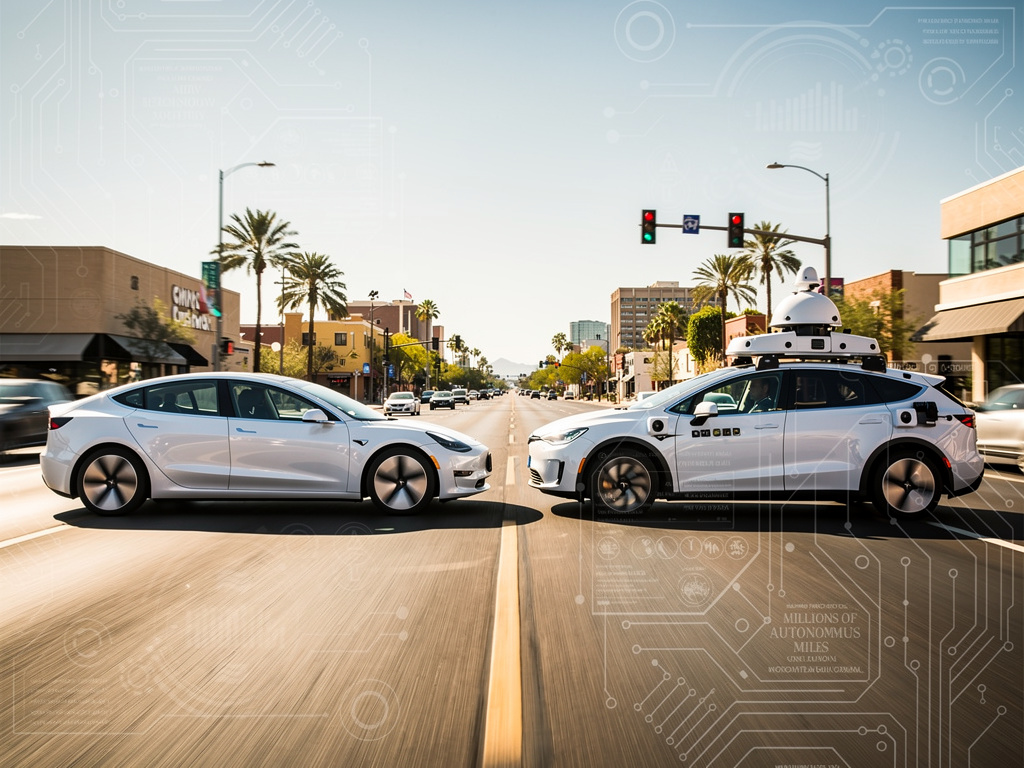
The Robotaxi Showdown: Tesla’s Bold Bets Meet Waymo’s Steady Stride
In the rapidly evolving world of autonomous vehicles, Tesla and Waymo stand as titans locked in a high-stakes contest for dominance in the robotaxi sector. Tesla, led by the visionary Elon Musk, has long promised a future where self-driving cars revolutionize transportation, but recent developments highlight a stark reality: Waymo, the Alphabet Inc. subsidiary, holds a commanding lead. This disparity isn’t just about technology; it’s a tale of execution, regulatory navigation, and market readiness that could define the next decade of urban mobility.
Drawing from insights in a recent analysis, Tesla’s robotaxi ambitions are facing scrutiny as Waymo expands its operations with proven reliability. According to MSN, Waymo has been operating driverless rides in multiple cities, amassing millions of miles in real-world testing, while Tesla’s efforts remain in early stages, often requiring human supervision. This gap underscores fundamental differences in approach: Waymo’s reliance on a multifaceted sensor suite including lidar, contrasted with Tesla’s camera-only system powered by neural networks.
Industry experts point out that Waymo’s head start stems from years of methodical development, starting from its origins as Google’s self-driving car project. Tesla, meanwhile, has pivoted aggressively toward robotaxis, unveiling concepts like the Cybercab, but deployment lags. Recent reports suggest that while Tesla’s stock soars on hype, on-the-ground progress tells a different story, with limited fleets and ongoing software refinements.
Technological Philosophies in Contrast
At the heart of this rivalry are divergent technological strategies. Waymo employs a comprehensive array of sensors—lidar, radar, and high-definition maps—to ensure precise navigation in complex environments. This setup, while costly, has enabled Waymo to achieve high levels of autonomy in geofenced areas like Phoenix and San Francisco. In contrast, Tesla bets on vision-based autonomy, using cameras and AI to mimic human driving, which Musk claims is more scalable and cost-effective.
Posts on X, formerly Twitter, reflect heated debates among enthusiasts and analysts. Some users highlight Tesla’s potential for rapid scaling due to its existing fleet of vehicles equipped with necessary hardware, potentially turning millions of cars into robotaxis overnight. However, critics argue that Waymo’s data-driven refinements give it an edge in safety and reliability, with fewer incidents reported in public operations.
Further examination reveals that Tesla’s Full Self-Driving (FSD) software, while impressive in demonstrations, still encounters challenges in unpredictable scenarios. A comparison test noted in MotorTrend found Waymo’s rides smoother and more confident, with Tesla’s system occasionally exhibiting hesitancy or abrupt maneuvers. This hands-on evaluation underscores why Waymo has secured regulatory approvals for unsupervised operations in more locations.
Market Expansion and Regulatory Hurdles
Waymo’s expansion strategy has been aggressive yet measured, rolling out services in Los Angeles and Austin, with plans for further growth. By late 2025, as reported in CNBC, Waymo was leading the robotaxi boom, offering public rides without safety drivers in select areas. This contrasts with Tesla’s supervised rides in Austin, where human oversight remains a requirement, limiting true autonomy.
Regulatory landscapes play a crucial role here. Waymo has navigated approvals from bodies like the California Public Utilities Commission, building trust through transparent safety data. Tesla, on the other hand, faces skepticism due to past incidents and Musk’s bold claims that sometimes outpace delivery. A deep dive in Forbes explores this battle, noting how Waymo’s incremental approach garners favor with regulators wary of unproven tech.
Moreover, economic factors amplify the divide. Waymo’s vehicles, equipped with expensive sensors, cost significantly more to produce than Tesla’s streamlined models. Yet, as one X post emphasized, Tesla’s manufacturing prowess could enable a fleet 17 times larger by 2026, potentially overwhelming competitors through sheer volume. Still, without full autonomy, this advantage remains theoretical.
Economic Implications and Investor Sentiment
Investor enthusiasm for Tesla remains sky-high, with shares reaching new peaks amid robotaxi optimism, as detailed in The New York Times. However, experts caution that this Wall Street fervor may not align with road realities, where Waymo operates hundreds of vehicles daily compared to Tesla’s handful. This disconnect raises questions about valuation sustainability if milestones slip.
On the flip side, Waymo’s parent company, Alphabet, benefits from a more stable narrative, with robotaxi revenues contributing to its diversified portfolio. Analysts in Reuters predict that these differing approaches will shape the industry’s future, with Tesla’s end-to-end neural networks potentially leapfrogging if scaled successfully.
Public sentiment, gleaned from X discussions, shows a mix of optimism and skepticism. Pro-Tesla voices tout the company’s data advantage from billions of miles driven by FSD-equipped cars, far surpassing Waymo’s figures. Detractors, however, point to real-world performance, where Waymo’s system handles edge cases with greater aplomb, as evidenced by smoother rides and fewer interventions.
Safety Records and Public Perception
Safety emerges as a pivotal battleground. Waymo has logged over 20 million autonomous miles with a strong safety record, reporting minimal accidents relative to human drivers. Tesla’s FSD, while accumulating vast data, has faced criticism for incidents during beta testing, prompting investigations by agencies like the National Highway Traffic Safety Administration.
A Gizmodo piece, found at Gizmodo, highlights the eccentricity of Musk’s promises, suggesting they sometimes overshadow substantive progress. This narrative influences public perception, with viral videos on X comparing ride experiences—Waymo often praised for seamlessness, Tesla for innovation but critiqued for inconsistencies like jittery steering.
Looking ahead, both companies are pushing boundaries. Tesla’s recent unsupervised tests, though limited, signal progress, while Waymo explores expansions into new markets. Industry insiders note that collaborations or technological convergences could emerge, but for now, the competition intensifies.
Innovation Trajectories and Future Prospects
Tesla’s strength lies in its software-centric model, leveraging over-the-air updates to refine autonomy rapidly. Recent X posts celebrate milestones like a coast-to-coast autonomous drive, showcasing capabilities beyond Waymo’s current geofenced operations. Yet, as Futurism argues, with only dozens of robotaxis deployed, Tesla appears light-years behind.
Waymo, conversely, invests in infrastructure like remote monitoring centers, enhancing reliability. This holistic approach, detailed in various analyses, positions it for broader adoption in ride-hailing, potentially partnering with services like Uber.
The broader industry, including players like Zoox, adds layers to this contest. CNBC reports note Zoox’s public rides debut in 2025, but Waymo’s faster expansion sets the pace. Tesla must close the gap through software breakthroughs to compete effectively.
Challenges in Scaling and Adoption
Scaling presents formidable challenges. Tesla aims to convert its existing fleet into robotaxis, a cost-efficient strategy that could disrupt markets. However, regulatory and safety hurdles loom large, with experts in The New York Times questioning camera-only systems’ robustness in adverse conditions.
Waymo’s model, while scalable in mapped areas, requires significant upfront investment in mapping and sensors. X users debate this, with some predicting Tesla’s neural nets will prevail due to lower costs and adaptability.
Adoption hinges on consumer trust. Surveys indicate growing acceptance of robotaxis, but incidents can erode confidence. Both companies invest in transparency, yet Tesla’s hype-driven communication sometimes backfires, as seen in InsideEVs, where unfulfilled promises in 2025 fueled doubts.
Strategic Moves and Competitive Edges
Strategically, Tesla integrates robotaxis into its ecosystem, including energy and AI ventures, creating synergies. Musk’s vision extends to a network of owner-operated vehicles, democratizing the service.
Waymo focuses on fleet operations, optimizing for efficiency. Reuters analyses suggest this could lead to industry standards favoring hybrid models.
Ultimately, the rivalry benefits consumers through innovation. As 2026 unfolds, with robotaxis poised for wider rollout per Business Insider, the true winner may be the technology that safest and most affordably transforms daily commutes.
Evolving Dynamics in Autonomous Mobility
Emerging trends show convergence: Waymo experimenting with vision-based enhancements, Tesla incorporating more data sources. X discussions speculate on potential acquisitions or partnerships reshaping the field.
Economic models differ too—Waymo’s per-ride fees versus Tesla’s potential subscription. Invezz, at Invezz, questions Tesla’s leadership claims, citing Waymo’s operational superiority.
As the sector matures, environmental impacts gain attention. Electric robotaxis promise reduced emissions, aligning with sustainability goals. Both firms contribute, but Waymo’s established presence accelerates this shift.
Pathways to Leadership
To lead, Tesla must demonstrate unsupervised autonomy at scale, addressing safety concerns head-on. Waymo, meanwhile, needs to expand beyond geofences without compromising reliability.
Industry watchers anticipate regulatory evolutions favoring proven tech, potentially benefiting Waymo short-term. Long-term, Tesla’s data moat could dominate.
This ongoing saga, rich with innovation and rivalry, continues to captivate, promising a future where autonomous rides become ubiquitous, driven by these pioneering forces.


 WebProNews is an iEntry Publication