
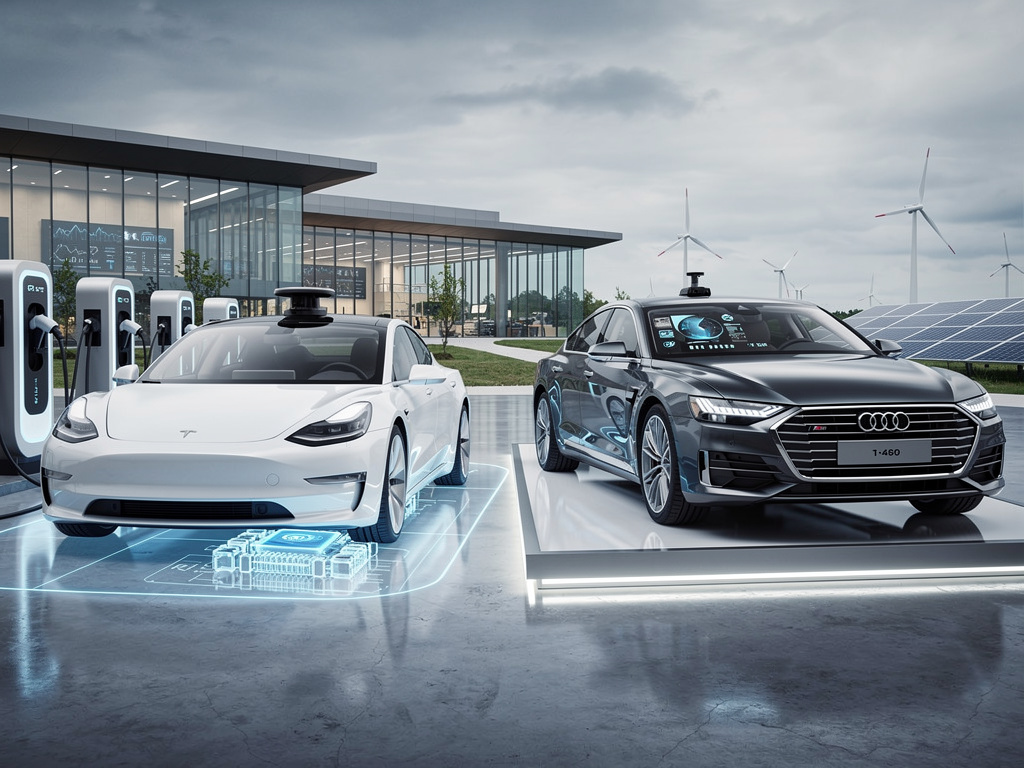
In the high-stakes arena of electric vehicle innovation, two giants stand out: Tesla, the disruptive pioneer, and Audi, the legacy automaker with deep engineering roots. As the push toward sustainable mobility accelerates, their rivalry offers a compelling lens into the future of automotive technology. Tesla has long dominated headlines with its bold claims and rapid iterations, while Audi leverages its Volkswagen Group backing to refine premium electric offerings. But who truly leads in EV tech? A closer examination reveals a nuanced contest, where strengths in battery efficiency, autonomous driving, and charging infrastructure define the frontrunners.
Recent developments underscore this dynamic. Tesla’s latest Model Y refresh, as reported in a CNET article, introduces more affordable variants with stripped-down features yet robust performance, aiming to broaden market access. Meanwhile, Audi has unveiled updates to its e-tron lineup, including the 2025 E-Tron GT, which boasts up to 912 horsepower and a 378-mile range, according to posts on X from industry watchers like Sawyer Merritt. These advancements highlight how both companies are iterating on core technologies to capture consumer interest amid fluctuating demand.
Beyond raw specs, the comparison hinges on real-world application. Tesla’s over-the-air software updates have revolutionized vehicle ownership, allowing continuous improvements without dealership visits. Audi, in contrast, emphasizes build quality and luxury integration, drawing on its heritage in high-end interiors and all-wheel-drive systems. A detailed breakdown from Tom Wood Automotive notes that while Tesla excels in acceleration and range, Audi’s vehicles often score higher in reliability surveys, appealing to buyers seeking refined experiences over cutting-edge novelty.
Battery Breakthroughs and Range Realities
Tesla’s battery technology remains a cornerstone of its edge, with proprietary 4680 cells promising higher energy density and lower costs. Recent studies, such as one featured in InsideEVs, show Tesla models retaining more range after three years compared to competitors, including some Audi variants. This durability stems from Tesla’s vertical integration, controlling everything from cell production to vehicle assembly, which minimizes supply chain vulnerabilities.
Audi counters with its Premium Platform Electric (PPE), a modular architecture shared with Porsche that enables faster charging and improved efficiency. For instance, the new Q6 e-tron achieves 320 kW charging speeds, reducing downtime significantly. Insights from Audi Fletcher Jones highlight how this platform integrates advanced thermal management, helping maintain battery health in extreme conditions—a critical factor for global markets.
Yet, challenges persist for both. Tesla faces scrutiny over build quality inconsistencies, as echoed in consumer reports, while Audi grapples with scaling production amid supply chain disruptions. A Reuters piece on EV sales in South America notes that without Tesla’s direct presence, brands like Audi are gaining ground through localized strategies, though Tesla’s global sales of models like the Model Y still outpace many rivals, per ArenaEV.
Autonomous Driving: Software vs. Hardware Prowess
In the realm of self-driving capabilities, Tesla’s Full Self-Driving (FSD) suite continues to push boundaries, relying on vision-based systems and vast data from its fleet. Recent X posts discuss Tesla’s 2025 plans, including enhancements to its Optimus robot, which could influence vehicle AI. However, regulatory hurdles and safety concerns have tempered enthusiasm, with critics pointing to incidents that question the technology’s readiness.
Audi, drawing from Volkswagen’s investments, integrates lidar and radar for a more sensor-heavy approach in its e-tron models. The A6 e-tron Avant, previewed in Auto Express, promises up to 435 miles of range with advanced driver-assistance systems that prioritize safety and compliance. This hardware-centric strategy aligns with European regulations, giving Audi an advantage in markets where Tesla’s camera-only system faces skepticism.
Industry insiders note that Tesla’s data advantage—millions of miles logged—fuels machine learning breakthroughs, potentially outpacing Audi’s more conservative iterations. A historical perspective from an old X post by Sean Mitchell recalls Audi’s former CEO admitting Tesla’s two-year lead in software architecture, a gap that may have narrowed but still influences perceptions.
Charging Networks and Ecosystem Integration
Infrastructure plays a pivotal role in EV adoption, and here Tesla’s Supercharger network reigns supreme, with over 50,000 stalls worldwide offering seamless integration for its vehicles. Recent expansions, including bidirectional charging in the Cybertruck as mentioned in X discussions, position Tesla at the forefront of vehicle-to-grid technologies, enabling homes to draw power from cars during outages.
Audi benefits from the Electrify America network, also under Volkswagen’s umbrella, but it lags in density and reliability compared to Tesla’s ecosystem. Comparisons in Audi Exchange St. Charles emphasize Audi’s focus on premium charging experiences, like lounge integrations, yet Tesla’s app-driven reservations and lower costs often win out for everyday users.
Moreover, Tesla’s energy products, such as Powerwall, create a holistic ecosystem that Audi is only beginning to match with home charging solutions. News from CNBC on Tesla’s rising reliability rankings in 2025 underscores how this integration boosts owner satisfaction, potentially tipping the scales in long-term loyalty.
Performance Metrics and Market Positioning
Diving into performance, Tesla’s Model S Plaid accelerates from 0 to 60 mph in under two seconds, a benchmark that Audi’s RS e-tron GT approaches but doesn’t surpass without modifications. X posts comparing models like the Tesla Model Y and Audi Q4 e-tron highlight Tesla’s edge in cargo space and efficiency, with real-world tests showing lower energy costs per mile.
Audi shines in luxury and handling, with its quattro system providing superior traction in adverse weather. A comprehensive analysis from Audi Orange Park praises Tesla’s innovation but critiques its service network, an area where Audi’s dealership presence offers reassurance.
As global sales shift, with affordable Chinese EVs challenging both, Tesla’s October 2025 sales dip noted in ArenaEV reports contrasts with Audi’s steady gains in premium segments. This suggests Audi’s strategy of blending electrification with traditional luxury could sustain it against Tesla’s volume-driven approach.
Innovation Pipelines and Future Trajectories
Looking ahead, Tesla’s roadmap includes next-gen platforms for more affordable models, as outlined in X updates, potentially disrupting entry-level markets. Innovations like the 4680 battery cells aim to cut costs by 50%, enabling broader accessibility.
Audi’s collaborations, such as with SAIC for China-specific models like the E5 Sportback starting at $33,000, per Wall Street Journal reporter Jonathan Cheng’s X post, show adaptive strategies. The Premium Platform Combustion updates for models like the A5 and Q5, as shared on X by Mthuthuzeli Mpiti, integrate hybrid tech, bridging to full electrification.
Both face external pressures: supply chain issues for batteries and semiconductors. Tesla’s vertical control mitigates some risks, while Audi’s group synergies provide scale. A Audi Beverly Hills guide notes that Audi’s design ethos prioritizes aesthetics and comfort, potentially appealing to demographics wary of Tesla’s minimalist cabins.
Sustainability and Regulatory Navigation
Sustainability metrics further differentiate the duo. Tesla’s Gigafactories emphasize renewable energy in production, reducing carbon footprints. Recent Consumer Reports rankings via CNBC laud Tesla’s strides in reliability, tying into eco-friendly manufacturing.
Audi advances with recycled materials in interiors and efficient production lines. Its e-tron models achieve high efficiency ratings, with the Q4 e-tron battling Tesla’s Model Y in tests from Auto Express, where range and charging speed are closely matched.
Regulatory environments shape their paths. In Europe, Audi benefits from stricter emissions rules favoring its hybrid options, while Tesla navigates U.S. incentives for domestic production. X sentiment reflects optimism for Tesla’s 2025 launches, but Audi’s updates, like those for the smallest SUV to counter the Model Y per Autoblog, signal aggressive competition.
Consumer Sentiment and Adoption Trends
Owner feedback reveals Tesla’s cult-like following, driven by tech-forward features, though service complaints persist. Audi owners value the brand’s prestige and smoother ride, as per Tom Wood Automotive comparisons.
Adoption trends show Tesla leading in volume, but Audi carving niches in luxury EVs. Global reports from Reuters indicate emerging markets favoring accessible options, where Tesla’s affordability push could dominate.
Ultimately, the leadership question depends on priorities: Tesla for bold innovation, Audi for refined execution. As both evolve, their rivalry propels the entire sector forward, benefiting consumers with better choices.


 WebProNews is an iEntry Publication