
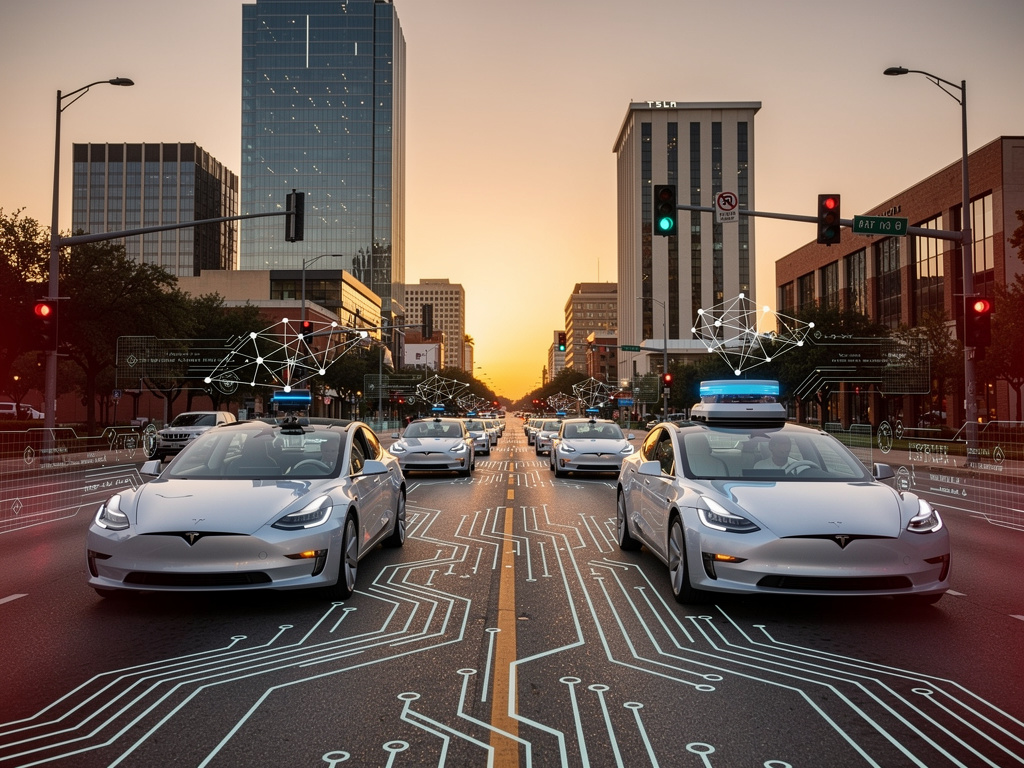
Tesla’s Autonomous Gamble: Robotaxis Roam Austin Without Human Oversight
In the bustling streets of Austin, Texas, a quiet revolution in transportation is unfolding. Tesla Inc., the electric vehicle pioneer led by Elon Musk, has begun testing its robotaxis without human safety monitors, marking a significant milestone in the pursuit of fully autonomous driving. This development, confirmed by Musk himself, comes amid a flurry of online videos and reports showing Tesla Model Y vehicles navigating public roads with no one behind the wheel. The move underscores Tesla’s aggressive push toward a future where cars drive themselves, potentially reshaping urban mobility and challenging traditional ride-hailing services.
The testing phase kicked off recently, with sightings of unoccupied Tesla vehicles circulating in Austin. According to reports, these robotaxis are operating under Tesla’s Full Self-Driving (FSD) software, which the company claims has reached a level of sophistication allowing for unsupervised operation. Musk, known for his bold predictions, announced on social media platform X that “testing is underway with no occupants in the car,” signaling confidence in the system’s reliability. This isn’t just a publicity stunt; it’s part of Tesla’s broader strategy to deploy a fleet of driverless vehicles, aiming to expand beyond Austin in the coming months.
Industry observers note that this step removes a critical safety layer—human intervention—that has been standard in autonomous vehicle trials. Competitors like Waymo and Cruise have faced scrutiny and setbacks after incidents involving their test vehicles, highlighting the risks involved. Tesla’s decision to proceed without monitors reflects Musk’s optimism about FSD’s capabilities, but it also raises questions about regulatory approval and public safety in a city known for its tech-savvy yet unpredictable traffic patterns.
From Supervised Trials to Full Autonomy
Tesla’s journey to this point has been marked by iterative advancements and repeated timeline adjustments. Earlier this year, the company operated robotaxis in Austin with safety operators in the passenger seat, ready to take control if needed. Musk has made similar claims about removing these monitors multiple times, including in September, October, and November, as detailed in coverage from Teslarati. Each announcement built anticipation, but the latest confirmation appears to be the real deal, with visual evidence emerging online.
A video shared widely on social media platforms shows a Tesla Model Y robotaxi cruising Austin streets sans any human presence, as reported by Business Insider. This aligns with Musk’s statements on X, where he emphasized that the vehicles are “fully autonomous” with no remote operators. The company’s goal, as outlined in its official posts, is to eliminate safety riders entirely by year’s end, starting in Austin and expanding to regions like Nevada, Florida, and Arizona.
Technologically, Tesla relies on its FSD Supervised v14 software, which enables door-to-door navigation without human input. Unlike rivals that use lidar sensors, Tesla’s approach is vision-based, leveraging cameras and neural networks trained on vast datasets from its fleet. This method, while cost-effective, has drawn criticism for potential blind spots in complex scenarios like heavy weather or unusual road events. Musk has acknowledged these challenges in past posts, noting that the Austin robotaxi build is several months ahead of the general release available to consumers.
Regulatory Hurdles and Safety Concerns
As Tesla accelerates its testing, regulatory bodies are watching closely. The National Highway Traffic Safety Administration (NHTSA) has investigated Tesla’s Autopilot and FSD systems following accidents, including fatal ones. In Austin, local authorities have yet to issue widespread approvals for unsupervised operations, but Tesla’s limited trials suggest some form of permission or exemption is in place. Reports from Electrek indicate that Musk predicted truly driverless robotaxis in Austin within weeks, a timeline that now seems met despite previous delays.
Safety remains paramount. Tesla touts its vehicles as among the safest on the road, with features like automatic emergency braking and collision avoidance. However, the absence of a human monitor amplifies risks; a single mishap could erode public trust and invite lawsuits. Industry analysts point to incidents with other autonomous programs, such as Cruise’s suspension in California after a pedestrian accident, as cautionary tales. Tesla’s data shows FSD achieving safety levels “far in excess of the average human driver,” according to Musk’s X posts, but independent verification is scarce.
Moreover, the expansion plans include doubling the Austin fleet to about 60 vehicles this month, as per reporting from the Austin American-Statesman. This scale-up tests not just the technology but also infrastructure readiness, from charging stations to traffic integration. In bad weather, operations might still be restricted, echoing limitations seen in Tesla’s initial limited service rollout in June, covered by The New York Times.
Competitive Pressures and Market Implications
Tesla’s unsupervised testing positions it ahead in the race for autonomous mobility, but it’s not without challengers. Waymo, a unit of Alphabet Inc., already offers fully driverless rides in select cities, while Amazon’s Zoox and others are ramping up efforts. Musk’s vision extends beyond Austin, with plans for nationwide rollout by year’s end, potentially disrupting Uber and Lyft. Economic models suggest robotaxis could lower costs dramatically, making rides affordable and accessible, but only if reliability is proven.
From a business perspective, this initiative ties into Tesla’s valuation, which hinges on autonomous tech as much as vehicle sales. Investors have rewarded bold moves, with stock fluctuations often tied to Musk’s announcements. Recent X posts from Tesla highlight ancillary benefits like app-controlled climate settings and trip planning with Grok, the company’s AI, enhancing user experience in autonomous scenarios.
Critics argue that Tesla’s hype outpaces delivery. Musk’s history of missed deadlines—dating back to 2019’s Autonomy Day—fuels skepticism. Yet, the current testing, corroborated by sightings and confirmations, lends credibility. As one industry insider noted, the real test will be scaling without incidents, a feat that could cement Tesla’s dominance.
Technological Underpinnings and Future Trajectories
Delving deeper into the tech, Tesla’s neural net architecture processes real-time data from eight cameras, enabling predictive behaviors like yielding to pedestrians or navigating construction zones. Musk has shared that integrations from the Austin build will “substantially reduce the need for driver attention,” with upgrades rolling out to consumer vehicles. This cross-pollination accelerates progress, as fleet data refines algorithms continuously.
Looking ahead, unsupervised robotaxis could transform sectors beyond transportation. Logistics firms eye similar tech for deliveries, while urban planners consider reduced congestion from efficient routing. However, ethical dilemmas arise: Who bears responsibility in accidents? Tesla’s terms shift some liability to users, but unsupervised ops complicate this.
Global expansion is on the horizon, with Musk hinting at international deployments once U.S. hurdles are cleared. In Europe and Asia, stricter regulations might slow adoption, but partnerships could bridge gaps. As posts on X from users and Musk suggest, public sentiment is mixed—excitement tempered by caution.
Economic and Societal Ripples
The economic ripple effects are profound. A successful robotaxi network could generate billions in revenue for Tesla, with Musk projecting ride-hailing as a major profit center. Analysts estimate that by 2030, autonomous vehicles might capture a significant share of the mobility market, displacing jobs in driving but creating opportunities in tech maintenance and data analysis.
Societally, accessibility improves for the elderly and disabled, fostering independence. Yet, equity concerns loom: Will robotaxis serve underserved areas, or concentrate in affluent zones? Austin’s diverse demographics make it an ideal proving ground, with Tesla’s fleet potentially addressing these issues through data-driven expansions.
Integration with smart cities is another angle. Tesla’s vehicles could communicate with traffic systems, optimizing flows and reducing emissions. Musk’s X commentary on civilization’s progress underscores this inevitability, provided safety benchmarks are met.
Challenges Ahead in Real-World Deployment
Despite optimism, challenges persist. Software glitches, as seen in prior FSD versions, could undermine confidence. Tesla’s response has been rapid updates, but unsupervised testing amplifies stakes. Reports from DNYUZ echo the excitement, noting Reuters-captured images of empty robotaxis.
Competition intensifies, with Chinese firms like Baidu advancing rapidly. Tesla’s edge lies in its massive data trove from millions of miles driven, refining AI models iteratively.
Ultimately, Austin’s streets are the crucible. Success here could propel Tesla toward widespread adoption, validating Musk’s vision of a driverless world. Failure, however, might set back the industry, reminding us that autonomy’s promise comes with perils. As testing continues, the world watches, weighing innovation against caution.


 WebProNews is an iEntry Publication