
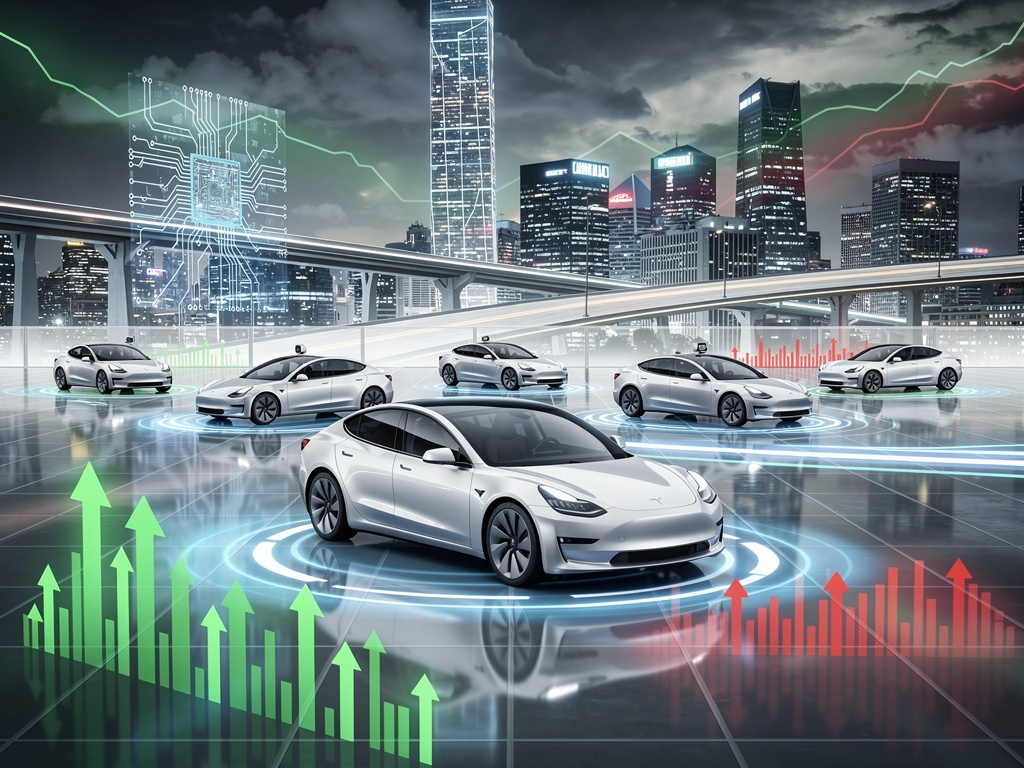
Tesla’s Autonomous Dreams Clash with Sales Reality
Tesla Inc. finds itself at a pivotal crossroads as the new year begins, with investor enthusiasm for its self-driving ambitions soaring even as vehicle sales projections paint a gloomier picture. Elon Musk’s relentless promotion of autonomous technology has propelled the company’s stock to new heights, yet the core business of selling cars appears to be stumbling. Recent reports indicate that Tesla’s fourth-quarter deliveries for 2025 are expected to decline significantly, underscoring challenges in a competitive electric vehicle market.
Analysts anticipate Tesla will report around 440,900 vehicle deliveries for the final quarter of 2025, marking an 11% drop from the previous year, according to data compiled by Bloomberg. This downturn comes despite efforts to introduce more affordable models and amid the loss of key U.S. tax incentives that once bolstered demand. Tesla unusually published its own compilation of analyst estimates this week, projecting an even steeper 15% decline, a move that highlights the company’s transparency—or perhaps its attempt to manage expectations.
The contrast is stark: while Tesla’s shares have surged on promises of robotaxis and full self-driving capabilities, actual consumer purchases tell a different story. Investors seem captivated by Musk’s vision of a future dominated by autonomous fleets, but everyday buyers are grappling with economic pressures, intensified competition from rivals like BYD and Ford, and shifting perceptions tied to Musk’s political stances.
Navigating Market Headwinds
Competition in the electric vehicle sector has intensified, with traditional automakers and new entrants alike vying for market share. Tesla’s once-dominant position is under siege as companies roll out compelling alternatives at competitive prices. The expiration of federal tax credits in the U.S. has further eroded Tesla’s edge, making its vehicles less attractive to price-sensitive consumers.
Adding to these woes, Tesla’s embrace of right-wing politics by Musk has alienated some potential buyers. Reports from sources like The Guardian note that consumer distaste for Musk’s political affiliations contributed to a tough year, with sales forecasts suggesting deliveries could fall short of expectations. This sentiment echoes across social media platforms, where posts on X (formerly Twitter) reflect a mix of optimism about technological advancements and concern over sales figures.
For instance, recent X discussions highlight analyst projections of a 5% contraction in 2025 sales compared to 2024, contrasting sharply with earlier promises from Musk of 20-30% growth. These online conversations underscore a divide: while some users celebrate milestones like the potential unsupervised Full Self-Driving (FSD) rollout, others criticize the company for missing growth targets amid an expanding overall EV market.
The Allure of Autonomy
Musk’s euphoria over self-driving technology remains a bright spot for investors. Tesla’s stock has climbed on announcements related to its Cybercab and robotaxi initiatives, with projections for producing up to 2 million Cybercab units annually. The company aims to launch ride-hailing networks in states like Texas and California, potentially revolutionizing urban transportation.
According to updates shared in earnings calls and echoed in posts on X, Tesla expects FSD to surpass human safety levels by mid-2025, paving the way for unsupervised operations. This technological leap could transform Tesla from a car manufacturer into a mobility services giant, generating recurring revenue from software and autonomous fleets.
However, skepticism persists among industry observers. While Bloomberg’s analysis in its recent report highlights the investor buy-in, it also warns that robotaxi prospects have yet to translate into immediate sales boosts. The article points out that Tesla likely sold fewer vehicles in the latter half of 2025 than the year prior, a trend that could extend into 2026 without significant interventions.
Internal Strategies and External Pressures
Tesla’s response to these challenges includes ramping up production of budget-friendly models and expanding into new markets. The company has introduced cheaper variants of its best-selling vehicles to counteract demand erosion, yet global competition continues to sap momentum. Reuters reported in a December 2025 piece that these factors, combined with the tax credit losses, are key drivers behind the anticipated delivery drop.
Internally, Tesla is betting big on its ecosystem, including energy storage solutions like Megapacks and robotics ventures such as Optimus. Posts on X from late 2025 recap achievements like the completion of factories in Nevada and Shanghai, suggesting these could bolster overall revenue even if vehicle sales lag. Analysts project that by 2029, Tesla’s EV sales might double, but near-term hurdles remain formidable.
Moreover, the company’s valuation increasingly hinges on its leadership in self-driving and robotics, as noted in various financial analyses. A post on X from December 2025 emphasized that much of Tesla’s market cap relies on these futuristic bets, despite underwhelming delivery numbers. This disconnect raises questions about sustainability: can hype sustain stock performance if core sales don’t rebound?
Investor Sentiment and Future Projections
Wall Street’s reaction has been mixed, with some viewing the sales dip as a temporary setback amid a broader technological pivot. InsideEVs, in a December 2025 article, discussed analyst projections of sales drops in 2025 but anticipated recovery by the decade’s end. This long-view optimism is fueled by Tesla’s aggressive timelines for Cybercab production and FSD expansions into Europe and China.
On X, enthusiasm persists among supporters who list 2025 highlights like the Model Y retaining its status as the global bestseller and the launch of robotaxi networks in select cities. These narratives contrast with bearish takes, such as one X post criticizing Tesla for failing to meet Musk’s growth forecasts, labeling it as poorly managed in recent times.
Critics argue that Tesla’s focus on autonomy might distract from addressing immediate sales issues. The Straits Times, in its January 2026 coverage, reiterated that while shares rise on robotaxi hype, six-month sales trailed prior periods, signaling potential stagnation.
Economic Factors at Play
Broader economic conditions exacerbate Tesla’s challenges. Interest rate fluctuations and inflationary pressures have made consumers cautious about big-ticket purchases like electric vehicles. Although anticipated rate cuts could stimulate demand, as mentioned in X discussions, the timing remains uncertain.
Tesla’s global footprint also exposes it to regional variances. Big declines in key markets, as highlighted in an NDTV Profit report from January 2026, stem from tougher competition and market saturation. The company must navigate these dynamics while pushing forward with innovations like the Robovan and more affordable models slated for 2026 and beyond.
Industry insiders note that Tesla’s strategy involves diversifying beyond vehicles. The Optimus robot, expected to enter production, could open new revenue streams, reducing dependence on car sales. X posts from 2024 and 2025 frequently tout this multi-pronged approach, predicting explosive growth post-2026.
Strategic Pivots Ahead
Looking forward, Tesla’s leadership is poised to leverage its technological edge. Musk’s forecasts, reiterated in older X posts, emphasize 20-30% growth, though recent realities have tempered such expectations. The company’s surprise publication of delivery estimates, as covered by CBT News in a late 2025 article, signals a proactive stance in communicating challenges.
To regain sales momentum, Tesla may need to innovate pricing, enhance marketing, and address consumer perceptions. Collaborations or policy advocacy for renewed incentives could also play a role. Meanwhile, the autonomous driving narrative continues to captivate, with milestones like FSD v14 and Optimus demonstrations keeping investors engaged.
Yet, the path is fraught with risks. If self-driving technology faces regulatory hurdles or delays, the sales slump could deepen. As one X user pondered, the market’s bet on massive 2025 sales has already led to slashed earnings estimates, underscoring the volatility of tying valuation to unproven tech.
Balancing Hype and Performance
In the eyes of many analysts, Tesla’s story is one of transformation. From an EV pioneer to a tech conglomerate, its trajectory depends on executing ambitious plans. The Motley Fool’s December 2025 analysis suggests that while Q4 deliveries might underwhelm, investors may overlook them in favor of long-term potential.
Social media buzz on X reinforces this, with users speculating on 2026 breakthroughs like widespread autonomous adoption. However, grounded assessments remind that two years ago, predictions eyed 3 million annual deliveries—a far cry from current estimates.
Ultimately, Tesla must bridge the gap between visionary promises and tangible results. As the company reports its figures on January 3, 2026, the industry will watch closely to see if Musk’s self-driving euphoria can indeed eclipse the darkening sales outlook, or if deeper adjustments are needed to steer back toward growth. With innovations on the horizon, the coming months could define whether Tesla accelerates into a new era or faces further deceleration.


 WebProNews is an iEntry Publication