
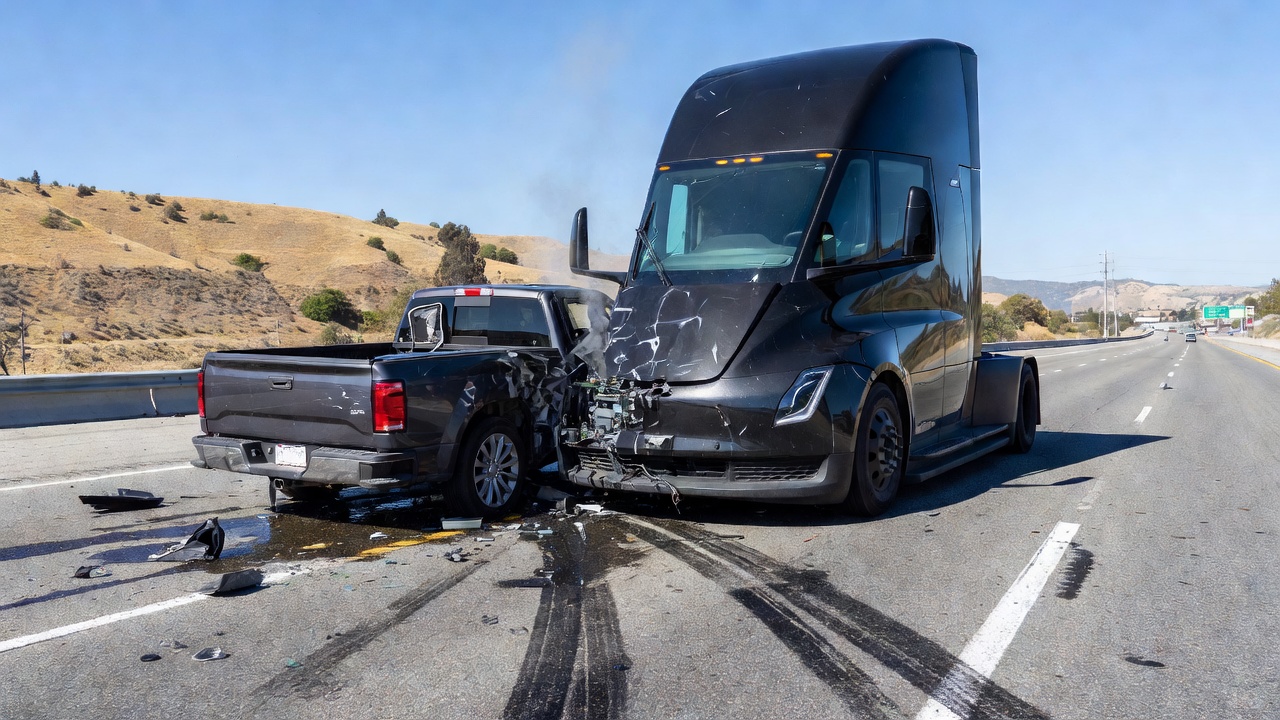
A tragic accident in California has brought renewed attention to the safety record of Tesla’s electric semi truck after the vehicle collided with a pickup truck, resulting in the deaths of a married couple. The crash, which occurred on a rural stretch of highway, claimed the lives of 57-year-old Mark and 56-year-old Mary Baugh, who were traveling in their Ford F-150 when the incident unfolded. According to reports from authorities and eyewitness accounts, the Tesla Semi appeared to have been operating at high speed when it struck the smaller vehicle, causing both to leave the roadway and catch fire.
The incident has prompted fresh questions about the capabilities and limitations of advanced driver assistance systems in heavy commercial vehicles. Tesla first unveiled the Semi in 2017 with ambitious promises of superior range, acceleration, and autonomous features that could transform long-haul trucking. Production versions finally reached customers in late 2022, with companies like PepsiCo and UPS among the early adopters. While many fleet operators have praised the truck’s performance in controlled conditions, real-world incidents like this one highlight the complex challenges of integrating such technology into mixed traffic environments.
California Highway Patrol investigators determined that the Tesla Semi, driven by a 49-year-old man from Arizona, rear-ended the Baughs’ pickup before both vehicles veered off the road near the town of Redding. The couple, who had been married for more than three decades, died at the scene from injuries sustained in the collision and subsequent fire. The truck driver survived with injuries and was transported to a local hospital. Authorities have not yet released a final determination on fault, though preliminary findings suggest the Semi may have been traveling faster than surrounding traffic.
This accident marks at least the third known fatal crash involving a Tesla Semi since deliveries began. Previous incidents included a 2023 collision in Arizona where a Semi struck a passenger car that had slowed due to construction, and another event where the truck’s automated systems appeared to struggle with identifying stationary objects. While Tesla maintains that its vehicles are among the safest on the road when properly monitored, critics argue that the company’s marketing of Autopilot and Full Self-Driving capabilities creates unrealistic expectations among operators.
The Baugh family has spoken publicly about their loss, describing Mark and Mary as devoted parents and grandparents who enjoyed road trips together. Their daughter told local news outlets that the couple had no warning before impact, suggesting the Semi approached rapidly from behind. “They were just driving home after visiting family,” she said. “It happened so fast that they never had a chance.” The family’s attorney has indicated they may pursue legal action against Tesla as investigators continue to examine data from the truck’s onboard systems.
Tesla has declined to comment specifically on this crash, citing its standard policy of cooperating with authorities while conducting its own internal review. The company has previously emphasized that its vehicles log extensive telemetry data that can help reconstruct events leading to collisions. In past statements, Tesla has noted that its trucks incorporate multiple layers of safety features, including automatic emergency braking, lane departure warnings, and forward collision alerts. However, these systems depend on clear sensor inputs and can face difficulties in certain conditions such as heavy rain, fog, or when other vehicles behave unpredictably.
Industry experts point out that commercial trucks present unique challenges for automation compared to passenger cars. With their greater mass and longer stopping distances, even minor miscalculations in speed or distance can lead to catastrophic outcomes. The National Highway Traffic Safety Administration has been investigating multiple Tesla crashes involving its advanced driver assistance technology, with particular focus on how the systems handle scenarios where human drivers might anticipate hazards earlier.
Data from early operators suggests the Tesla Semi achieves impressive efficiency, with some reporting energy costs roughly half those of traditional diesel trucks. PepsiCo, which operates several units in California, has highlighted reduced maintenance needs and strong driver feedback regarding the smooth acceleration and quiet cabin. Yet these operational benefits stand in contrast to the growing list of serious incidents that have drawn regulatory scrutiny.
The crash has reignited debate about the pace of autonomous vehicle deployment on public roads. While companies like Waymo and Cruise have focused primarily on ride-hailing services in limited geographic areas, Tesla has taken a different approach by releasing features broadly and relying on customer supervision. This strategy has allowed rapid data collection but has also exposed the technology to varied driving conditions and operator behaviors that can sometimes exceed current system capabilities.
According to information shared with Futurism, the specific Tesla Semi involved in the fatal collision with the Baughs was part of a larger fleet and had accumulated thousands of miles without previous reported issues. However, the publication notes that investigators recovered video footage from the truck’s cameras showing the moments before impact, which may prove critical in determining whether the driver or the automated systems were primarily responsible.
Safety advocates have called for stricter oversight of commercial autonomous systems, arguing that the potential for loss of life increases significantly when heavy vehicles are involved. Organizations like the Truck Safety Coalition have urged regulators to require more extensive testing in realistic mixed-traffic scenarios before allowing widespread adoption. They point to the fact that even a small percentage of failures can translate to numerous incidents when vehicles operate continuously across millions of miles.
Tesla’s approach to software updates adds another layer of complexity to these investigations. The company frequently pushes improvements to its driver assistance features over the air, meaning the exact configuration of systems at the time of any given crash requires detailed analysis. While this allows rapid iteration based on real-world data, it also creates variability that complicates efforts to establish consistent safety benchmarks.
The Baughs’ children have established a memorial fund to honor their parents’ legacy of community involvement. Mark worked as a construction supervisor while Mary dedicated much of her time to local charities and their church. Friends remember the couple for their kindness and the way they supported numerous young people through mentoring programs. Their sudden deaths have left a noticeable void in their tight-knit community.
As the investigation proceeds, attention has turned to the truck driver’s account of events. According to preliminary statements, he reported that the vehicle did not respond as expected when he attempted to slow down behind the slower-moving pickup. Whether this relates to a mechanical issue, sensor confusion, or driver input remains under review. Tesla has a history of disputing findings that suggest shortcomings in its technology, often attributing crashes to human error even when automated features were engaged.
This latest tragedy adds to a growing body of evidence that autonomous and semi-autonomous systems still require substantial refinement before they can be considered truly reliable across all conditions. While the technology has advanced considerably since Tesla first announced the Semi, practical deployment continues to reveal gaps between laboratory performance and real highway challenges. The sheer kinetic energy involved in truck collisions means that errors carry particularly heavy consequences.
Industry observers expect that this incident will prompt additional calls for mandatory black box data reporting and independent verification of manufacturer safety claims. The Federal Motor Carrier Safety Administration has already begun expanding its oversight of electric and automated commercial vehicles, recognizing that traditional regulations may not adequately address new technological risks.
For the families affected by these crashes, statistics and policy debates offer little comfort. The loss of Mark and Mary Baugh represents yet another reminder that behind every accident report lies real human suffering. Their story underscores the need for continued vigilance as manufacturers push the boundaries of vehicle automation.
Tesla maintains that its long-term vision includes fully autonomous trucks that could operate without human drivers, potentially reducing fatigue-related incidents that plague the trucking industry. Yet achieving that goal safely will require overcoming significant technical hurdles while maintaining public confidence. Each serious crash tests that confidence and raises the stakes for subsequent deployments.
The California Highway Patrol continues to analyze data from both vehicles, including the Tesla’s extensive sensor logs and the pickup’s simpler recording systems. Forensic teams have examined the wreckage for clues about speeds, braking patterns, and possible contributing factors like weather or road conditions. While final reports often take months to complete, the preliminary evidence has already sparked widespread discussion about appropriate safeguards for advanced commercial vehicles.
As more companies integrate Tesla Semis into their operations, the pressure increases to demonstrate that these trucks can share the road safely with conventional traffic. The technology offers clear environmental and economic advantages, but those benefits must be weighed against the human costs when systems fall short. The Baugh family’s grief stands as a solemn testament to what is at stake when innovation outpaces safety assurance.
Moving forward, regulators, manufacturers, and fleet operators will need to collaborate more closely to establish clearer standards for testing, monitoring, and accountability. The alternative risks repeating tragedies that erode support for technological progress in transportation. For now, the focus remains on understanding exactly what happened on that California highway and ensuring that similar circumstances do not claim additional lives in the future. The memory of Mark and Mary Baugh demands nothing less than a thorough examination of both the specific crash and the broader systems that allowed it to occur.


 WebProNews is an iEntry Publication