
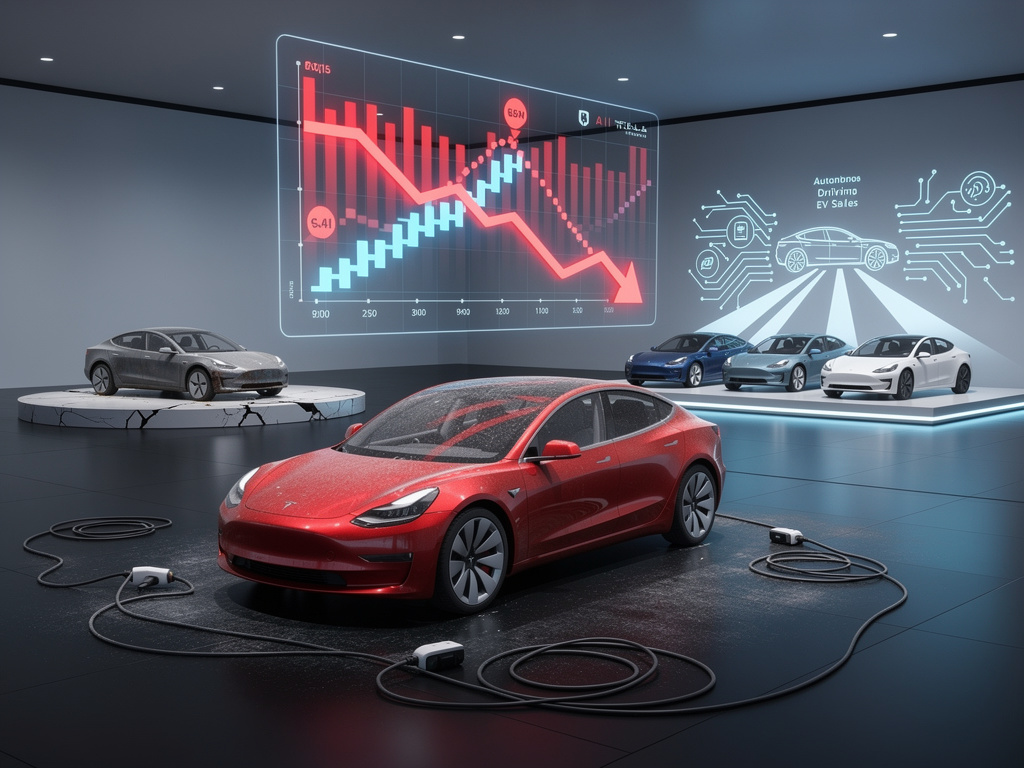
As Tesla Inc. navigates a turbulent 2025, the electric-vehicle giant finds itself in a precarious position, racing against time to stem a potential second consecutive year of declining sales. Recent data paints a stark picture: U.S. sales plummeted to under 40,000 units in November, marking the lowest monthly figure in nearly four years. This downturn comes despite aggressive discounting and the introduction of more affordable models, underscoring deeper issues within the company and the broader market for battery-powered cars. Elon Musk, Tesla’s chief executive, has been vocal about external pressures, but insiders and analysts point to a mix of internal missteps and shifting consumer sentiments.
The expiration of federal EV tax credits at the end of 2024 has exacerbated the situation, removing a key incentive that once buoyed demand. Tesla responded by slashing prices on its flagship Model 3 and Model Y, rolling out “Standard” variants priced as low as $35,000 to attract budget-conscious buyers. Yet, these moves have failed to ignite sales, with estimates from Cox Automotive showing a 20% drop from October’s figures. According to a report in Reuters, even the Cybertruck, Tesla’s much-hyped electric pickup, has underperformed, contributing only marginally to overall volume.
Musk has attributed some of the blame to broader economic factors, including high interest rates and a slowdown in global EV adoption. On social media platform X, formerly Twitter, he has posted about supply chain constraints echoing past challenges, such as chip shortages that hampered production in previous years. However, critics argue that Tesla’s aging lineup—dominated by models like the Model 3 and Y, which haven’t seen major refreshes in years—has left the company vulnerable to fresher competition from rivals like BYD Co. and Ford Motor Co.
Aggressive Discounts and Their Limits
In a bid to reverse the slide, Tesla has unleashed a flurry of promotions, including zero-interest financing for up to 72 months on select models and referral bonuses worth thousands in credits. These incentives, detailed in a recent article from Business Insider, aim to clear inventory and boost deliveries before year-end. The company is targeting a narrow window to surpass 2024’s sales total of about 1.8 million vehicles globally, but with only weeks left, the math looks daunting. Analysts project that without a miraculous December surge, Tesla could see its first back-to-back annual declines since its early days as a startup.
This strategy isn’t new for Tesla; price cuts have been a hallmark of Musk’s playbook, often used to stimulate demand during lulls. But the current environment differs. The end of tax credits has leveled the playing field, making Tesla’s offerings less competitively priced against gasoline vehicles, especially as oil prices stabilize. Moreover, consumer hesitation stems from concerns over charging infrastructure and range anxiety, issues that Tesla’s Supercharger network has mitigated but not eliminated entirely.
Adding to the complexity, Musk’s public persona and political involvements have alienated some potential buyers. Surveys from industry groups indicate that a portion of the liberal-leaning EV buyer base has soured on the brand amid Musk’s outspoken support for certain policies and figures. While Tesla maintains a loyal following, this backlash has contributed to softer demand in key markets like California, where sales dipped 15% year-over-year in the third quarter.
Global Pressures and Competitive Shifts
Expanding beyond the U.S., Tesla’s international performance tells a similar story of strain. In China, the world’s largest EV market, sales fell 6% in November, per data referenced in posts on X, as local players like BYD undercut prices with government-backed incentives. Europe hasn’t fared much better, with a 30% drop attributed to regulatory hurdles and economic slowdowns. A piece in The Times of India highlights how cheaper Tesla variants failed to spark interest, even as the company ramped up production at its Shanghai Gigafactory.
Musk has downplayed these figures, emphasizing long-term bets on autonomy and artificial intelligence. In recent X posts, he reiterated Tesla’s focus on self-driving technology, predicting that software updates like Full Self-Driving (FSD) version 13 will revolutionize the industry. Yet, regulatory scrutiny from bodies like the National Highway Traffic Safety Administration continues to delay widespread deployment, limiting FSD’s revenue potential in the short term.
Competitors are capitalizing on Tesla’s vulnerabilities. Rivian Automotive Inc. and Lucid Group Inc. have introduced models with superior range and luxury features, while traditional automakers like General Motors Co. push affordable EVs subsidized by their vast dealer networks. Tesla’s reliance on direct sales, while innovative, leaves it exposed in regions with poor online penetration or where physical showrooms matter.
Internal Challenges and Leadership Focus
Inside Tesla, the sales slump has prompted a reevaluation of priorities. Musk, who juggles roles at SpaceX, xAI, and now advisory positions in the U.S. government, has admitted to stretching thin. X posts from earlier this year reveal his return to “sleeping in conference rooms” to oversee critical projects, including Starship launches and AI integrations. This divided attention, some executives whisper, has slowed decision-making on new vehicle development, such as the long-awaited affordable “Model 2” compact car.
Financially, the picture is mixed. While vehicle sales falter, Tesla’s energy storage business—bolstered by Megapack batteries—posted record revenues, offsetting some automotive losses. Stock investors, as noted in a report from Parameter, seem unfazed, with shares rising 3% despite the November data, betting on AI-driven growth over traditional carmaking.
Critics, however, warn that ignoring core automotive execution could prove costly. Aging factories and supply chain bottlenecks, reminiscent of 2021’s chip crisis that Musk publicly lamented, persist. Tesla’s Fremont plant, for instance, operates below capacity, hampered by labor disputes and parts shortages.
Strategic Pivots and Future Bets
To counter these headwinds, Tesla is doubling down on innovation. The company plans to unveil a revamped Model Y in 2026, incorporating advanced battery tech for longer range and faster charging. Musk has teased robotaxi services as a game-changer, potentially generating billions in recurring revenue once regulatory hurdles clear. Insights from Electrek suggest that without tax credits, Tesla may lobby for new incentives or explore partnerships with governments to subsidize infrastructure.
Yet, skepticism abounds. Analysts from firms like Morgan Stanley question whether these futuristic bets can sustain the company through immediate sales droughts. The Cybertruck’s production ramp-up, plagued by quality issues, exemplifies the risks: initial hype gave way to recalls and customer complaints, further denting brand perception.
Musk’s leadership style—bold, unfiltered, and often controversial—remains a double-edged sword. His X commentary on topics ranging from population decline to AI supremacy keeps Tesla in the headlines, but it also invites scrutiny. For instance, recent posts defending Tesla’s autonomy edge over rivals like Waymo have rallied fans, yet failed to translate into sales momentum.
Market Realities and Consumer Sentiment
Broader market dynamics reveal a maturing EV sector where early adopter enthusiasm wanes. Global EV sales growth slowed to 20% in 2025 from 40% the prior year, per International Energy Agency data. Tesla, once the undisputed leader, now holds about 15% market share, squeezed by hybrids that offer a bridge for hesitant buyers.
Consumer surveys, including those cited in Torque News, point to Musk’s polarizing politics as a factor in brand aversion. One respondent quipped that buying a Tesla feels like “endorsing a worldview,” prompting some to opt for alternatives like the Chevrolet Bolt or Hyundai Ioniq.
Despite these challenges, Tesla’s ecosystem—encompassing solar products, home batteries, and a vast charging network—provides a moat. The company’s vertical integration allows for cost efficiencies that peers envy, potentially enabling deeper discounts without eroding margins entirely.
Path Forward Amid Uncertainty
Looking ahead, Tesla must balance short-term fixes with long-term vision. Insiders suggest accelerating the Model 2 launch to under $25,000 could recapture entry-level buyers, especially in emerging markets. Musk has hinted at this in X discussions, stressing the need for volume production to replace the global fleet of internal-combustion vehicles.
Regulatory environments will play a pivotal role. In the U.S., potential policy shifts under new administrations could reinstate incentives, while Europe’s stringent emissions rules might favor EVs. Tesla’s Berlin Gigafactory expansion aims to tap this, targeting 1 million annual units by 2027.
Ultimately, Tesla’s fate hinges on execution. As Musk refocuses on core operations, the company could emerge stronger, leveraging its tech prowess to outpace rivals. But with sales teetering, 2025 serves as a critical test of resilience in an industry where innovation alone may not suffice.


 WebProNews is an iEntry Publication