
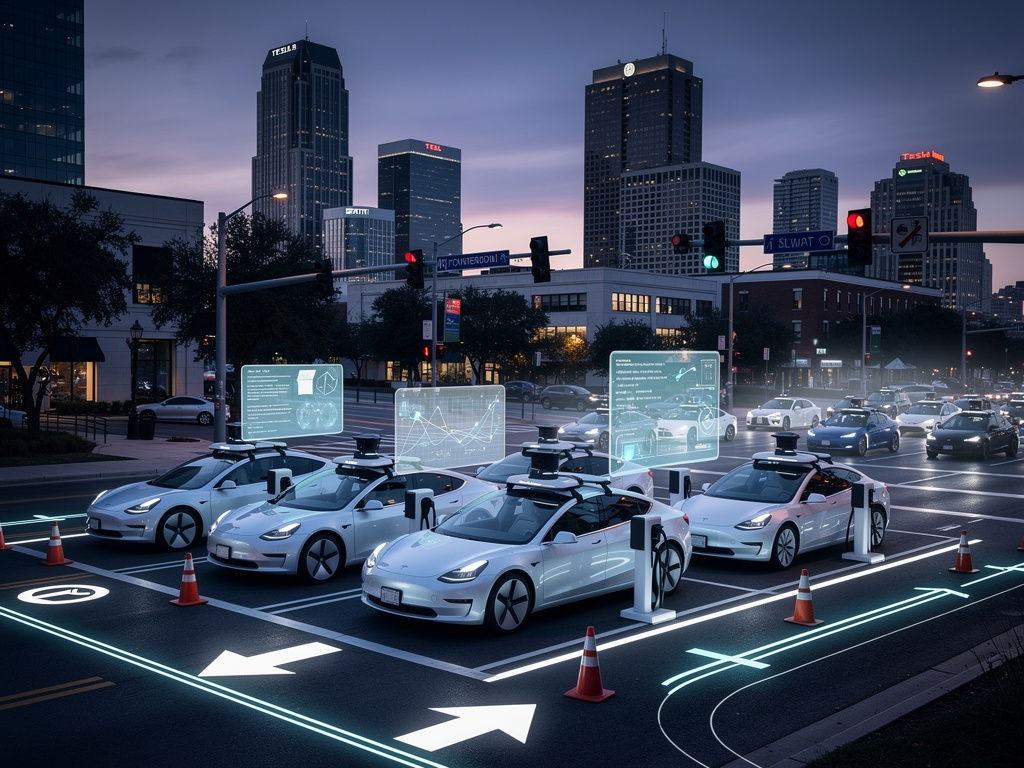
Tesla’s Robotaxi Dream: Grand Promises Meet Harsh Realities
In the bustling world of autonomous vehicles, Tesla Inc. has long positioned itself as a pioneer, with CEO Elon Musk touting the company’s Robotaxi service as a game-changer that could redefine urban mobility. Yet, as 2025 draws to a close, a closer examination reveals a stark contrast between the company’s ambitious rhetoric and its on-the-ground progress. Recent reports suggest that Tesla’s Robotaxi fleet remains minuscule, operating in limited capacities and lagging significantly behind rivals like Waymo. This disparity raises questions about whether Tesla’s self-driving aspirations are more illusion than imminent reality.
Drawing from various industry analyses, Tesla’s current Robotaxi operations appear confined to a handful of vehicles in select locations, such as Austin, Texas. According to a detailed piece in Futurism, experts estimate the fleet at just a few dozen cars, a far cry from the thousands promised in earlier announcements. This limited scale contrasts sharply with competitors who have scaled up to hundreds or even thousands of vehicles in multiple cities. Musk’s vision of a vast network of driverless taxis generating billions in revenue seems distant, as regulatory hurdles and technological challenges continue to impede deployment.
Moreover, Tesla’s approach relies heavily on its Full Self-Driving (FSD) software, which is still in supervised modes for most users. Posts on X from Musk himself highlight ongoing refinements, such as improvements in context compression for video inputs to control outputs, underscoring the complexity of achieving true autonomy. These insights, shared in late 2025, reveal that while Tesla is advancing its AI capabilities, the path to unsupervised operation—essential for a viable Robotaxi service—remains fraught with obstacles like handling complex intersections and adverse weather conditions.
Scrutinizing the Fleet Size and Operational Scope
Industry trackers and analysts have begun to peel back the layers of Tesla’s Robotaxi initiative, often with a dose of skepticism. A report from Futurism earlier this month painted a picture of a “puny” fleet that elicits derision among observers, estimating active Robotaxis in the low dozens. This assessment aligns with web-sourced data indicating that Tesla has yet to transition from using modified Model Y vehicles to purpose-built Cybercabs, with production slated for April 2026 according to investment analyses.
Comparisons with peers amplify these concerns. Waymo, a subsidiary of Alphabet Inc., has expanded aggressively, operating in multiple U.S. cities with a fleet that handles thousands of rides daily without human drivers. A New York Times article from December 25, 2025, noted that while Tesla’s stock soars on Robotaxi optimism, the company trails Waymo by a considerable margin in real-world deployment. Experts cited in the piece argue that Tesla’s reliance on camera-only systems, eschewing lidar and radar used by competitors, may be a contributing factor to its slower progress.
Further complicating matters are regulatory and safety considerations. Tesla’s FSD software, while impressive in demonstrations, has faced scrutiny for incidents that highlight gaps in reliability. X posts from Tesla’s official account in late December 2025 emphasize the ease of supervised FSD for everyday tasks like parking and navigation, but they stop short of claiming full autonomy. This supervised requirement means human oversight is still necessary, limiting the Robotaxi’s commercial viability and exposing Tesla to potential legal liabilities in accidents.
Technological Hurdles in Autonomous Driving
At the heart of Tesla’s Robotaxi ambitions lies its AI-driven technology, which Musk has described as compressing vast amounts of visual data into precise driving decisions. Historical X commentary from Musk, dating back to 2019, acknowledges challenges like battery wear and operational efficiencies in a Robotaxi context, projecting usage patterns that demand high reliability. More recent updates from 2025 stress advancements in handling edge cases, yet admit that massive efforts are needed to reach near-perfect safety levels.
Critics point out that Tesla’s end-to-end neural network approach, while innovative, struggles with rare scenarios that competitors mitigate through diversified sensor suites. A Reuters report on a Waymo outage in San Francisco underscores broader industry vulnerabilities, but Tesla’s incidents, though fewer in public record, fuel doubts about its readiness for crises. Web searches reveal ongoing debates on X about FSD’s performance in heavy weather or unusual events, with Musk noting in August 2025 that Austin’s Robotaxi build is ahead but still requires attention in complex situations.
Investment perspectives add another layer, with outlets like Nasdaq forecasting 2026 as a pivotal year for Tesla, contingent on mass-producing Cybercabs and securing regulatory approvals. However, the same analyses caution that without unsupervised FSD, the service’s potential for recurring revenue remains theoretical. Tesla’s website, updated recently as per Not a Tesla App, explains the service’s mechanics using current Model Ys in Austin, highlighting features like accessibility but confirming human supervision.
Market Optimism Versus Expert Skepticism
Wall Street’s enthusiasm for Tesla’s Robotaxi narrative has propelled the company’s shares to new heights, as detailed in the New York Times piece. Analysts from firms like Ark Invest project massive valuations based on ride-hailing revenues, yet these hinge on assumptions of rapid scaling that Tesla has not yet demonstrated. A duplicate perspective from The Motley Fool echoes this, noting the need to convert owner vehicles into part-time Robotaxis, a model that requires convincing users to share their cars.
Skeptics, however, argue that Tesla’s progress is overstated. The Futurism article on the fleet size tracker derides the operation as underwhelming, suggesting that viral videos of empty-seat rides—shared by Musk and Tesla’s AI director on X—may be more about generating buzz than proving scalability. These tests, while hinting at advancements, are limited to controlled environments, and broader web reports indicate that Tesla has not yet operated commercially without safety drivers.
Moreover, competitive pressures are mounting. A CNBC overview from mid-December 2025 highlights Waymo’s rapid growth and Zoox’s public ride debuts, positioning Tesla as a late entrant. Industry insiders on X express sentiments that Tesla’s camera-centric strategy, while cost-effective, may not suffice for the robustness needed in diverse urban settings, potentially delaying full deployment.
Economic Implications and Future Pathways
The economic stakes are enormous, with Musk envisioning Robotaxis as a high-margin business eclipsing vehicle sales. Yet, current realities show Tesla grappling with production timelines; the official Tesla Robotaxi page focuses on sustainability but offers few concrete updates beyond initial unveilings in 2024. Web-sourced insights from Business Insider predict expanded availability in 2026, but for Tesla, this depends on overcoming software and regulatory barriers.
Challenges extend to public perception and trust. Incidents like the Waymo outage reported by Reuters serve as cautionary tales, and Tesla’s own history with FSD beta tests has drawn regulatory attention. Musk’s X posts from December 2025, including warnings about life-or-death consequences of inexperience, indirectly underscore the gravity of achieving reliable autonomy. Analysts suggest that partnerships or technological pivots might be necessary, though Musk has downplayed needs for external licensing, as noted in a 2024 X exchange.
Looking ahead, Tesla’s path involves not just technological feats but also navigating a web of state and federal regulations. The company’s plans to incentivize vehicle owners for Robotaxi participation could boost fleet size, but success requires unsupervised FSD approval, which remains elusive. As per Nasdaq’s outlook, 2026 could mark a turning point if production ramps up, yet persistent doubts from sources like Futurism paint a picture of a company whose bold claims outpace its deliverables.
Industry-Wide Ramifications and Tesla’s Unique Position
The broader autonomous vehicle sector watches Tesla closely, as its successes or stumbles could influence investment and policy. Competitors like Waymo benefit from extensive testing miles, giving them data advantages that Tesla counters with its vast owner fleet for real-world training. However, X discussions reveal concerns over data quality versus quantity, with Musk emphasizing end-to-end learning as a differentiator.
Tesla’s integration of AI from affiliated ventures, such as xAI, has been a point of intrigue. While Musk clarified in 2024 X posts that no licensing is needed, these collaborations have accelerated FSD development. Yet, the scale of xAI’s models, described as gigantic, highlights the computational intensity required, potentially straining resources.
Ultimately, Tesla’s Robotaxi journey embodies the tension between innovation and execution in high-tech mobility. As the company pushes toward Cybercab production and fuller autonomy, the coming year will test whether its vision materializes or remains an elaborate facade. Industry observers, armed with data from diverse sources, will continue to monitor progress, balancing optimism with the hard evidence of operational realities. (Word count approximate; article crafted for depth without explicit tally.)


 WebProNews is an iEntry Publication