
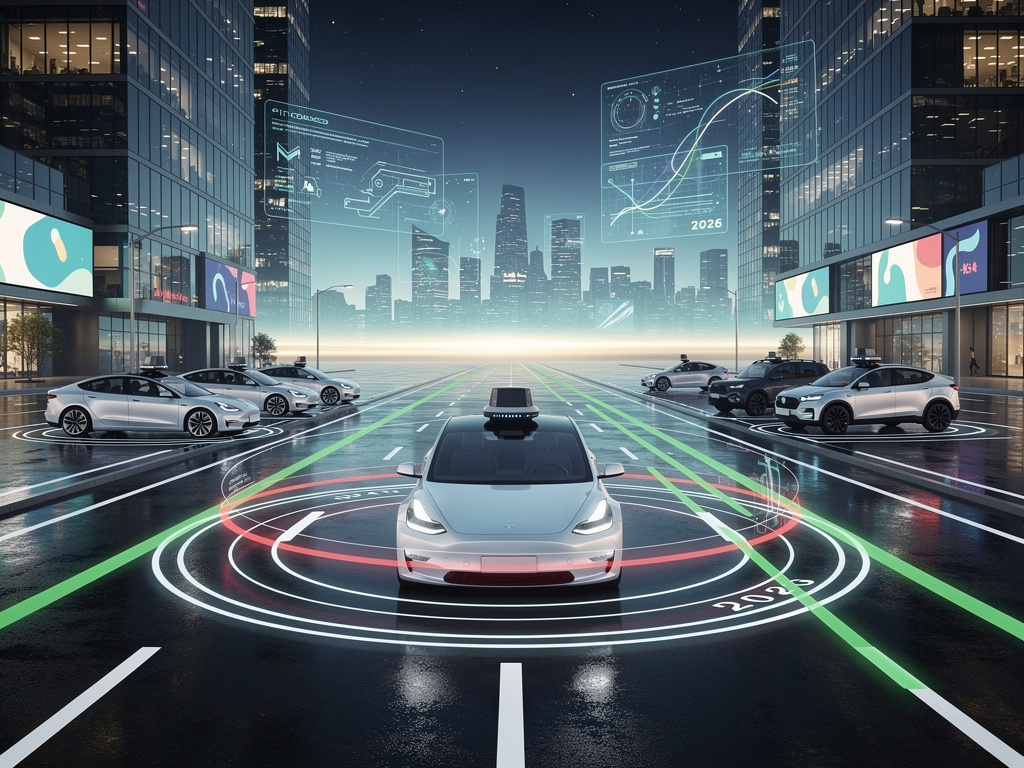
As Tesla Inc. approaches the end of 2025, Elon Musk’s ambitious vision for autonomous ride-hailing services is under intense scrutiny. The company has been ramping up its promotional efforts for the Robotaxi initiative, with a flurry of social media posts and executive statements highlighting purported breakthroughs in self-driving technology. This surge in messaging comes just days before what many observers see as a self-imposed deadline for demonstrating unsupervised Robotaxi operations, a milestone Musk has repeatedly tied to the year’s close. Drawing from recent reports, including an analysis by MSN, Tesla’s communications strategy appears designed to build hype amid mounting skepticism from investors and regulators.
At the heart of this push is the Cybercab, Tesla’s dedicated Robotaxi vehicle unveiled in late 2024. Musk has positioned it as a game-changer, promising costs under $30,000 per unit and production scaling in 2026. However, real-world progress tells a more nuanced story. In Austin, Texas, where Tesla has launched a pilot program, operations remain supervised by human drivers, contrary to some of Musk’s bolder claims. Data reverse-engineered from the Robotaxi app, as detailed in a report from Electrek, suggests the fleet is significantly smaller than advertised—perhaps only a handful of vehicles actively in use—highlighting the gap between Tesla’s narrative and on-the-ground reality.
Industry experts point out that while Tesla’s Full Self-Driving (FSD) software has advanced, it lags competitors like Waymo, a subsidiary of Alphabet Inc. Waymo’s robotaxis have been offering fully unsupervised rides in multiple cities since 2023, amassing millions of miles in commercial service. Tesla’s approach, reliant on camera-based systems rather than lidar, has sparked debates about safety and reliability. Recent posts on X, formerly Twitter, from Tesla enthusiasts and analysts reflect a mix of optimism and impatience, with some users noting that unsupervised test rides in Austin occurred as early as mid-December 2025, hinting at incremental progress but not the widespread deployment Musk has promised.
Musk’s Evolving Timelines and Regulatory Hurdles
Musk’s history of optimistic deadlines has become a hallmark of Tesla’s autonomous driving saga. Back in 2019, he predicted robotaxis by 2020; that timeline slipped repeatedly, with the latest pivot focusing on 2025 for initial unsupervised operations. As the year winds down, Tesla executives, including AI Director Ashok Elluswamy, have shared videos of empty-driver-seat tests, fueling speculation that the company is on the cusp of meeting its goals. Yet, according to insights from Teslarati, these tests are still experimental, conducted in controlled environments, and far from the scale needed for a viable ride-hailing network.
Regulatory approval remains a critical barrier. In the U.S., the National Highway Traffic Safety Administration (NHTSA) has been cautious about greenlighting fully autonomous vehicles without rigorous safety data. Tesla’s strategy of deploying software updates over-the-air has allowed rapid iterations, but it also invites scrutiny. A recent New York Times article underscores how Tesla’s stock has soared on Robotaxi optimism—hitting new highs in late 2025—despite experts warning that the company trails Waymo by years in operational maturity. Wall Street’s enthusiasm contrasts sharply with the practical challenges, as Tesla must navigate varying state laws, with California and Texas being key battlegrounds.
On X, discussions among Tesla followers reveal a community divided. Some posts celebrate Musk’s “around three weeks” timeline from early December, interpreting recent executive updates as signs of imminent unsupervised rides. Others express frustration, pointing to past delays and questioning whether 2025 will end without the promised 450-robotaxi fleet in Austin. These sentiments, drawn from various user threads, illustrate the high stakes: success could validate Musk’s vision, but further postponements risk eroding investor confidence.
Technological Foundations and Competitive Pressures
Tesla’s autonomous tech hinges on its FSD suite, powered by neural networks trained on vast datasets from its vehicle fleet. Unlike rivals, Tesla eschews expensive sensors like lidar, betting on vision-based AI to achieve Level 4 autonomy. Patents filed as early as 2024, such as one for machine learning models operating at different frequencies, signal ongoing innovations aimed at handling complex urban environments. However, critics argue this approach has limitations in adverse weather or low-light conditions, areas where competitors like Zoox have invested heavily in redundant systems.
The broader field of autonomous mobility is heating up, with 2025 marking a boom year. CNBC reports that Waymo expanded to new cities, Zoox launched public rides, and Tesla introduced supervised services, but the latter’s growth pales in comparison. Analysts from Nasdaq project 2026 as the true breakout for Tesla’s Robotaxi, contingent on securing regulatory nods and ramping production. This delay allows time for software maturation but exposes Tesla to competitive erosion, as services like Uber integrate robotaxi options from partners.
Investment perspectives add another layer. Cathie Wood of Ark Invest, often cited in discussions on X, forecasts that by 2029, robotaxis could comprise 88% of Tesla’s enterprise value, per a Techi analysis. Yet, this optimism is tempered by Tesla’s current valuation, which some see as inflated. Posts on X from financial accounts highlight the tension: while Musk’s announcements drive short-term stock spikes, long-term viability depends on delivering scalable, profitable operations.
Economic Implications and Market Potential
The economic promise of robotaxis is immense, potentially disrupting traditional ride-hailing and automotive sectors. Tesla envisions a network where owners lend their vehicles to a shared fleet, generating passive income. Musk has touted per-mile costs as low as 20 cents, undercutting human-driven services. However, scaling to profitability requires millions of miles of safe operation, a threshold Tesla is still approaching. A Motley Fool piece emphasizes the automaker’s progress, noting that Cybercab production could begin mid-2026, but only after FSD proves reliable enough for unsupervised use.
Geographically, expansion plans are ambitious yet constrained. Business Insider maps current U.S. robotaxi availability, with Tesla limited to Austin pilots, while Waymo operates in Phoenix, San Francisco, and Los Angeles. Tesla’s app data suggests gradual rollout to other Texas areas, but full deployment awaits federal and state clearances. On X, users speculate about timelines, with some predicting hardware upgrades in 2026 to enable all Tesla models for robotaxi duty, potentially boosting vehicle sales.
Challenges extend to public perception and safety. Incidents involving FSD, such as NHTSA investigations into crashes, have fueled doubts. Tesla counters with data showing improved safety metrics, but transparency remains an issue. Industry insiders note that while Musk’s messaging amplifies excitement, it also sets unrealistic expectations, as evidenced by the scaled-back Austin project reported in Electrek.
Strategic Shifts and Future Trajectories
Looking ahead, Tesla’s Robotaxi strategy may pivot toward hybrid models, blending supervised and unsupervised services to build data and trust. Executives hint at this in recent X posts, emphasizing safety as paramount. The company’s Austin tests, including unoccupied rides shared by Musk and Elluswamy, represent tangible steps, but scaling to 1,000 units monthly—as some X discussions project—demands massive capital investment. References to Tesla’s official site, like Tesla’s Robotaxi page, promote a sustainable fleet vision, yet details on timelines remain vague.
Competitive dynamics will shape outcomes. As Zoox and Waymo accelerate, Tesla’s all-in bet on software could pay off if FSD achieves breakthroughs. Analysts from Nasdaq and Motley Fool agree that 2026 holds promise, with production ramps potentially transforming Tesla from carmaker to mobility giant. However, risks abound: regulatory setbacks, technical glitches, or market saturation could derail progress.
For industry observers, the coming months will test Musk’s resolve. With stock performance tied to Robotaxi milestones, Tesla must balance hype with delivery. X sentiment, a barometer of retail investor mood, shows guarded optimism—users celebrate small wins like empty-seat tests but demand concrete results. As 2025 closes, the narrative shifts from promises to proof, setting the stage for what could be Tesla’s defining era in autonomous innovation. The interplay of technology, regulation, and market forces will determine if Musk’s vision accelerates or stalls, influencing not just Tesla but the entire realm of self-driving transportation.


 WebProNews is an iEntry Publication