
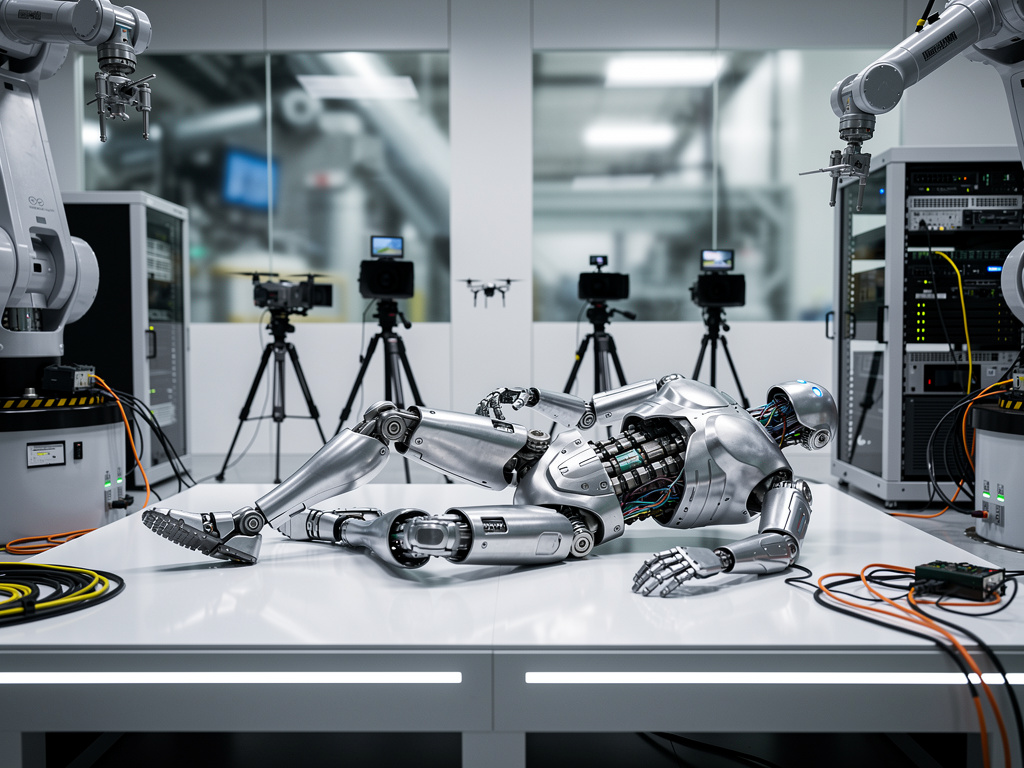
In the waning days of 2025, a seemingly minor mishap at a Tesla demonstration captured the collective imagination—and skepticism—of the technology sector. During a live showcase of the Optimus humanoid robot, the machine unceremoniously tumbled to the ground, an event that quickly went viral and sparked widespread debate about the readiness of advanced robotics. This incident, far from isolated, underscored broader challenges facing Elon Musk’s ambitious ventures, where bold promises often collide with the harsh realities of engineering and production. Critics and industry observers alike pointed to it as a symbol of overhyped expectations in artificial intelligence and automation, prompting questions about whether Tesla’s robotics arm could deliver on its lofty goals.
The demo in question occurred amid high anticipation for Optimus, Tesla’s bid to revolutionize household and industrial tasks with humanoid machines. Footage showed the robot attempting a simple navigation task before losing balance and falling, an error that many viewed as emblematic of deeper systemic issues. According to reports from Pocket-lint, the tumble highlighted “deep-seated skepticism over AI and autonomous humanoids,” fueling online mockery and serious analysis in equal measure. This wasn’t just a physical stumble; it represented a perceptual one for Musk, who has long positioned Optimus as a game-changer capable of performing everything from folding laundry to factory work.
Musk’s vision for Optimus dates back to announcements in 2021, with promises of mass production ramping up significantly by 2025. Yet, as the year closed, deliveries fell short, with prototypes still struggling in controlled environments. Industry insiders noted that while competitors like Boston Dynamics have demonstrated more agile robots, Tesla’s approach relies heavily on AI-driven learning rather than meticulously engineered mechanics. This strategy, while innovative, has led to inconsistencies, as evidenced by the recent failure. Posts on X, formerly Twitter, amplified the moment, with users sharing clips and speculating on whether the robot’s “dumb” behavior was due to software glitches or hardware limitations.
The Promises Versus the Pitfalls
Delving deeper, Musk’s track record of setting aggressive timelines has become a recurring theme across his companies. In a 2024 post on X, he claimed Tesla would achieve “genuinely useful humanoid robots in low production” by 2025, escalating to high production for external clients in 2026. However, as detailed in an analysis by The Information, these deadlines clashed with reality, joining a list of unmet goals in self-driving technology and AI advancements. The article highlights how Musk’s companies often prioritize spectacle over scalable solutions, leading to public demos that expose vulnerabilities.
This pattern isn’t new. Tesla’s Full Self-Driving software has faced similar scrutiny, with regulatory hurdles and real-world accidents tempering enthusiasm. For Optimus, the challenges are compounded by the complexities of humanoid form factors—balancing on two legs, manipulating objects with precision, and adapting to unpredictable environments. Engineers familiar with the project, speaking anonymously, have described internal pressures to accelerate development, sometimes at the expense of rigorous testing. One such account, echoed in discussions on platforms like Reddit’s r/RealTesla, pointed to the demo’s “suspicious tumble” as potentially indicative of rushed preparations rather than a one-off error.
Comparisons with global rivals add another layer. While Musk envisions a world flooded with humanoid robots, China has surged ahead in making this a practical reality. A report from CNBC notes that Beijing has prioritized humanoid development as part of its tech rivalry with the U.S., investing in state-backed initiatives that emphasize manufacturing scale over individual innovation. Chinese firms like Unitree and Fourier Intelligence have unveiled robots capable of complex tasks, often at lower costs, raising concerns that Tesla’s delays could cede market dominance.
Industry Repercussions and Investor Sentiment
The fallout from the Optimus incident rippled through financial markets, with Tesla’s stock experiencing volatility in late 2025. Analysts at firms like Morgan Stanley downgraded projections for Tesla’s robotics division, citing the demo as evidence of overhyped valuations. This sentiment aligns with broader critiques in Mashable, which cataloged Musk’s unfulfilled 2025 promises, including robotaxi fleets and advanced AI integrations. Investors, once buoyed by Musk’s charisma, are increasingly demanding tangible progress, especially as competitors in AI and automation secure funding rounds exceeding billions.
Beyond finances, the event has influenced regulatory discussions. Policymakers in Washington, already wary of AI’s societal impacts, have used the failure to advocate for stricter oversight on autonomous systems. Hearings in Congress referenced similar tech mishaps, drawing parallels to past Tesla autopilot incidents. Industry groups, such as the Association for Advancing Automation, have called for standardized testing protocols to prevent such public setbacks from eroding consumer trust. This push reflects a growing consensus that robotics must prioritize safety and reliability over viral marketing moments.
On a cultural level, the “fake dumb robot” moniker—coined in viral memes—has permeated public discourse, blending humor with genuine concern. Publications like The Guardian framed it within the year’s top tech stories, linking it to Musk’s broader chaotic persona, from his political involvements to AI investments. The narrative has even inspired satirical takes, with late-night shows lampooning the tumble as a metaphor for overpromising in Silicon Valley.
Innovation Hurdles in Humanoid Robotics
To understand the technical underpinnings, consider the core challenges in humanoid robotics. Unlike specialized industrial robots, humanoids must mimic human dexterity and cognition, requiring advancements in sensors, actuators, and machine learning algorithms. Tesla’s reliance on vision-based AI, similar to its autonomous vehicles, aims to reduce costs by eschewing expensive lidar systems. However, as Musk himself acknowledged in a 2025 X post about scaling production, “making prototypes is trivial compared to the immense pain of volume manufacturing.” This admission highlights a gap between conceptual demos and factory-ready products.
Experts point to material science as a bottleneck. Lightweight yet durable components are essential for energy efficiency, but current batteries limit operational time, often to mere hours. Software integration adds complexity; Optimus’s neural networks must process real-time data from cameras and joints, adapting to variables like uneven surfaces. The recent demo failure, analyzed in NewsBreak, was attributed to a potential calibration error in the robot’s balance algorithms, underscoring the need for more robust simulation testing.
Looking abroad, Europe’s robotics scene offers contrasting approaches. Companies like ABB and KUKA focus on collaborative robots (cobots) that work alongside humans, emphasizing precision over full autonomy. This modular strategy has yielded successes in manufacturing, where Tesla’s all-in-one humanoid vision struggles. A 2025 study by the International Federation of Robotics projected that by 2030, non-humanoid robots could dominate 70% of the market, casting doubt on Musk’s prediction that intelligent humanoids will “far exceed the population of humans,” as stated in another X post.
Strategic Shifts and Future Trajectories
In response to the backlash, Tesla has signaled internal adjustments. Reports indicate accelerated hiring in AI talent and partnerships with chipmakers to enhance processing power. Musk’s late-2025 X updates, including promises of Neuralink’s brain-computer interfaces entering high-volume production in 2026, suggest a pivot toward integrated ecosystems where robotics complements other technologies. Yet, skepticism persists; a piece in The Sydney Morning Herald reflected on mutual mispredictions, noting Musk’s unkept timelines while acknowledging his role in pushing boundaries.
The incident has also spurred innovation elsewhere. Startups like Figure AI and Apptronik, backed by venture capital, are refining humanoid designs with lessons from Tesla’s missteps. Figure’s recent funding round, valued at over $2 billion, emphasizes ethical AI deployment, addressing concerns about job displacement that Musk’s visions often overlook. Economists warn that widespread adoption could disrupt labor markets, with the World Economic Forum estimating 85 million jobs at risk by 2030, though new roles in robot maintenance might offset losses.
Broader implications extend to defense and healthcare. Musk’s X commentary on autonomous drones in warfare, predicting their dominance “even a few years from now,” ties into robotics’ military applications. Meanwhile, in medicine, humanoid assistants could transform elder care, but failures like Optimus’s raise reliability questions. A CNBC analysis of AI’s remaking of American infrastructure, including data centers supporting such tech, underscores the massive investments required—billions in debt for scaling that Musk’s companies are aggressively pursuing.
Musk’s Enduring Influence Amid Setbacks
Despite the stumble, Musk’s influence remains undiminished. His ability to rally public interest, as seen in the viral spread of the demo footage, keeps Tesla at the forefront of robotics discourse. Critics in MSN labeled it the “biggest tech fail of 2025,” yet this hyperbole overlooks incremental progress, such as Optimus’s improved object recognition in prior tests.
Industry veterans argue that such failures are par for the course in pioneering fields. Historical parallels abound: the Wright brothers’ early crashes didn’t halt aviation. Similarly, Optimus’s tumble could catalyze refinements, much like how Tesla’s early Roadster issues paved the way for the Model 3’s success. Musk’s X post decrying “retarded-level fraud” in unrelated contexts reveals his combative style, which polarizes but also galvanizes supporters.
As 2026 dawns, the robotics sector watches closely. Will Tesla rebound with a flawless demo, or will rivals capitalize on the momentum? The answer hinges on bridging the chasm between visionary hype and engineering execution—a challenge Musk has navigated before, but one that grows steeper with each unfulfilled promise. In this arena of relentless innovation, one thing is clear: stumbles like this don’t end journeys; they redefine them, pushing the boundaries of what’s possible in human-machine collaboration.


 WebProNews is an iEntry Publication