
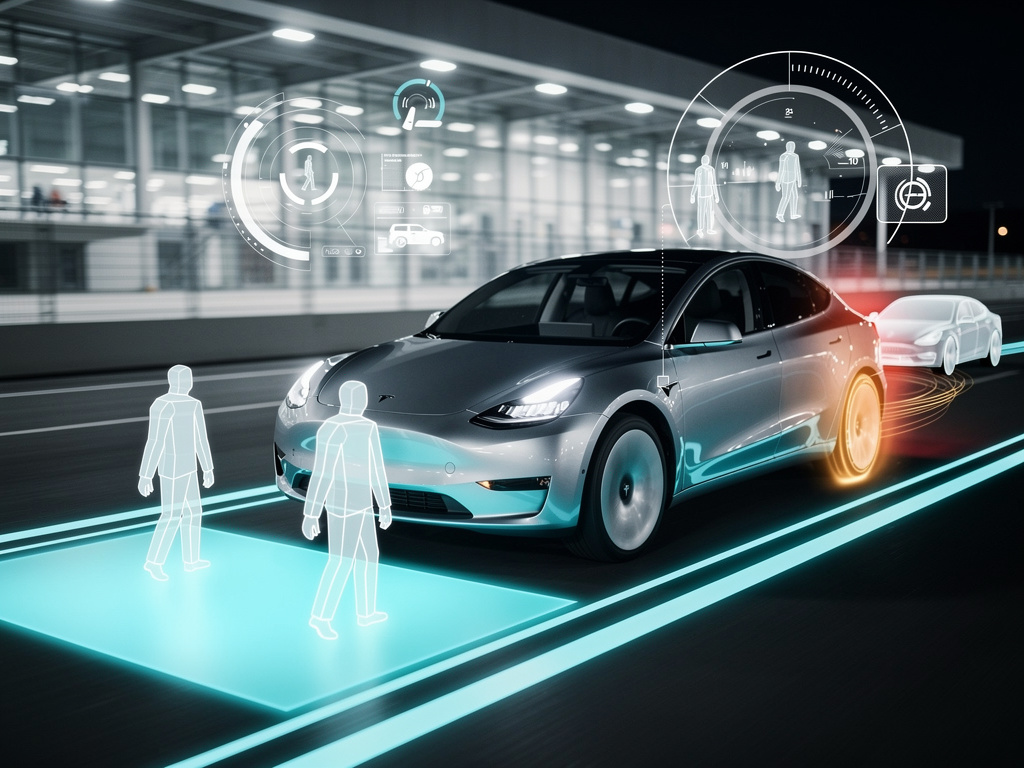
The National Highway Traffic Safety Administration delivered a clear message this week. The 2026 Tesla Model Y stands alone as the first vehicle to pass the agency’s newly expanded battery of tests for advanced driver assistance systems.
Announced May 7, the result marks a concrete win for Tesla’s camera-based approach in a regulatory process long criticized for lagging behind actual technology on the road. No other model has met the full set of criteria yet. That fact alone will ripple through boardrooms from Detroit to Stuttgart.
NHTSA’s Updated Tests Set a New Standard for Driver Assistance Features
The tests, added to the New Car Assessment Program after congressional direction and approved by NHTSA in November 2024, evaluate four specific capabilities on a strict pass-fail basis. They cover pedestrian automatic emergency braking, lane keeping assistance, blind spot warning, and blind spot intervention. The 2026 Model Y, those units built on or after November 12, 2025, cleared every one. It also satisfied the agency’s four longstanding ADAS requirements: forward collision warning, crash imminent braking, dynamic brake support, and lane departure warning.
“By successfully passing these new tests, the 2026 Tesla Model Y demonstrates the lifesaving potential of driver assistance technologies and sets a high bar for the industry. We hope to see many more manufacturers develop vehicles that can meet these requirements,” said NHTSA Administrator Jonathan Morrison, according to the agency’s official press release.
These additions didn’t appear overnight. Congress pushed for stronger evaluation of features that automakers market aggressively yet often leave vaguely defined. Previous NCAP updates brought electronic stability control, then forward collision warning, rear visibility, and automatic emergency braking over the past 15 years. The 2026 requirements represent the latest chapter in that gradual expansion. They aim to give buyers straightforward data instead of relying solely on manufacturer claims or marketing labels that obscure real performance differences.
Tesla equips the relevant features as standard on the updated Model Y. Its vision-only system, which dispenses with radar and lidar in favor of cameras and neural networks, proved sufficient under the new protocols. Industry observers have long questioned whether such a setup could match sensor-fusion strategies favored by legacy carmakers. Early evidence now suggests it can. A report from Not a Tesla App noted that the Model Y’s performance shows vision-based detection handling complex scenarios at least as effectively as traditional configurations.
But one success doesn’t rewrite the entire safety landscape. NHTSA still stresses that ADAS tools require drivers to stay fully attentive and in control. The tests measure assistance. They do not certify full self-driving capability. Tesla’s Full Self-Driving software, while related, operates under separate regulatory scrutiny and faces its own ongoing questions about real-world reliability and crash data.
Competitors will feel pressure. Many already offer similar features under different brand names. Few have submitted vehicles that satisfy the complete new NCAP checklist. TechCrunch reached out to NHTSA for details on pending models and plans to update its coverage as responses arrive. Its article highlights how the criteria attempt to catch up with the rapid pace of feature proliferation that often confuses consumers.
Reuters provided additional context on timing. The Trump administration had delayed certain NCAP changes by a year before the 2026 rules took effect. The program itself dates to 1978 and remains a powerful marketing tool. Automakers chase five-star ratings with near-religious intensity because shoppers respond to them. Now those stars and the new pass-fail ADAS badges will carry fresh weight. The Reuters report underscores how these evaluations sit alongside crashworthiness assessments that have shaped vehicle design for decades.
So what changes for Tesla? Validation from the same agency that has sometimes clashed with the company over crash reporting and Autopilot investigations. The Model Y already holds NHTSA’s top five-star overall safety rating. This latest distinction adds another data point for sales teams and could influence insurance calculations or fleet procurement decisions.
Yet challenges remain. Pedestrian automatic emergency braking must work across varied lighting, speeds, and angles. Lane keeping systems face criticism when they nudge too aggressively or fail to recognize faded lines. Blind spot intervention demands split-second accuracy. Tesla passed the prescribed scenarios. Real roads present infinite variations.
Analysts expect other manufacturers to accelerate their own testing and submissions. Some may tweak software. Others could add hardware. The 10-year NCAP roadmap mentioned in the NHTSA release signals further evolution ahead, possibly including more stringent metrics or entirely new categories.
Tesla, for its part, wasted little time highlighting the news on social channels. The achievement aligns with its long-standing argument that its vehicles rank among the safest sold. Government confirmation at this regulatory level arrives at a useful moment. Demand for the refreshed Model Y, sometimes called the Juniper update in enthusiast circles, could benefit from the endorsement.
Still, safety sells only when buyers trust the underlying claims. NHTSA’s move to incorporate these pass-fail results into consumer materials should help build that trust across brands. One company crossed the line first. The rest now have a visible target.
The announcement also arrives amid broader debates about driver assistance liability, data collection, and the boundary between helpful alerts and systems that encourage distraction. Morrison’s statement walks that line carefully. It praises potential while reminding the industry that more work lies ahead.
For investors and executives watching the automotive sector, the implications stretch beyond one model. Suppliers of camera modules, processing chips, and training data for neural nets may see renewed interest. Traditional radar and lidar providers could face tougher questions about cost and necessity if vision systems continue to satisfy regulators.
None of this guarantees market dominance. Execution, pricing, reliability, and service networks still matter enormously. But in the narrow arena of standardized government safety testing for assistance features, Tesla just posted the first perfect score. That result will echo in design reviews and marketing decks for months to come.


 WebProNews is an iEntry Publication