
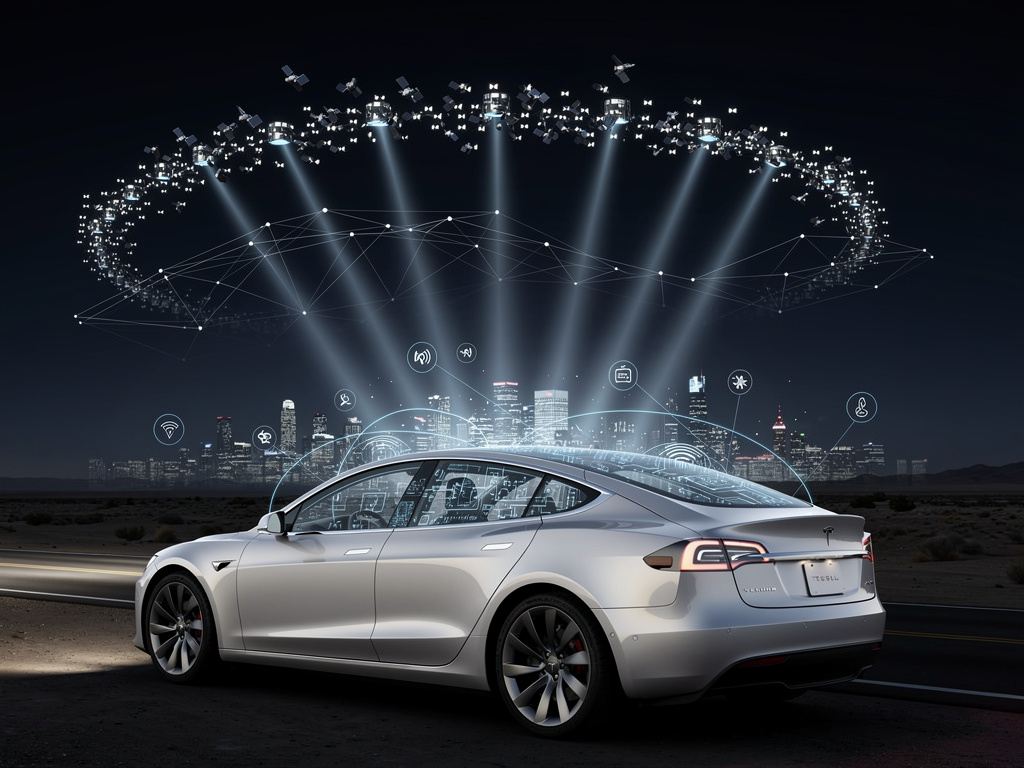
Orbiting Ambitions: How Tesla’s Starlink Fusion Could Redefine the Drive
Tesla Inc. is on the cusp of a transformative leap in automotive technology, aiming to embed Starlink satellite internet directly into its vehicles. This move, spearheaded by Elon Musk’s intertwined empires of electric cars and space-based communications, promises to eliminate connectivity dead zones and unlock new realms of in-car functionality. Recent patent filings and regulatory approvals suggest that Tesla’s electric vehicles (EVs) could soon boast seamless, high-speed internet from SpaceX’s Starlink constellation, potentially reshaping how drivers interact with their cars, the road, and the world beyond.
The integration isn’t just about streaming videos on long drives; it’s a strategic play to enhance Tesla’s core offerings, from autonomous driving to over-the-air updates. According to a report from MSN, this convergence could yield massive payoffs, including boosted vehicle sales and new revenue streams through premium connectivity services. Industry analysts are buzzing about the potential, as it aligns with Musk’s vision of a fully connected ecosystem where cars, satellites, and AI work in harmony.
But the path to this orbital synergy hasn’t been straightforward. Tesla has long relied on cellular networks for features like navigation and software updates, but these falter in remote areas. Starlink, with its low-Earth orbit satellites, offers a solution by providing broadband speeds anywhere on the planet. The challenge lies in seamlessly incorporating the necessary hardware without compromising vehicle design or performance.
Patent Innovations Paving the Way
A key development came in late 2025 when Tesla filed a patent for a “Vehicle Roof Assembly with Radio Frequency Transparent Material.” This innovation, detailed in coverage by Electrek, describes embedding satellite antennas directly into the car’s roof, using materials that allow radio waves to pass through with minimal interference. This isn’t merely cosmetic; it ensures that the vehicle’s sleek lines remain intact while enabling constant connectivity.
The patent builds on earlier collaborations between Tesla and SpaceX. For instance, Starlink has already been tested in Tesla’s premium connectivity packages, but full integration would eliminate the need for external dishes or add-ons. Posts on X, formerly Twitter, from users like Tesla enthusiasts highlight experiments with Starlink Mini dishes mounted in cars, noting pros like reliable remote access but cons such as power draw and reboot times during vehicle shutdowns.
Regulatory hurdles have also been cleared. The Federal Communications Commission (FCC) recently approved Starlink for in-motion use in vehicles, a nod that opens the door for widespread adoption. This approval, combined with Tesla’s patent, positions the company to roll out the feature in upcoming models, potentially starting with refreshes of the Model 3 and Model Y.
Technical Hurdles and Engineering Feats
Integrating Starlink antennas poses engineering challenges, including signal attenuation through metal roofs and the need for low-latency connections crucial for real-time applications like Full Self-Driving (FSD). Tesla’s solution involves redesigning the roof with composite materials that are transparent to radio frequencies, as explained in a piece from Road & Track. This could allow for phased-array antennas hidden beneath the glass or paneling, maintaining aerodynamics and aesthetics.
Power management is another critical aspect. Starlink hardware requires consistent energy, and Tesla’s 12V systems have historically powered down when the car is off, leading to connectivity interruptions. X users have shared workarounds, such as custom installations that keep devices running, but official integration would need to address this for seamless operation. Moreover, bandwidth allocation remains a concern; Starlink’s network, while expansive, must handle increased demand from mobile users without congestion.
On the software side, Tesla’s ecosystem could leverage Starlink for enhanced data syncing. Imagine FSD systems pulling real-time traffic data from satellites, bypassing terrestrial networks prone to outages. This ties into Musk’s broader ambitions, where Tesla vehicles contribute to a crowdsourced mapping network, improved by constant uplink capabilities.
Market Implications and Competitive Edge
The payoff for Tesla could be enormous, as noted in the MSN article. With Starlink, Tesla owners in rural or underserved areas gain access to features previously limited by cellular coverage, such as remote monitoring via the Tesla app or instant software updates. This could drive sales in regions where connectivity is a barrier, expanding Tesla’s market reach beyond urban centers.
Competitors are watching closely. Rivian and Ford have explored satellite options, but Tesla’s vertical integration with SpaceX gives it a unique advantage. A report from InsideEVs emphasizes how this could “rock” the EV sector by combining power, connectivity, and comfort everywhere. For instance, emergency calls and texts via satellites, as previewed in older partnerships like T-Mobile and Starlink, could become standard, enhancing safety.
Revenue models are evolving too. Tesla’s current Premium Connectivity subscription, at $10 monthly, might see upgrades with Starlink, justifying higher fees for unlimited data. This could mirror Starlink’s own mobility plans, creating synergies that boost both companies’ bottom lines. Analysts project that such integrations could add billions to Tesla’s valuation by differentiating its vehicles in a crowded EV market.
Consumer Benefits and Everyday Transformations
For everyday drivers, Starlink integration means no more connectivity blackouts on road trips. Streaming services, video calls, and even work-from-car scenarios become viable, turning commutes into productive time. X posts from Tesla owners express excitement about eliminating “dead zones,” with one user noting how it could enable real-time OTA updates anywhere, ensuring vehicles stay cutting-edge.
Safety features stand to gain immensely. In accidents or breakdowns in remote areas, satellite connectivity ensures quick emergency responses. This builds on Tesla’s existing SOS features but extends them globally, potentially saving lives. Moreover, for autonomous fleets like the upcoming Cybercab, constant satellite links are essential for coordination and updates without reliance on ground infrastructure.
However, challenges persist. Data privacy concerns arise with always-on connections, as vehicles transmit vast amounts of information. Regulatory bodies may scrutinize how this data is handled, especially across borders. Additionally, the environmental impact of launching more satellites for Starlink’s expansion draws criticism, though proponents argue the benefits in connectivity outweigh the costs.
Broader Industry Ripples and Future Visions
Looking ahead, Tesla’s Starlink push could influence the entire automotive sector. Legacy manufacturers might partner with satellite providers to keep pace, fostering a new era of connected mobility. A French publication, Presse Citron, speculates this as Elon Musk’s next “good idea,” potentially ending internet-free zones for drivers.
Innovation doesn’t stop at cars. Similar tech could extend to Tesla’s Semi trucks or even Optimus robots, creating a unified network under Musk’s umbrella. X discussions highlight potential for global fleets with no borders, enabling seamless operations from urban hubs to remote outposts.
Yet, skeptics point to execution risks. Past Tesla timelines have slipped, and integrating complex satellite tech could delay rollouts. Bandwidth limitations, as debated on X, might cap speeds during peak usage, tempering expectations for ultra-high-definition streaming on the move.
Strategic Synergies and Economic Upsides
Economically, the fusion amplifies Musk’s cross-company leverage. SpaceX’s Starlink, already profitable, gains a captive market in Tesla’s millions of vehicles, accelerating subscriber growth. Conversely, Tesla benefits from proprietary tech that competitors can’t easily replicate, solidifying its lead in smart vehicles.
International expansion is another boon. In markets like India or Africa, where cellular infrastructure lags, Starlink-equipped Teslas could pioneer EV adoption. Coverage from HT Auto notes how this patent signals Tesla’s intent to gear up for global connectivity challenges.
Partnerships may emerge, such as with airlines or shipping, building on Starlink’s aviation successes. X users like aviation experts praise the low-latency advantages over geosynchronous systems, hinting at broader transportation applications.
Navigating Uncertainties and Ethical Considerations
Uncertainties loom, including geopolitical tensions affecting satellite operations. Conflicts could disrupt constellations, impacting reliability. Ethical debates on data usage intensify, with calls for transparent policies on how driving data feeds AI training.
Despite these, optimism prevails. Tesla’s history of disruptive innovation suggests Starlink integration will overcome obstacles, much like its battery advancements. As one X post envisions, this could create a “powerful combo” with Grok AI for smarter routing and real-time insights.
In the grand scheme, this isn’t just about better Wi-Fi; it’s about reimagining mobility in a connected world. Tesla’s bet on Starlink could set the standard, driving the industry toward a future where every vehicle is a node in a vast, orbital network, forever changing the driving experience.


 WebProNews is an iEntry Publication