
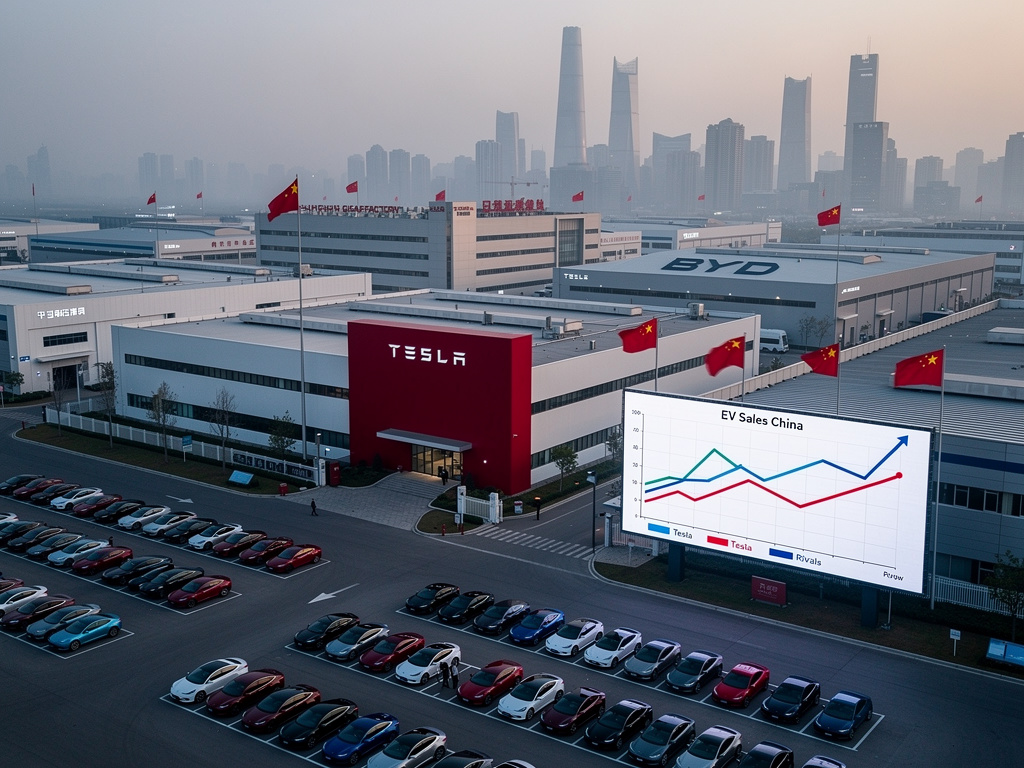
In a market where domestic champions like BYD continue to surge and new entrants multiply by the quarter, Tesla has managed to maintain a competitive position in China-made electric vehicle sales — a feat that speaks to the durability of its brand, the efficiency of its Shanghai Gigafactory, and the strategic recalibrations the company has made to stay relevant in the world’s largest auto market.
According to data reported by CNBC, Tesla has sustained a competitive showing in China-made EV sales despite significant industry headwinds, including intensifying price wars, rising geopolitical tensions, and the relentless expansion of homegrown competitors. The report underscores that while Tesla’s dominance has been challenged, the company has not ceded its position among the top sellers of electric vehicles manufactured on Chinese soil — a distinction that matters enormously for a foreign automaker operating in an increasingly nationalistic consumer environment.
Shanghai Gigafactory: Tesla’s Most Potent Weapon in the East
Tesla’s Shanghai Gigafactory, which came online in late 2019, remains the linchpin of its China strategy. The facility is not only Tesla’s most productive plant globally on a per-unit basis, but it also serves as a critical export hub, shipping Model 3 and Model Y vehicles to markets across Europe and the Asia-Pacific region. The factory’s operational efficiency — characterized by shorter production cycles and lower labor costs compared to Tesla’s Fremont, California facility — gives the company a cost advantage that has proven essential during China’s ongoing EV price war.
The price war, which BYD effectively ignited in early 2023 and which has only intensified since, has forced virtually every automaker in China to slash prices or offer aggressive incentives. Tesla has been an active participant, cutting prices on its Model 3 and Model Y multiple times over the past two years. While these reductions have pressured margins, they have also helped Tesla maintain sales volumes at a time when consumer sentiment toward foreign brands has wavered. Industry analysts have noted that Tesla’s willingness to sacrifice short-term profitability for market share retention has been a calculated gamble — one that appears to be paying off in terms of unit sales, even if it has drawn scrutiny from Wall Street.
BYD’s Shadow Looms Large, But Tesla Carves Out Its Niche
The elephant in the room for any discussion of China’s EV market is BYD, which has transformed from a battery manufacturer into the world’s largest seller of new energy vehicles. BYD’s product lineup spans a vast price range, from the ultra-affordable Seagull — which retails for under $10,000 — to the premium Yangwang U8 SUV. This breadth of offerings gives BYD an almost unassailable position in the Chinese market, where it commands a market share that dwarfs any single competitor. Yet Tesla occupies a distinct segment: the premium, technology-forward niche that Chinese consumers still associate with Silicon Valley innovation and Elon Musk’s personal brand.
That brand equity, however, has become a double-edged sword. Musk’s increasingly prominent role in U.S. politics, particularly his involvement with the Department of Government Efficiency (DOGE) under the Trump administration, has generated backlash in some international markets. In China, where consumer nationalism can shift purchasing decisions overnight, there have been sporadic reports of anti-Tesla sentiment on social media platforms like Weibo. Yet the sales data suggests that this sentiment has not translated into a meaningful decline in purchases. Chinese consumers, particularly in tier-one cities like Shanghai, Beijing, and Shenzhen, continue to view Tesla as a status symbol and a technology leader — a perception reinforced by the company’s advanced driver-assistance features and its Supercharger network.
The Price War Shows No Signs of Abating
China’s EV price war has been one of the most disruptive forces in the global automotive industry. What began as a series of targeted price cuts has evolved into a structural reality: margins across the Chinese EV sector have been compressed to razor-thin levels, and several smaller players have been forced into bankruptcy or consolidation. Companies like NIO, Xpeng, and Li Auto — once heralded as the “Chinese Tesla” — have struggled to achieve consistent profitability, even as their sales volumes have grown. The shakeout has been brutal, and analysts expect it to continue through 2026 and beyond.
For Tesla, the price war has necessitated a delicate balancing act. The company must keep its vehicles competitively priced to maintain volume, but it cannot afford to erode margins to the point where its China operations become unprofitable. Tesla’s vertically integrated supply chain — including its in-house battery production capabilities and its proprietary manufacturing processes like the gigacasting of vehicle underbodies — provides a structural cost advantage that most competitors lack. This advantage has allowed Tesla to participate in the price war without suffering the same degree of financial pain as less efficient rivals.
Geopolitical Crosscurrents Add Complexity
The geopolitical environment has added another layer of complexity to Tesla’s China operations. U.S.-China trade tensions, which have escalated under successive American administrations, have created uncertainty for all foreign companies operating in China. While Tesla has largely been spared from the most punitive measures — in part because its Shanghai factory employs thousands of Chinese workers and contributes to the local economy — the broader climate of distrust between Washington and Beijing creates a persistent background risk.
Tariffs imposed by the U.S. on Chinese-made EVs have not directly affected Tesla’s China sales, but they have reshaped the competitive dynamics of the global EV market. Chinese automakers that might have focused on exporting to the United States have instead doubled down on their domestic market and on markets in Europe, Southeast Asia, and Latin America. This has intensified competition within China itself, as more players fight for a share of a market that, while still growing, is no longer expanding at the breakneck pace of previous years. As reported by CNBC, Tesla’s ability to maintain its competitive position amid these headwinds is a testament to the strength of its brand and the efficiency of its manufacturing operations.
Product Pipeline and the Refreshed Model Y
Tesla’s product strategy in China has also played a role in sustaining its sales performance. The refreshed Model Y, which began deliveries in early 2025, has been well received by Chinese consumers. The updated vehicle features a redesigned interior, improved range, and enhanced technology features that have helped it compete more effectively against domestic rivals like the BYD Song Plus and the NIO ES6. The Model 3 Highland refresh, which launched in late 2023, similarly helped reinvigorate demand for Tesla’s sedan offering.
Looking ahead, Tesla’s planned introduction of a more affordable vehicle — often referred to internally as the “Model Q” or the next-generation compact — could be a game-changer in China. If Tesla can deliver a vehicle priced below 200,000 yuan (approximately $27,500), it would open up a massive segment of the market that is currently dominated by BYD and other domestic brands. The Shanghai Gigafactory is expected to play a central role in the production of this vehicle, leveraging its existing supply chain and manufacturing expertise to achieve the cost targets necessary for such an aggressive price point.
What the Numbers Reveal About Tesla’s Staying Power
The China Passenger Car Association (CPCA) data consistently shows Tesla among the top five sellers of new energy vehicles in China, a remarkable achievement for the only major foreign automaker without a domestic joint venture partner. While Tesla’s market share has declined from its peak — a natural consequence of the market’s rapid expansion and the proliferation of competitive offerings — its absolute sales volumes have remained robust. The company delivered over 600,000 vehicles from its Shanghai factory in 2024, and early indications suggest that 2025 and 2026 production targets remain ambitious.
Insurance registration data, which is often considered a more accurate measure of actual consumer demand than wholesale delivery figures, has also painted a relatively positive picture for Tesla in China. While month-to-month fluctuations are common — often driven by production cycles, seasonal demand patterns, and the timing of price adjustments — the overall trend suggests that Tesla continues to attract a loyal and growing customer base in the Chinese market.
A Foreign Automaker’s Unlikely Resilience
Tesla’s sustained competitiveness in China stands in stark contrast to the struggles of other foreign automakers in the country. Legacy brands like Volkswagen, Toyota, and General Motors have seen their Chinese market shares erode significantly as consumers increasingly prefer domestic EV brands. The shift has been particularly pronounced in the electric and plug-in hybrid segments, where Chinese brands offer a compelling combination of advanced technology, attractive design, and aggressive pricing that legacy foreign automakers have struggled to match.
Tesla’s resilience can be attributed to several factors: its first-mover advantage in the premium EV segment, its direct-to-consumer sales model that bypasses traditional dealership networks, its continuous over-the-air software updates that keep vehicles feeling fresh, and the cult-like brand loyalty that Elon Musk has cultivated among a segment of Chinese consumers. Whether these advantages will prove durable in the face of ever-intensifying competition remains an open question, but for now, the data is clear — Tesla is not just surviving in China’s fiercely competitive EV market, it is holding its own against some of the most formidable competitors the automotive industry has ever seen.


 WebProNews is an iEntry Publication