
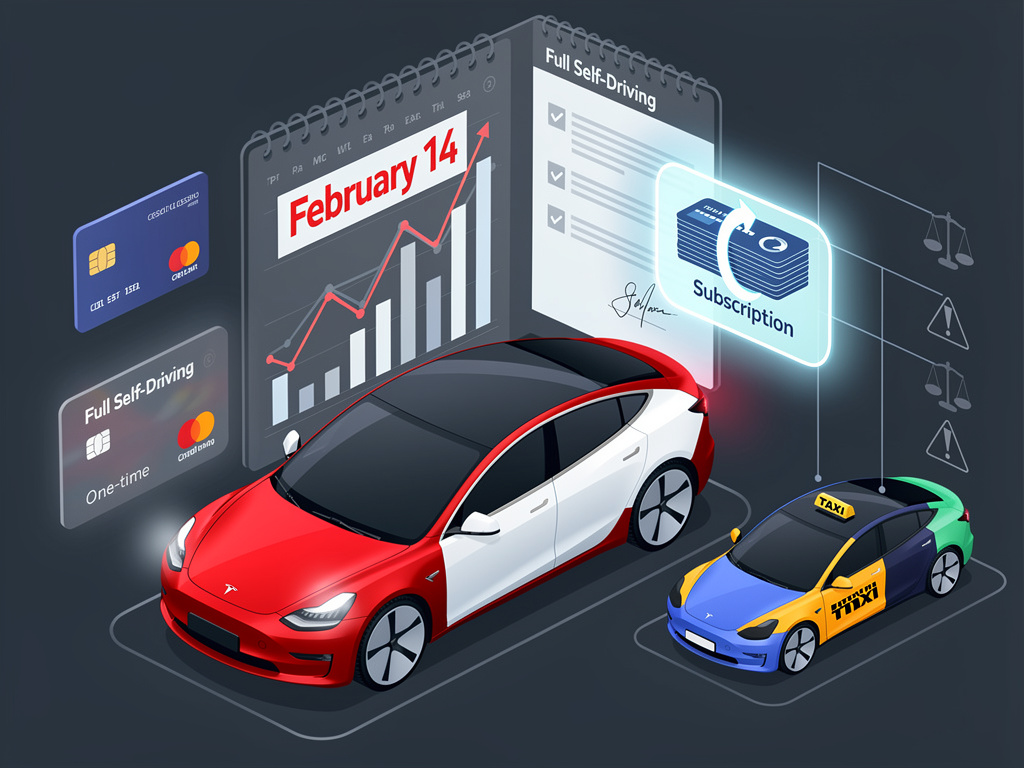
Tesla Inc. is overhauling its Full Self-Driving software model, ending one-time purchases after February 14 and shifting exclusively to monthly subscriptions, Chief Executive Elon Musk announced on X Wednesday. The pivot marks a profound change in how the electric-vehicle maker monetizes its most advanced driver-assistance system, potentially unlocking steadier revenue streams amid intensifying competition and regulatory scrutiny.
Mr. Musk’s post on X stated: “Tesla will stop selling FSD after Feb 14. FSD will only be available as a monthly subscription thereafter.” The move, detailed across multiple outlets, comes as Tesla grapples with lagging behind Alphabet Inc.’s Waymo in robotaxi deployment, with Waymo achieving over 450,000 paid weekly rides in December, according to CNBC.
This subscription-only approach builds on Tesla’s existing $99 monthly FSD plan introduced in the U.S. in April 2024, lowering barriers for trial while aiming to cultivate a vast subscriber base. Existing owners with lifetime FSD licenses retain access, but new buyers face recurring fees, reshaping ownership economics.
Roots of the Subscription Shift
Tesla’s decision stems from years of price volatility for its FSD package, which has swung from $3,000 to $15,000 since 2016. Mr. Musk has repeatedly hiked upfront costs, as seen in his 2020 X post announcing a $1,000 increase worldwide. The subscription model, first teased in 2023 with promises of free trials, now becomes mandatory post-February 14, per TechCrunch.
Industry observers note this aligns with software giants like Adobe Inc. and Microsoft Corp., which transitioned to subscriptions for predictable cash flows. For Tesla, FSD subscriptions could bolster margins as hardware sales face headwinds from rivals such as BYD Co. and legacy automakers ramping electric production.
The timing coincides with Tesla’s push toward unsupervised autonomy. Mr. Musk recently emphasized needing “roughly 10 billion miles of training data” for safe self-driving, underscoring the iterative software nature best suited to recurring payments, as reported by Electrek.
Implications for Musk’s Compensation
Central to the strategy is Mr. Musk’s $1 trillion pay package, tied to milestones including 20 million FSD subscribers by 2030. TechCrunch highlights that halting upfront sales forces subscription growth, directly impacting his eligibility. Tesla’s board approved the package amid shareholder lawsuits, making subscriber metrics pivotal.
Financially, one-time FSD sales generated sporadic revenue spikes, but subscriptions promise annuity-like income. Analysts estimate current FSD take rates below 20%, but easier access could double that, per posts on X from Tesla enthusiasts tracking adoption.
Legal clouds loom large. Tesla faces probes from the National Highway Traffic Safety Administration over FSD crashes and class actions alleging overstated capabilities. A subscription model might mitigate refund risks tied to perpetual licenses, as noted in The Verge.
Competitive Pressures Mount
Waymo’s lead in commercial robotaxis underscores Tesla’s challenges. While Tesla touts billions of real-world miles from its fleet, deployment lags. Mr. Musk’s January X post affirmed focus on FSD improvements, but rivals like Cruise LLC (General Motors Co.) and Zoox Inc. (Amazon.com Inc.) advance amid Tesla’s supervised-only FSD label.
Tesla’s Q1 2024 shareholder update, shared on X, emphasized AI investments including FSD training on billions of miles. The subscription shift could fund this, with Mr. Musk eyeing global rollout post-regulatory nods.
Owner flexibility increases: U.S. drivers can subscribe via the app for $99 monthly, cancellable anytime. This contrasts with prior $8,000-$12,000 upfront costs, potentially boosting uptake among Tesla’s 6 million vehicles, according to Reuters.
Broader Business Model Evolution
Beyond FSD, Tesla eyes robotaxi networks. Mr. Musk envisions owners renting vehicles autonomously, with subscriptions feeding data loops for refinement. A February 2024 X announcement slashed U.S. pricing to $99, sparking trial surges.
Critics question FSD readiness. Despite version 12.5’s end-to-end neural nets, incidents persist, fueling skepticism. Bloomberg reports the switch aims to sustain R&D amid stock volatility, with TSLA shares dipping post-announcement.
Global expansion hinges on approvals. Mr. Musk pledged trials beyond North America once local adaptation proves viable, per his 2023 X comments. Europe and China, key markets, demand compliance with stringent rules.
Investor and Regulatory Horizons
For investors, recurring FSD revenue diversifies from auto sales, mirroring SaaS valuations. Electrek calls it a “big move,” potentially valuing Tesla closer to tech peers. Yet, Musk’s trillion-dollar aspirations rest on execution.
Regulators watch closely. The U.S. Senate probes autonomous tech safety, while California mandates reporting. Tesla’s transparency push, including algorithm disclosures, may aid subscription legitimacy, as Musk hinted on X.
Owners react mixed on X: excitement for affordability battles wariness over dependency. As February nears, Tesla’s bet on subscriptions tests its autonomy ambitions against real-world execution.


 WebProNews is an iEntry Publication