
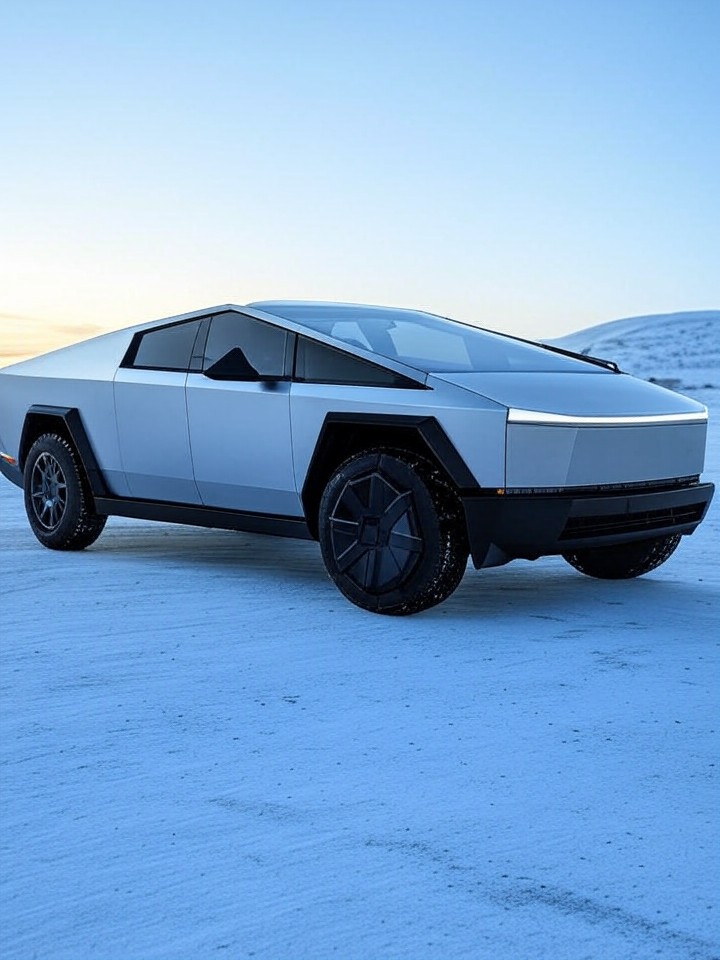
Cybertruck’s Fading Spark: Elon Musk’s Bold Bet Meets Market Reality
Tesla Inc.’s Cybertruck, once heralded as a revolutionary force in the electric vehicle sector, is grappling with a stark downturn in sales that underscores broader challenges for the company under CEO Elon Musk. Recent data from Cox Automotive reveals that U.S. registrations for the angular pickup truck plummeted by more than 68% in the fourth quarter of 2025 compared to the previous year, painting a picture of waning consumer interest. This decline comes despite Musk’s pre-launch projections of 250,000 annual units, a target that now seems increasingly out of reach as production ramps up but demand falters.
The figures are telling: In 2025, Tesla managed to sell around 62,000 Cybertrucks globally, far short of expectations. Industry analysts point to a combination of factors, including the vehicle’s polarizing design, high price point starting at over $100,000 for top models, and lingering quality issues that have plagued early adopters. Reports of rusting panels and software glitches have circulated widely, eroding confidence among potential buyers who might otherwise embrace Tesla’s innovative ethos.
Musk, ever the optimist, has defended the Cybertruck on social media, calling it Tesla’s “best vehicle ever.” Yet, the numbers contradict this narrative. According to estimates shared in a Business Insider report, fourth-quarter registrations dropped to levels not seen since the truck’s initial rollout, highlighting a disconnect between hype and reality.
Market Pressures and Competitive Dynamics
Beyond the Cybertruck’s specific woes, Tesla faces intensifying rivalry in the electric pickup arena. Ford’s F-150 Lightning, for instance, has edged out the Cybertruck in U.S. sales for 2025, with data from Cox Automotive showing Ford’s model capturing a larger share of the burgeoning EV truck market. This shift is partly attributed to Ford’s established reputation in trucks and more accessible pricing, which appeals to traditional pickup buyers wary of Tesla’s futuristic aesthetic.
Posts on X, formerly Twitter, reflect growing sentiment among consumers and investors alike, with many expressing disappointment over the Cybertruck’s performance. Users have noted sales figures that align with Cox’s data, suggesting a broader backlash against Musk’s leadership style and public persona, which some believe has alienated potential customers. This online chatter underscores how social media amplifies perceptions, turning minor issues into major hurdles for brand loyalty.
Tesla’s overall deliveries also suffered in 2025, with a 16% drop in the fourth quarter to 418,227 vehicles, as reported by CNBC. This marks the company’s worst fourth quarter since 2022 and contributes to a second consecutive year of declining annual sales. The Cybertruck, intended as a flagship product to bolster Tesla’s lineup, has instead become a symbol of overambition amid economic headwinds like rising interest rates and consumer caution.
Elon Musk’s Vision Versus Execution Challenges
Musk’s ambitious targets for the Cybertruck date back to its 2019 unveiling, where he promised a game-changer capable of outselling rivals like the Ford F-150. However, production delays and scaling issues delayed widespread availability until late 2023, by which time market conditions had shifted. Inflation and supply chain disruptions further complicated matters, inflating costs and extending wait times for buyers.
Analysts from Wolf Street have labeled the Cybertruck a “failed model,” drawing parallels to historical automotive flops like the Ford Edsel. They estimate Tesla’s development losses at around $1 trillion, a staggering figure that highlights the financial risks of Musk’s high-stakes bets. While Tesla’s stock has shown resilience, trading near levels comparable to Microsoft, options markets indicate volatility, with puts suggesting a potential 90% collapse within a year.
The backlash extends to Musk himself, whose political statements and management decisions have drawn scrutiny. A piece in Axios notes that vehicle sales are crucial for funding Musk’s AI ambitions, yet declining revenues could jeopardize projects like the Optimus robot and Cybercab autonomous vehicle. This interplay between Tesla’s core automotive business and its futuristic ventures raises questions about resource allocation.
Global Implications and EV Market Shifts
On a global scale, Tesla’s struggles are magnified by competitors like China’s BYD, which surpassed Tesla as the world’s top EV seller in 2025, according to The New York Times. BYD’s success stems from affordable models and aggressive expansion, contrasting with Tesla’s premium positioning. The elimination of federal EV incentives in the U.S. has hit Tesla harder, as its higher-priced vehicles rely more on such subsidies to attract buyers.
Domestically, Tesla’s U.S. sales hit a near four-year low in November 2025, despite introducing cheaper variants, as detailed in a Reuters exclusive. Cox Automotive data cited there shows registrations for models like the Cybertruck lagging, even as the broader EV market grows modestly. This suggests Tesla-specific issues, including brand fatigue and saturation in key segments.
Looking ahead to 2026, projections from Cox Automotive anticipate a 2.4% decline in overall new-vehicle sales to 15.8 million units, with EVs facing headwinds. However, some optimism persists for Tesla, with Benzinga reporting the Model Y as the top-selling EV in the U.S. for 2025, despite a 15% Q4 dip. This resilience in other models could provide a buffer, but the Cybertruck’s underperformance remains a drag.
Strategic Pivots and Future Prospects
In response, Tesla is eyeing production adjustments and potential price cuts to stimulate demand. Musk has teased updates, including enhanced autonomy features, but skepticism abounds given past delays. A Business Insider analysis outlines key deadlines for 2026, such as Cybercab volume production and a Roadster demo, which Musk must meet to restore investor confidence.
Critics argue that Tesla’s pivot toward robotaxis and AI, as explored in a CNN Business article, distracts from core automotive strengths. The robotaxi service remains largely conceptual, yet it’s driving Tesla’s valuation, creating a precarious balance. Shareholders are riding a wave of promises, but tangible results are needed to sustain momentum.
Industry insiders speculate that Tesla may need to rethink the Cybertruck’s positioning, perhaps through targeted marketing or variants tailored to commercial fleets. Posts on X indicate mixed sentiments, with some users praising the truck’s durability while others decry its impracticality for everyday use. This feedback loop could inform future iterations, but time is of the essence as competitors advance.
Investor Sentiment and Broader Economic Ties
Investor reactions have been mixed, with Tesla’s stock experiencing fluctuations tied to sales reports. The dramatic miss on 2025 Cybertruck targets, as highlighted in CleanTechnica, revives debates over Musk’s forecasting accuracy. Originally, reservations exceeded 2 million, suggesting years of backlog, yet actual sales in Q2 2025 dipped to just 4,300 units, per Fortune.
This pattern of overpromise and underdelivery isn’t new for Tesla, but the Cybertruck’s case amplifies concerns amid a cooling EV market. Economic factors, including higher borrowing costs, have made big-ticket purchases like the Cybertruck less appealing, exacerbating the decline.
For industry observers, the Cybertruck saga serves as a case study in innovation risks. While Musk’s vision has propelled Tesla to prominence, sustaining growth requires adapting to market realities. As 2026 unfolds, Tesla’s ability to course-correct will determine whether the Cybertruck becomes a footnote or a comeback story.
Lessons from Historical Parallels and Path Forward
Drawing from automotive history, the Cybertruck’s trajectory echoes vehicles that prioritized novelty over utility. Yet, Tesla’s ecosystem—encompassing charging networks and software updates—offers unique advantages that could revive interest. Analysts suggest bundling incentives or expanding into new markets to boost uptake.
Musk’s influence remains a double-edged sword; his endorsements can spark rallies, but controversies deter buyers. A USA Today piece questions Musk’s claim of the Cybertruck as Tesla’s pinnacle, given contradicting sales data.
Ultimately, the path forward hinges on execution. With looming deadlines and competitive pressures, Tesla must balance ambition with pragmatism to reclaim its edge in the electric vehicle domain. The Cybertruck’s story is far from over, but its current chapter warns of the perils of unchecked optimism in a demanding market.


 WebProNews is an iEntry Publication