
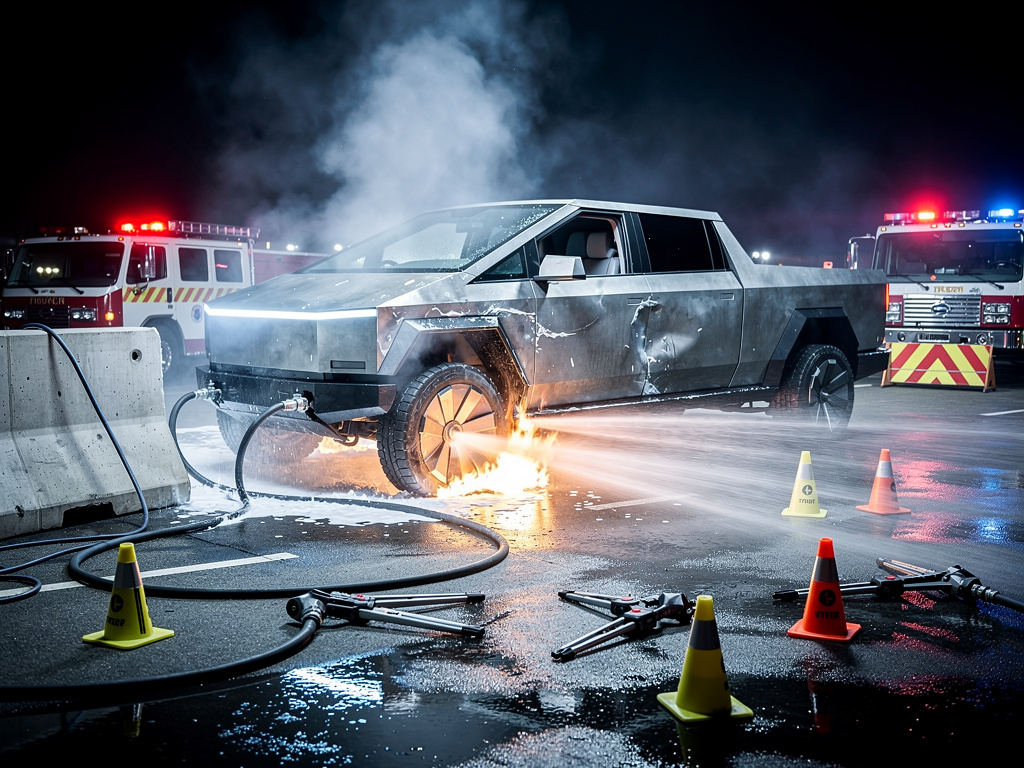
The Cybertruck Inferno: Why Tesla’s Futuristic Pickup is Igniting Fears Among First Responders
In the evolving world of electric vehicles, Tesla’s Cybertruck stands out with its angular, stainless-steel exoskeleton and promises of indestructibility. But recent incidents have cast a shadow over this bold design, particularly when it comes to fire safety and the challenges it poses to firefighters. Reports from various crashes and blazes reveal a vehicle that, while marketed as apocalypse-proof, may trap occupants and complicate rescue efforts in emergencies. Drawing from accounts in publications like The Washington Post and Futurism, these events underscore a growing concern: the Cybertruck’s innovative features could be turning routine responses into high-stakes battles against time and flames.
One chilling example emerged from a November 2024 crash in Piedmont, California, where a Cybertruck veered off the road, struck a tree, and erupted in flames, claiming the lives of three people. According to a report highlighted in The Washington Post, firefighters cited “poor access” as a key factor hindering their ability to extinguish the fire. The vehicle’s lithium-ion battery pack, known for its potential to ignite in intense, chain-reaction blazes, burned longer and hotter than typical vehicle fires. Experts note that such EV fires can reach temperatures exceeding 5,000 degrees Fahrenheit, disintegrating materials and complicating containment.
Tesla has denied responsibility in legal filings related to the Piedmont incident, asserting that the Cybertruck met safety standards and that misuse or poor maintenance may have contributed. Yet, lawsuits are mounting, alleging defective design elements that trap passengers during crises. In another case from August 2024, a Cybertruck in Harlingen, Texas, collided with a fire hydrant and burned for 90 minutes, as detailed in Road & Track. The prolonged burn time required extensive resources, highlighting how EV batteries demand specialized tactics, such as massive water volumes or foam suppressants, to quell thermal runaway.
Design Flaws Under Scrutiny
The Cybertruck’s doors, which lack traditional handles and rely on electronic latches, have become a focal point of criticism. In emergencies, if the vehicle’s power fails, occupants must locate a hidden manual release—a process that’s not intuitive and often unlabeled. This issue was explored in depth by Futurism, which described the truck as a “firefighter’s nightmare” due to its baffling emergency features. Posts on X from firefighters echo this sentiment, with one paramedic-firefighter stating that the lithium batteries make extractions extremely difficult, refusing to ride in one personally.
Further complicating matters is the Cybertruck’s gigacast aluminum underbody and ultra-hard steel panels, which resist cutting tools commonly used in rescues. Firefighters trained on conventional vehicles find their hydraulic jaws and saws inadequate against this fortified structure. A Reddit thread on r/electricvehicles, discussing multiple Cybertruck fires in 2024, pointed out that while EVs overall have lower fire rates than internal combustion engines—about 25 per 100,000 versus 1,530—the intensity of those fires poses unique hazards.
Industry experts, including Phil Koopman, a professor emeritus at Carnegie Mellon University, have labeled the inability to escape or access the Cybertruck post-crash as a “disastrous design failure.” In a post on X, Koopman emphasized how these elements exacerbate risks during fires. Lawsuits, such as one filed after a deadly fire in Texas, claim Tesla’s futuristic features prioritize aesthetics over safety, leading to preventable deaths.
Real-World Incidents Pile Up
Recent news amplifies these concerns. A December 2025 report from PennLive noted that the National Highway Traffic Safety Administration is investigating claims about the hidden mechanical door releases. This probe follows at least a dozen cases since 2019 where Tesla passengers struggled to exit during emergencies. One X post from a user described a Cybertruck crash where survivors faced an inferno, with doors failing and fires raging uncontrollably.
In Colorado, a Cybertruck towing a woodchipper sparked a half-acre grass fire in June 2025, as covered by EVXL. The multi-agency response underscored the broader environmental risks of unchecked EV blazes. Firefighters reported using over 50,000 gallons of water in some Tesla Semi fires, a tactic that’s resource-intensive and environmentally taxing, especially in water-scarce areas.
Comparisons to other EVs reveal the Cybertruck’s outliers. While hybrids and full EVs have higher fire rates in some stats—3,475 per 100,000 for hybrids—Cybertruck incidents seem disproportionately problematic due to its size and battery density. A post on X from a firefighter highlighted the immense energy transfer in crashes, noting how the truck’s build disproportionately affects other vehicles and occupants.
Evolving Firefighting Strategies
Fire departments are adapting, but the Cybertruck accelerates the need for change. Training programs now emphasize EV-specific hazards, like the risk of reignition hours after initial extinguishment. In Belgium, a hybrid vehicle fire in 2023 nearly caused a catastrophe, as shared in an X post advocating for national guidance on lithium battery incidents. U.S. firefighters, per accounts on X, are pushing for similar protocols.
Tesla has reached out to some fire departments, providing information on vehicle access points, as mentioned in a years-old piece by a journalist on X. However, critics argue this is insufficient. The company’s new safety website, launched in December 2025 and reported by Repairer Driven News, promotes doors that automatically unlock in collisions—a feature timed suspiciously before a Bloomberg investigation into 15 Tesla-related deaths.
Yet, skepticism remains. An X post from a safety expert questioned whether these updates address core issues like the monowiper’s engineering failures, now under Tesla’s investigation as per Not a Tesla App. While not directly fire-related, such flaws hint at broader quality concerns that could indirectly impact emergency responses.
Legal and Regulatory Pressures Mount
Lawsuits are proliferating, with families alleging negligence in design. A case detailed in AA Law claims the Cybertruck poses higher fire risks than other vehicles, leading to severe injuries or fatalities. Tesla’s responses often shift blame to users, but this hasn’t quelled public outcry.
Regulatory bodies are stepping in. The NHTSA’s probe could lead to recalls or mandates for clearer emergency instructions. Meanwhile, sentiment on X reflects growing wariness, with users sharing stories of near-misses and calling for bans on subsidized EVs that prioritize innovation over safety.
Firefighters’ unions and safety advocates are lobbying for standardized EV training and equipment upgrades. One X post from a conservative commentator even suggested banning EVs outright, citing unlawful government favors that brought them to market.
Broader Implications for EV Adoption
As Tesla pushes boundaries, the Cybertruck’s troubles could slow EV adoption. Consumers, informed by media reports and social media buzz, may hesitate over safety perceptions. An X thread discussed how ICE vehicles, despite higher fire frequencies, are easier to handle in emergencies due to familiar designs.
Innovation must balance with practicality. Tesla’s apocalypse-proof marketing, as critiqued in Futurism, may appeal to enthusiasts but alienates first responders who deal with real-world consequences.
Looking ahead, collaboration between automakers and emergency services is crucial. Tesla’s outreach is a start, but comprehensive reforms—like visible manual releases and easier access points—could mitigate risks.
Toward Safer Electric Horizons
The Cybertruck’s saga serves as a cautionary tale in the rush toward electrification. While EVs promise environmental benefits, their fire dynamics demand respect. Firefighters, adapting to these challenges, emphasize preparation over panic.
Incidents like the Hartford crash on Christmas 2025, where a Cybertruck driver fled after a fatal collision as reported in CT Insider, add layers to the narrative, blending fire risks with human error.
Ultimately, resolving these issues requires transparency from Tesla and proactive measures from regulators. As more Cybertrucks hit roads, ensuring they don’t become rolling hazards will define the future of automotive safety. Firefighters, on the front lines, hope for designs that aid, rather than hinder, their lifesaving work.


 WebProNews is an iEntry Publication