
JB Straubel doesn’t mince words. “I think we should be really worried,” the Tesla cofounder told attendees at Fortune’s Brainstorm Tech conference in Aspen on June 9. “I think the grid can’t handle it.” The pace of growth and demand for energy is unprecedented, he added. Straubel, who left Tesla in 2019 to launch Redwood Materials, the battery recycling and materials company he now leads as CEO, sees trouble ahead for American ambitions in artificial intelligence.
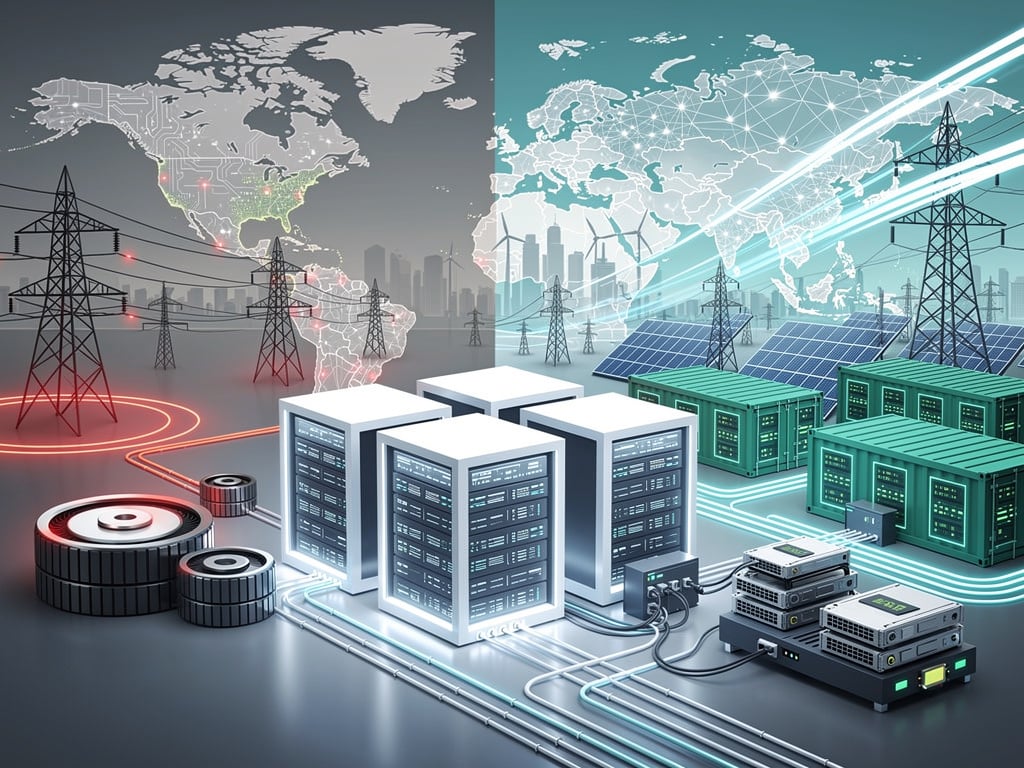
Data centers hungry for electricity to train and run ever-larger models are straining an aging electrical system. Projections show U.S. data-center consumption climbing from 176 terawatt-hours in 2023, or 4.4 percent of national electricity use, to between 325 and 580 terawatt-hours by 2028. That range equals 6.7 to 12 percent of total power. Some regions already face delays. Others scramble for alternatives. And China? It moves faster on building the generation, storage and grid upgrades needed to support its own AI surge.
Straubel’s alarm lands at a moment when the gap appears to widen. Beijing invests twice as much as Washington in power plants, storage and transmission, according to recent analyses. Its manufacturers dominate battery production and related supply chains. The United States, meanwhile, wrestles with permitting delays, local opposition to new lines and the sheer time required to bring massive new capacity online. The result is a race where one side seems stuck in the starting blocks.
Yet Straubel isn’t merely sounding an alert. Through Redwood, he pushes practical fixes. The company has pivoted hard into energy storage. It repurposes used electric-vehicle batteries — many still holding 50 percent or more of their original capacity — for second-life applications. These packs form the backbone of microgrids tailored for data centers. One early project with Crusoe Energy delivers 12 megawatts of solar power backed by 63 megawatt-hours of storage. It stands as the largest such system in North America using repurposed EV batteries. Redwood calls the approach a direct response to surging demand that traditional grid infrastructure cannot meet quickly enough.
The numbers behind the opportunity are staggering. Redwood receives more retired EV batteries than it can currently process. “It’s so much bigger even than our current ability to process,” Straubel said in a recent interview. “That almost keeps me up at night, because I’m, like, geez, we have to scale by 10 times just to be able to do what’s in the market now even if EV sales stayed flat for the next 10 years.” The flood of incoming material gives the company a domestic feedstock that sidesteps some reliance on freshly mined minerals controlled largely overseas.
Investors have taken notice. Redwood’s valuation topped $6 billion after fresh funding rounds that included participation from Google. The company raised hundreds of millions more specifically to accelerate its grid-scale storage business. Partnerships with automakers such as General Motors aim to build utility-scale systems manufactured entirely in the United States. These efforts target exactly the kind of flexible, rapidly deployable capacity that data-center operators need when grid connections lag.
But second-life batteries represent only one piece. Straubel and others in the industry stress the need for far more new generation, transmission upgrades and policy changes that speed construction. PJM Interconnection, the nation’s largest grid operator, has warned of potential supply shortfalls reaching 60 gigawatts in coming years. Blackouts could appear as soon as 2027 in stressed areas. Natural-gas plants fill some gaps, yet they clash with decarbonization targets. Renewables arrive too slowly without storage to balance their intermittency.
China’s advantages extend beyond investment scale. It controls the majority of global refining for lithium, cobalt, graphite and other battery inputs. Its factories produce most of the world’s battery cells. And its grid modernization incorporates digital controls and power electronics at a pace that leaves U.S. utilities playing catch-up. A Carnegie Mellon University analysis from May 2026 highlighted risks from dependence on Chinese-linked technologies in battery management systems, inverters and grid orchestration software. The paper urged faster domestic development without slowing overall build-out.
American responses have gained momentum. The Inflation Reduction Act poured billions into clean-energy manufacturing, though political shifts and potential rollbacks create uncertainty. Battery storage additions hit records last year, with 18.9 gigawatts installed nationwide. California briefly drew 43 percent of its power from batteries during peak moments. Yet these gains feel incremental against the AI-driven surge. International Energy Agency forecasts show global data-center electricity demand doubling to 945 terawatt-hours by 2030, with the United States and China accounting for nearly 80 percent of that growth.
Straubel’s Redwood sits at the intersection of these forces. Its original mission — recycling lithium-ion batteries to recover lithium, nickel, cobalt and other materials — now feeds directly into stationary storage. By keeping these materials in domestic loops, the company reduces exposure to volatile global markets dominated by Beijing. Executives emphasize that the midstream segment of the battery supply chain, where materials are processed and components assembled, deserves urgent policy focus. Without it, recycled content risks being shipped overseas for refinement.
Critics argue the United States cannot simply tariff or regulate its way out of the deficit. It must build. That means reforming permitting for transmission lines that often take a decade or more to complete. It means accepting some trade-offs on environmental reviews. And it means treating grid expansion with the urgency once reserved for wartime production. Reports on battery minerals describe the situation as demanding a “wartime footing” to rebuild processing capacity and reduce vulnerabilities in defense, infrastructure and civilian power.
Still, optimism flickers in the details. Long-duration storage technologies offer one avenue for the U.S. to differentiate itself. While China leads in scale of deployment, America hosts a wider array of emerging chemistries and designs. Analysts at BloombergNEF note that this technological diversity could prove advantageous if paired with faster commercialization. Redwood’s bet on second-life systems fits that pattern — taking existing assets and squeezing more value from them rather than waiting for perfect new solutions.
The AI boom won’t pause for grid planners. Hyperscalers already sign deals for dedicated power plants, build their own generation or locate in regions with surplus capacity. Some explore nuclear restarts or small modular reactors, though those projects face their own timelines. Others turn to behind-the-meter storage to smooth demand spikes. Straubel’s message carries a hint of frustration mixed with determination. The technology exists. The materials flow in growing volumes. What lags is the collective will and regulatory speed to connect them at scale.
Conversations at industry gatherings now routinely circle back to these constraints. Executives swap stories of multi-year waits for interconnection queues. Utility forecasters revise load projections upward every quarter. And throughout it all, China’s power sector adds capacity that dwarfs incremental U.S. gains. The disparity raises strategic questions that extend beyond economics. Reliable, affordable electricity underpins everything from national defense to technological leadership.
Straubel’s company continues to expand its footprint in Nevada and beyond. New factories process battery scrap and end-of-life packs. Energy-storage products roll out for commercial and utility customers. Each deployment proves that creative reuse can deliver real megawatts without the full environmental cost of new mining. But even Straubel acknowledges the limits. Scaling tenfold remains a formidable task. The grid upgrade required to support widespread AI infrastructure will test American ingenuity and political resolve like few challenges before it.
Whether policy makers heed the warning remains uncertain. What is clear is the stakes. Fall too far behind, and the United States risks ceding ground not only in batteries but in the computational power that increasingly defines economic and military strength. Straubel put it plainly in Aspen. The grid can’t handle it. Time is short. The race is on.


 WebProNews is an iEntry Publication