
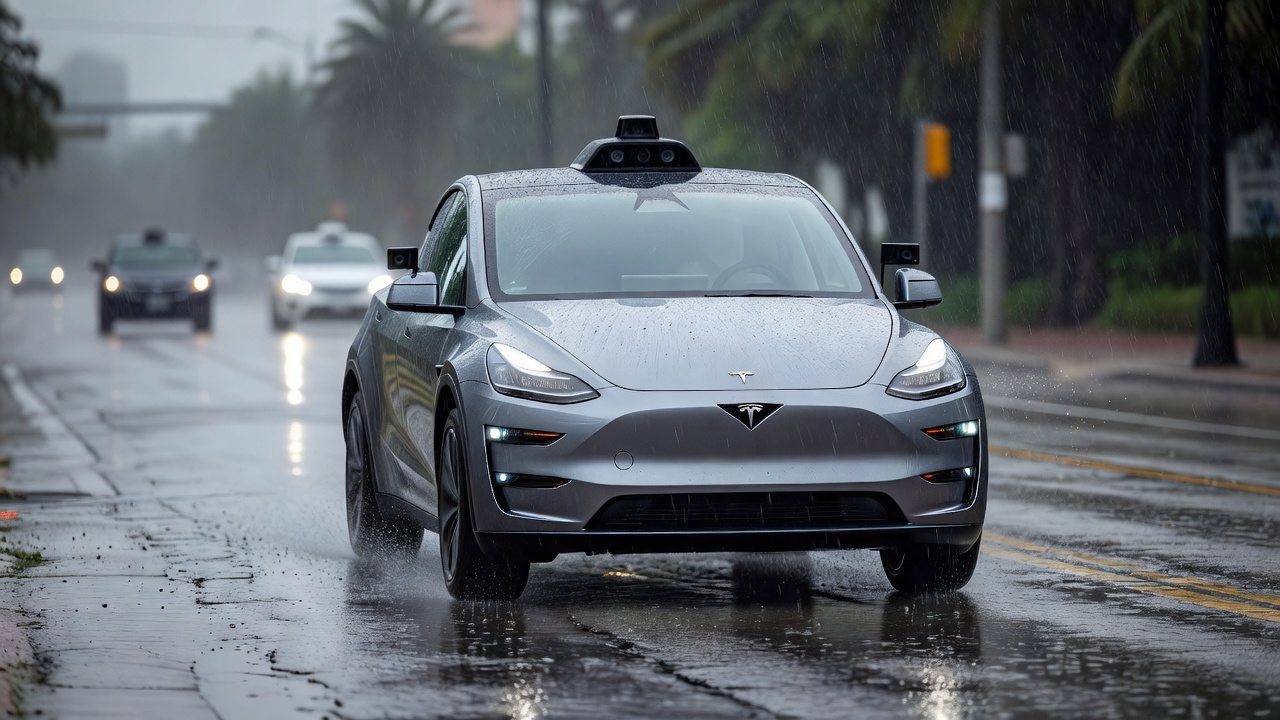
Tesla has rolled out its robotaxi service in Miami. The announcement came July 3 via the company’s official robotaxi account on X with a simple declaration. “Robotaxi now available in Miami.”
Just like that the electric vehicle maker entered its third state with fully driverless operations. Florida joins Texas and California. And unlike earlier cautious steps the cars in Miami operate without safety monitors from day one. Reuters first reported the launch details.
Ashok Elluswamy confirmed the unsupervised status within hours. As Tesla’s vice president of AI software he posted on X that the vehicles run without any human in the front seat. Riders must download a dedicated Robotaxi app for iOS or Android. Expect a waitlist. The pattern mirrors how Tesla introduced access in Austin Dallas and Houston.
The initial service area covers roughly 10 to 14 square miles in western and central Miami-Dade County. It includes West Miami Doral and a slice of Coral Gables. Miami International Airport falls inside the zone. Major roads such as SR 826 the Palmetto Expressway US 41 the Tamiami Trail and connectors like SR 968 953 959 and 972 define the boundaries. Teslarati mapped the geofence based on the announcement.
Notice what’s missing. Downtown Miami. Brickell. Wynwood. The Design District. Miami Beach. Those popular spots sit outside the current boundaries. Riders heading to the beach or nightlife hubs will need to wait for future expansion. One early X post captured the frustration. “Tesla’s Miami Robotaxi Is Here But You Can’t Ride It to the Beach.”
Yet the launch still marks progress. Tesla started unsupervised rides in Austin last month after months of monitored operations. The company pushed back timelines for several cities earlier this year according to reports. Miami arrives as the map grows faster than the visible fleet. Tesla has not disclosed exact vehicle numbers for the new market. In Texas the fleet hovers around 20 cars in some accounts. Competitors operate hundreds.
Florida’s weather immediately tests the system. Heavy rain and glare pose the hardest challenge yet for Tesla’s camera-only approach. The setup relies on vision rather than the lidar and radar mix used by Alphabet’s Waymo or Amazon’s Zoox. Federal regulators have questioned the technology’s performance in degraded visibility. A National Highway Traffic Safety Administration review launched in March examined FSD incidents tied to such conditions across millions of vehicles. TechTimes highlighted the stakes for the Miami deployment.
But videos from early riders show capability. One clip posted on X captured an unsupervised Model Y navigating flooded roads in Miami. “Very well done” wrote the poster. Another user shared footage of the first rides. The cars handle turns traffic and sudden downpours with the poise that has defined recent Tesla autonomy demonstrations.
Elon Musk has set bold expectations. He anticipates wider availability of fully self-driving cars across the U.S. by the end of the year. The robotaxi push forms a core part of that vision. Paid robotaxi miles nearly doubled in the first quarter of 2026 though the company still scales cautiously.
Competition intensifies. Waymo operates a much larger fleet in Texas and maintains broader coverage in multiple cities. Zoox accelerates its own ride-hailing efforts. Both boast more established driverless networks in select markets. Tesla’s bet remains on rapid software iteration and a vast existing vehicle base that could one day join the network. For now the dedicated Cybercab production vehicles remain limited. Modified Model Ys fill the gap in Miami.
Regulatory tailwinds help in Florida. The state maintains permissive rules for autonomous vehicles. No human driver required if the technology meets safety thresholds. That environment allowed the unsupervised launch. Other planned cities for the second half of 2026 include Orlando Tampa Phoenix and Las Vegas. Each brings unique hurdles. Orlando’s tourist crowds. Tampa’s storms. Phoenix’s heat and sprawl.
Analysts watch the economics. Morgan Stanley projected Tesla could operate 1,000 robotaxis by year end. Revenue potential grows if utilization rates climb and wait times shrink. Current users in Austin report variable availability. Miami starts small. The geofence keeps operations contained while data accumulates.
Critics point to past delays. Tesla once promised robotaxis years earlier. Regulatory scrutiny safety incidents and software hiccups slowed the timeline. Yet the company has delivered incremental wins. Unsupervised operation in multiple cities this year counts as one. Zero at-fault robotaxi accidents in Austin since February according to NHTSA data offers reassurance.
So what happens next. Tesla must expand the Miami map to capture more demand. Integrate real user feedback to refine the FSD model. Prove the camera system holds up through Florida’s rainy season. And scale the fleet without compromising the safety record that has become its calling card.
Early signs point to ambition. The launch came during what some called Tesla’s “long weekend” of announcements. Miami joined Austin Dallas Houston San Antonio and the Bay Area in quick succession. The network now spans five markets with unsupervised rides in several.
Drivers and passengers alike test the service. Some post smooth experiences. Others note long waits or limited routing. One video showed a nightmare start to a ride yet the poster saw resilience in the decision to launch quickly. “If you’re not embarrassed then you waited too long to launch.”
Tesla’s approach differs from rivals. It skips the heavy sensor suite. Trusts neural networks trained on billions of miles of real-world data. Iterates fast through over-the-air updates. The strategy carries risk but also the potential for lower costs and faster geographic spread.
Miami offers the perfect proving ground. Congested roads. Unpredictable weather. Tourists unfamiliar with local driving norms. An international airport feeding constant traffic. If the robotaxis master this environment they gain credibility.
The coming weeks will reveal more. Fleet growth inside the geofence. User adoption numbers. Any incidents that draw fresh regulatory eyes. Updates from Elluswamy and Musk on X. And whether those beach-bound trips finally become possible.
For now the cars roll. Cameras scan. Passengers ride alone. And an industry watches to see if vision-only autonomy can deliver on the promise in one of America’s most demanding cities.


 WebProNews is an iEntry Publication