
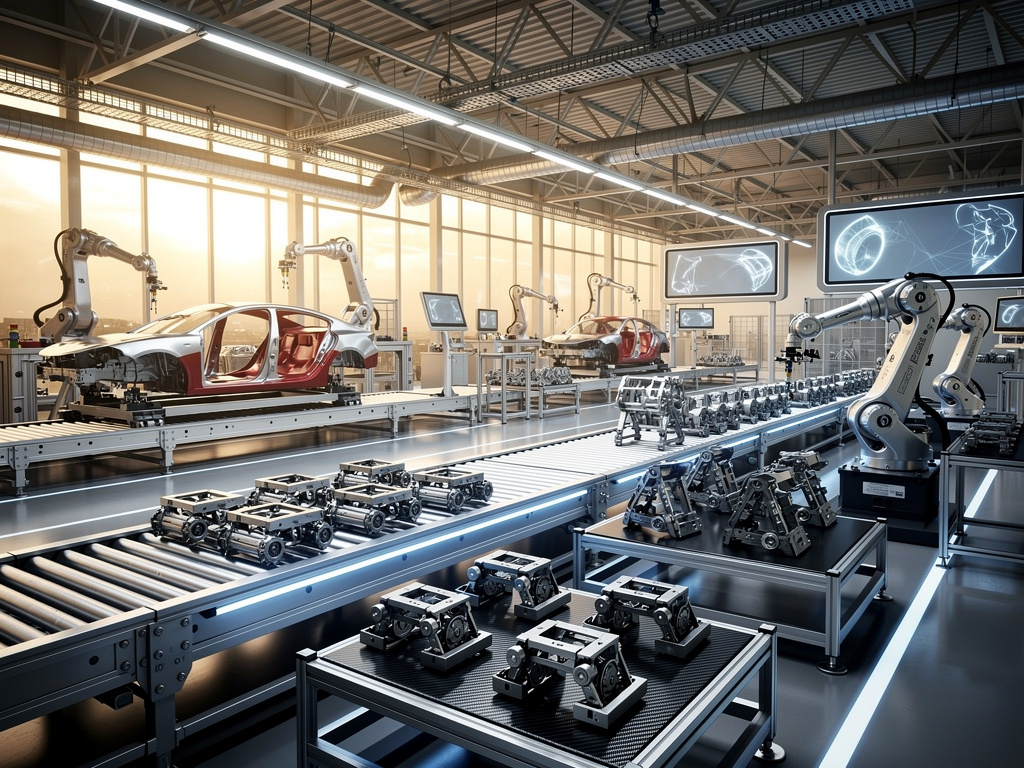
Tesla Inc. is shuttering production of its flagship Model S sedan and Model X SUV next quarter, reallocating the prized Fremont factory lines to churn out Optimus humanoid robots, Chief Executive Elon Musk announced Wednesday during the company’s Q4 2025 earnings call. The move marks a pivotal shift from legacy electric vehicles to artificial intelligence-driven robotics, as Tesla grapples with softening EV demand and bets big on automation’s promise.
“It’s slightly sad, but it is time to bring the S and X program to an end. It’s part of our overall shift to an autonomous future,” Musk said, according to Teslarati. The decision comes as Tesla’s automotive sales dipped in 2025, with global EV leadership ceded to BYD, prompting executives to prioritize high-margin ventures like Optimus.
Fremont, Tesla’s original California plant acquired from Toyota and Numly Inc. in 2010, has long housed the Model S and X assembly lines known internally as GA1. These lines, operating below capacity for years, will now transition to Optimus production, accelerating the humanoid robot’s ramp from pilot stages to mass output.
Fremont’s Pivot to Robotics
Tesla’s Fremont facility already runs a pilot Optimus line, with units deployed for internal tasks like battery cell sorting. Musk envisions 1 million Optimus robots annually from Fremont alone, followed by a 10 million-unit line at Giga Texas. “We expect to have thousands of Optimus robots working in Tesla factories by the end of this year,” Musk stated during the Q1 2025 earnings call, per Teslarati.
The conversion aligns with Tesla’s “Physical AI” strategy, where Optimus Gen 3 leverages Full Self-Driving neural networks for unscripted factory work. Over 1,000 units are already navigating Giga Texas and Fremont battery lines, identifying components and performing kitting, as detailed in a FinancialContent report from January 16, 2026.
Challenges persist: Optimus faced delays in 2025 due to redesigns, overheating motors, and teleoperation reliance, leading to the exit of program head Milan Kovac, Electrek reported. Musk tempered expectations, warning production would be “agonizingly slow” initially before scaling rapidly, according to InsideEVs.
Model S and X Legacy Ends Honorably
Launched in 2012, Model S pioneered the luxury EV segment with up to 410 miles of range and Plaid variants exceeding ludicrous speed. Model X, with its falcon-wing doors, added family utility. Yet sales lagged mass-market Model 3 and Y, prompting Musk to once call their continuation “sentimental,” as noted in Tesla Motors Club forums referencing past earnings calls.
Tesla pledged ongoing support for existing owners, including software updates and service. Recent 2026 models featured simplified suspension controls and quieter cabins, but inventory now dominates configurators in regions like Europe and Israel, signaling wind-down, per NotATeslaApp.
“If you’re interested in buying a Model S or X, it’s best to do it now,” Musk advised, echoing Teslarati coverage. Production halts in Q2 2026 free capacity amid Tesla’s 89% factory utilization drop from 2021 peaks, as Manufacturing Today analyzed.
Optimus: Tesla’s Trillion-Dollar Wager
Musk projects Optimus as Tesla’s “biggest product ever,” potentially eclipsing vehicles with $20,000-$30,000 pricing at scale. Gen 3 boasts 22 degrees of freedom in hands, 20-hour battery life, and end-to-end neural nets trained on human video data, targeting factory drudgery before household chores.
Tesla aims for 50,000 units by end-2026, with Fremont’s Line One as hub. Giga Texas construction for 10 million annual capacity began late 2025. “Optimus will eliminate poverty and provide universal high income,” Musk posted on X in November 2025, fueling a $1.39 trillion valuation heavily tied to robotics and autonomy, per InsideEVs.
Investor Jason Calacanis praised early Gen 3 demos at CES 2026 as “eye-opening,” while skeptics highlight falls in demos and unproven real-world autonomy, as Fortune covered. Competition from Figure 01 and Boston Dynamics intensifies.
Financial Pressures Driving the Switch
Tesla’s FY 2025 revenues hit $94.8 billion, with automotive at $69.5 billion but net income at $3.8 billion amid price cuts and competition. Q4 call highlighted Optimus and Cybercab as growth engines, with a $2 billion xAI investment to bolster AI, disclosed in shareholder decks.
Stock reactions were mixed post-announcement, as X posts from analysts like @scottbudman noted the pivot. Musk’s vision: Optimus scales faster than any product, reaching millions yearly in under five years.
Fremont’s retooling underscores Tesla’s evolution from EV maker to AI powerhouse, with Model S and X yielding to robots poised to redefine labor—if timelines hold.


 WebProNews is an iEntry Publication