
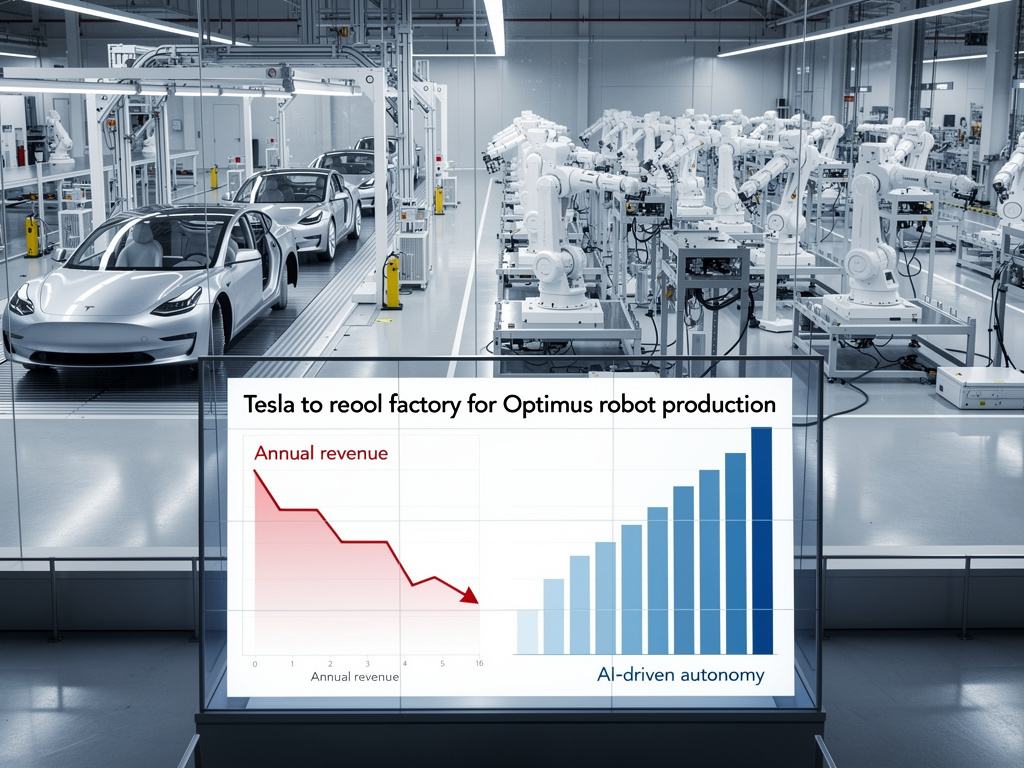
Tesla Inc. is shuttering production of its pioneering Model S sedan and Model X crossover next quarter, redirecting precious Fremont factory space to mass-manufacture Optimus humanoid robots. CEO Elon Musk framed the move as an “honorable discharge” for the vehicles that launched the company into the electric-vehicle era, signaling a bold pivot from carmaking to artificial intelligence in the physical world.
During the Q4 2025 earnings call on January 28, 2026, Musk announced: “We’re going to take the Model S and X production space in our Fremont factory and convert that into an Optimus factory with the long-term goal of having a million units a year of Optimus robots.” The decision comes amid Tesla’s first annual revenue decline, with 2025 sales dropping 3% to $94.8 billion and vehicle deliveries falling 9% to 1.64 million units, as reported by Automotive News.
Q4 revenue slid 3% to $24.9 billion, while net income plunged 61% to $840 million. Model S and X sales, bundled with Cybertruck, tumbled 40% to 50,850 units in 2025, representing a tiny fraction of output. In Europe, Model S deliveries cratered 70% to 538 units and Model X fell 63% to 639, per the same report.
Pioneers Fade Amid Declining Demand
The Model S, launched in 2012 at $96,630 including shipping, and Model X, introduced in 2015 with signature falcon-wing doors starting at $101,630, once defined Tesla’s premium aspirations. But they’ve been overshadowed by mass-market Model 3 and Y, which dominated 43% of U.S. EV sales last quarter versus 1.5% for S and X, according to Sherwood News.
Musk called the discontinuation “slightly sad” but necessary as Tesla transitions to autonomy and robotics. “It’s time to basically bring the Model S and X programs to an end with an honorable discharge because we’re really moving into a future that is based on autonomy,” he said, per CNBC. Existing owners can expect long-term support, though custom orders may soon close.
No layoffs are planned; Musk indicated headcount growth at Fremont to support the robot ramp, as noted by USA Today. Fremont Mayor Raj Salwan welcomed the shift, calling it “a vote of confidence in our workforce, supplier ecosystem, and advanced manufacturing base,” via CBS San Francisco.
Optimus Emerges as Core Bet
Optimus, Tesla’s 56 kg, 170 cm tall humanoid, relies on AI for tasks like sorting, lifting, and carrying. Gen 3, the first mass-production design, unveils this quarter, with volume output by late 2026 and external sales in 2027 at under $20,000 per unit. Musk envisions it as the “biggest product of all time,” driving unprecedented economic growth: “If you have ubiquitous AI that is essentially free or close to it and ubiquitous robotics, you will have an explosion in the global economy that is truly beyond all precedent,” he told Euronews.
The Fremont lines, previously yielding 100,000 vehicles yearly, target 1 million Optimus annually despite a “completely new supply chain” with no shared parts, Musk explained to Fox Business. Currently in R&D, Optimus performs basic factory tasks but awaits material deployment.
Tesla plans six new production lines in 2026 across vehicles, robots, energy, and batteries, leveraging existing sites. CFO Vaibhav Taneja forecasted capital expenditures exceeding $20 billion, more than double 2025’s $8.5 billion, including $2 billion in Musk’s xAI to bolster physical AI, per Automotive News.
Financial Pressures Fuel the Pivot
Tesla’s automotive revenue dropped 11% in 2025 amid global EV competition and a U.S. “consumer credit cliff.” Yet Q4 beat estimates with $0.50 adjusted EPS versus $0.45 expected. Full Self-Driving subscriptions doubled to 1.1 million, and robotaxi pilots expanded sans safety drivers in Austin since mid-January 2026, eyeing seven more cities by mid-year, as detailed by The Guardian.
Cybercab, a steerless two-door robotaxi, ramps slowly in Texas from H1 2026. Musk predicts human driving shrinking to 5% or 1%, with autonomy dominating. Morgan Stanley projects over 1 billion humanoids by 2050 in a $5 trillion market, pitting Tesla against Hyundai, BMW, Mercedes, and Mobileye, according to Automotive News.
Analysts see execution risks in unproven scaling to 10 million Optimus yearly by 2027, but the Fremont conversion underscores commitment. Tesla’s shareholder deck lists Optimus as a distinct capacity item, marking its industrial ascent, per AInvest.
Rivals and Market Realities
Hyundai’s Robot Metaplant trains bots for repetitive tasks by 2028, complex assembly by 2030. Mobileye targets $20,000 units at 50,000 annually post-Mentee Robotics acquisition. Tesla claims leads in real-world intelligence and dexterity, eyeing fivefold human productivity as an “infinite money glitch.”
Critics question timelines, given past delays, but Musk insists Optimus learns via observation, verbal cues, or video. Fremont’s evolution boosts California’s robotics hub status, with Model 3/Y lines intact.
As Tesla retools, investors watch Q2 2026 for final S/X units and Optimus prototypes. The bet: robots eclipse cars in transforming global manufacturing and daily life.


 WebProNews is an iEntry Publication