
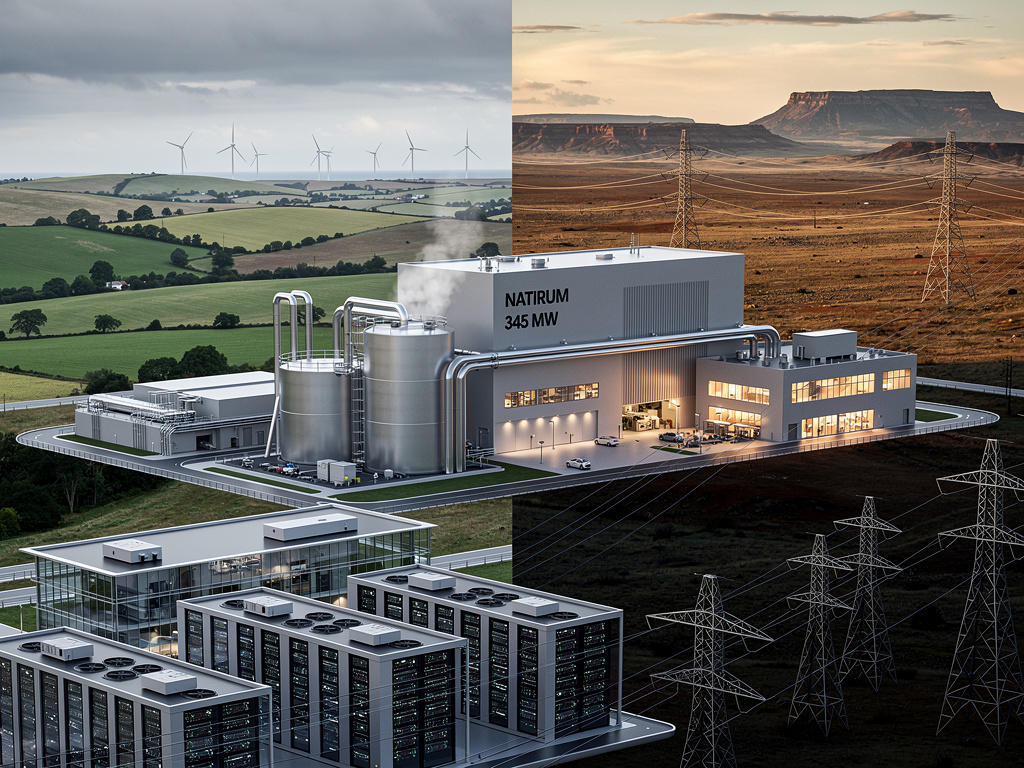
TerraPower just took its most decisive step yet beyond American soil. On June 16 the Bill Gates-backed nuclear innovator launched TerraPower UK Ltd and kicked off Step 1 of the UK’s Generic Design Assessment for its Natrium reactor. The move marks the company’s first permanent presence outside the United States and its initial bid to export a technology already under construction in Wyoming.
The timing feels deliberate. Britain wants more nuclear power. Data centers devour electricity. Renewables swing with the weather. Policymakers talk openly about energy security after years of dependence on imported gas. TerraPower’s sodium-cooled fast reactor, paired with molten-salt storage, promises steady baseload plus the ability to ramp output on demand. That combination caught regulators’ attention.
The company submitted its GDA application last October. By February the Department for Energy Security and Net Zero had reviewed the filing and accepted the design into the formal process. Now Step 1 begins in earnest. Regulators from the Office for Nuclear Regulation, the Environment Agency and Natural Resources Wales will examine safety, security and environmental aspects before any site-specific licensing even starts. World Nuclear News first detailed the acceptance in February.
Chris Levesque, TerraPower’s president and chief executive, struck a note of long-term seriousness. “TerraPower is entering the UK market with a long-term commitment to supporting the nation’s clean energy future and establishing ourselves as a serious and reliable deployment partner,” he said in the company’s announcement. The words carry weight. TerraPower has spent years refining the Natrium concept. Its demonstration plant near the retiring Naughton coal station in Kemmerer, Wyoming, broke ground on non-nuclear portions in 2024. Nuclear construction followed NRC approval this spring. The target for first fission sits at the end of 2030. That schedule gives UK reviewers a live project to watch.
And watch they will. Officials highlighted the US-UK Atlantic Partnership for Advanced Nuclear Energy as a vehicle for sharing data and lessons in real time. Construction progress in Wyoming, commissioning data, even early operating experience could inform the British assessment. Such parallelism rarely happens this cleanly. But then Natrium isn’t a typical light-water design. It uses liquid sodium as coolant. It breeds fuel as it runs. The integrated storage system lets operators pull extra heat to push electrical output from 345 megawatts to 500 megawatts for more than five hours. Utilities like that flexibility when wind and solar dominate the grid.
TerraPower isn’t selling theory. It already has a landmark agreement with Meta to supply as many as eight Natrium plants in the United States, the first two potentially online by 2032. The deal, announced earlier this year, signals that hyperscalers see advanced nuclear as a firm power solution for their exploding electricity needs. Britain faces similar pressures. Its own nuclear fleet is aging. Hinkley Point C, the massive EPR project, now eyes 2030 for first power at a cost that has ballooned past original projections. Smaller, factory-built designs suddenly look attractive.
Dr. Ian Hudson will lead the new UK subsidiary. He brings more than three decades of nuclear experience. A permanent office allows closer coordination with British engineering firms, supply-chain partners and government bodies. TerraPower already works with KBR on potential UK siting studies. The collaboration predates today’s announcement but gains fresh momentum now that regulators have begun their review.
Yet hurdles remain. The GDA process typically stretches several years across multiple steps. Step 1 focuses on initial familiarization and resource planning. Later stages dive deeper into design details, fault studies and waste handling. Any gaps identified must be closed before construction consent follows. TerraPower executives express confidence. They point to the technical rigor applied during the US licensing campaign that secured the NRC construction permit in March. That permit itself was historic. It was the first for a non-light-water reactor in nearly a decade.
UK officials sounded equally measured. The ONR noted that assessment would begin once arrangements around timescales and resources were finalized. The Environment Agency welcomed the chance to apply lessons from the transatlantic partnership. Both bodies understand the stakes. Britain has set ambitious targets for nuclear expansion. Advanced reactors from multiple vendors, including Rolls-Royce’s SMR and designs from X-energy and Holtec, are already navigating the same GDA pipeline. Competition is real. So is the shared goal of replacing coal and gas with carbon-free firm power.
TerraPower’s technology carries extra appeal for a country phasing out coal. The Natrium plant can repurpose existing coal sites, using some of the existing infrastructure while delivering cleaner, more flexible generation. Kemmerer itself sits next to a retiring coal unit. The symbolism isn’t lost on policymakers on either side of the Atlantic.
Financial backing helps. The US Department of Energy has committed up to $2 billion through its Advanced Reactor Demonstration Program, matched by TerraPower and its partners. That public-private investment de-risks the first-of-a-kind plant. Success there opens doors for follow-on deployments, both domestically and abroad. Meta’s involvement adds another layer of commercial validation. When one of the world’s largest electricity consumers bets on your reactor, investors and regulators notice.
Still, nuclear projects rarely move in straight lines. Supply chains for specialized components, especially sodium-compatible materials and advanced fuels, must scale. Workforce shortages plague the sector globally. Regulatory alignment between the US and UK, while improved, will require constant effort. And public acceptance, though growing, demands transparency on waste, safety records and local economic benefits.
TerraPower’s UK push comes at a moment when advanced nuclear has shed some of its earlier skepticism. Governments from Washington to London to Brussels now view it as essential to hitting net-zero targets without sacrificing reliability. The technology’s ability to load-follow renewables addresses a criticism long leveled at traditional nuclear plants. Its higher burn-up of fuel reduces waste volume. Proponents argue the design is inherently safer because sodium operates at low pressure and the reactor can shut down passively.
Critics counter that sodium reacts violently with water and air, creating new engineering challenges. TerraPower spent years testing those risks in specialized facilities. Its engineers insist the lessons are baked into the current design. UK regulators will test those claims rigorously. The GDA exists precisely to surface such issues early.
So what happens next? Step 1 will establish the review framework. Subsequent steps will examine the reactor’s core physics, control systems, containment and emergency protocols. Parallel work on site identification and environmental impact assessments will proceed. If all goes well, the first UK Natrium could follow the Wyoming unit by only a few years. That acceleration would represent a significant win for both nations’ nuclear revival efforts.
The announcement also carries geopolitical undertones. Closer US-UK cooperation on advanced nuclear strengthens Western energy security at a time when dependence on Russian and Chinese supply chains remains a concern. TerraPower’s design uses high-assay low-enriched uranium fuel. Securing reliable supplies of that fuel will matter as much as the reactor itself. The company has already begun investing in domestic fuel production in the United States.
For industry insiders the message is clear. TerraPower no longer sees itself solely as a US developer. It aims to become a global supplier of advanced nuclear plants. The UK represents the first serious test of that ambition. Success here could open doors across Europe and beyond. Failure would slow momentum at a time when the world needs nuclear capacity faster than ever.
Today’s milestone doesn’t guarantee a plant on British soil. But it does plant the flag. And in the cautious world of nuclear energy, that first flag often determines who gets to build the rest.
Recent coverage from GeekWire captured the subsidiary launch in detail, while NucNet highlighted quotes from UK regulators praising the early engagement. TerraPower’s own release on June 16 provides the primary source for executive statements and technical parameters. The story continues to develop. Watch Wyoming. The data generated there will shape what Britain decides next.


 WebProNews is an iEntry Publication