
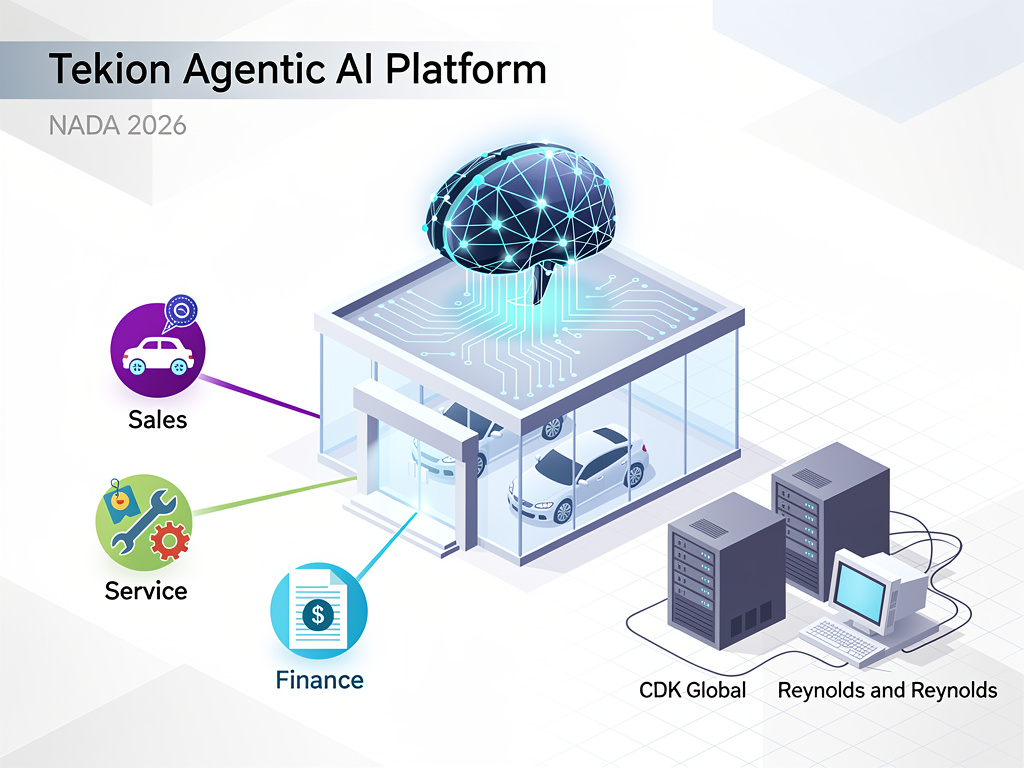
At the National Automobile Dealers Association’s annual convention in Las Vegas this year, the buzz wasn’t just about new vehicle models or financing incentives. It was about artificial intelligence — specifically, the kind that doesn’t just assist humans but acts on their behalf. Tekion Corp., the enterprise software company founded by former Tesla CIO Jay Vijayan, used the NADA 2026 stage to unveil what it calls the industry’s first truly “agentic AI” platform purpose-built for automotive retail, a move that could fundamentally reshape how dealerships operate, sell cars, and service customers.
The announcement, made on February 5, 2026, represents the culmination of years of investment in what Tekion describes as an “AI-native” architecture — a system designed from the ground up around artificial intelligence rather than one that bolts AI capabilities onto legacy software. According to BusinessWire, the company’s platform now features AI agents capable of autonomously handling complex dealership workflows — from customer engagement and inventory management to service scheduling and financial compliance — with minimal human intervention.
From Digital Retailing to Autonomous Dealership Operations
The automotive retail industry has long been characterized by fragmented technology stacks, with dealerships relying on a patchwork of dealer management systems (DMS), customer relationship management (CRM) tools, desking software, and service lane applications that rarely communicate seamlessly with one another. Tekion’s pitch is that its Automotive Retail Cloud (ARC) platform eliminates this fragmentation by housing every dealership function within a single, unified system powered by AI agents that can reason, plan, and execute tasks across departments.
Jay Vijayan, Tekion’s founder and CEO, has been vocal about his vision for what he calls the “autonomous dealership.” In the company’s NADA 2026 announcement, Vijayan described the new agentic AI capabilities as a paradigm shift. “We are not adding AI to old systems,” he stated, according to the company’s press release. “Tekion was built as an AI-native platform from day one. This allows us to deploy agentic AI that understands the full context of dealership operations and can take meaningful action — not just surface insights.”
What ‘Agentic AI’ Actually Means for Car Dealers
The term “agentic AI” has become one of the most discussed concepts in enterprise technology circles over the past year, but its application in automotive retail is still nascent. Unlike traditional AI tools that respond to prompts or generate recommendations for humans to act upon, agentic AI systems are designed to autonomously complete multi-step tasks. In a dealership context, this could mean an AI agent that identifies a customer who has been browsing SUVs on the dealership’s website, cross-references that customer’s trade-in history and credit profile, generates a personalized offer, schedules a test drive, and follows up — all without a salesperson lifting a finger.
Tekion’s platform reportedly deploys these agents across the entire dealership value chain. On the sales floor, AI agents can handle lead qualification, pricing optimization, and deal structuring. In the service department, they can predict maintenance needs based on vehicle telematics data, automatically schedule appointments, order parts, and communicate with customers via text or email. In the back office, agents manage compliance documentation, reconcile accounts, and flag anomalies in financial reporting. The breadth of these capabilities, if they perform as advertised, would represent a significant leap beyond what incumbent DMS providers like CDK Global and Reynolds and Reynolds currently offer.
The Competitive Stakes in Dealership Technology
Tekion’s aggressive push into agentic AI comes at a time when the dealership technology sector is undergoing considerable upheaval. CDK Global, the dominant DMS provider serving roughly 15,000 dealerships in North America, suffered a devastating cyberattack in June 2024 that knocked thousands of dealerships offline for weeks and exposed deep vulnerabilities in the industry’s reliance on legacy infrastructure. That incident accelerated conversations among dealer groups about the need for more modern, cloud-native platforms — a tailwind that Tekion has been eager to capitalize on.
Reynolds and Reynolds, the other major incumbent, has maintained its market position through long-term contracts and deep integration with OEM systems, but it too faces pressure to modernize. Meanwhile, companies like Dealertrack (a Cox Automotive brand) and newcomers in the AI space are all vying for a piece of the dealership technology market, which analysts estimate is worth tens of billions of dollars annually when factoring in software, data services, and digital retailing tools.
Tekion’s Silicon Valley DNA and Dealership Street Credibility
What sets Tekion apart from many of its competitors is its pedigree. Vijayan spent nearly a decade at Tesla, where he served as the company’s first CIO and built much of the internal technology infrastructure that supports Tesla’s direct-to-consumer sales model. He founded Tekion in 2016 with the explicit goal of bringing Silicon Valley engineering principles to an industry that had been underserved by technology innovation for decades. The company has raised over $800 million in venture capital from investors including Advent International, Alkeon Capital, and Durable Capital Partners, achieving a valuation north of $3.5 billion.
But Silicon Valley ambitions don’t always translate smoothly to the dealership world, where relationships, OEM mandates, and deeply entrenched workflows can make technology transitions extraordinarily complex. Tekion has worked to build credibility by signing major dealer groups and earning OEM certifications. The company’s platform is now used by thousands of dealerships across the United States, and it has secured partnerships with several major automakers who have certified ARC as a preferred or approved DMS platform.
The Promise and Peril of Autonomous AI in High-Stakes Transactions
For all the excitement around agentic AI, the deployment of autonomous AI agents in automotive retail raises important questions about accountability, accuracy, and customer trust. Car purchases are among the largest financial transactions most consumers undertake, and the regulatory environment surrounding auto lending, trade-in valuations, and consumer disclosures is complex and varies by state. An AI agent that structures a deal incorrectly, misrepresents financing terms, or fails to comply with state-specific disclosure requirements could expose a dealership to significant legal liability.
Tekion has acknowledged these concerns and says its platform includes built-in compliance guardrails and human-in-the-loop checkpoints for high-stakes decisions. The company’s agentic AI framework, as described in its NADA 2026 materials, is designed to escalate to human managers when transactions exceed certain thresholds or when regulatory flags are triggered. Still, the industry will be watching closely to see how these safeguards perform in practice, particularly as dealerships scale their use of autonomous agents.
What Dealers on the Ground Are Saying
Early adopters of Tekion’s platform have generally praised its modern interface and integration capabilities, though some have noted the challenges of migrating from legacy systems. The transition from a traditional DMS to a cloud-native platform requires significant change management, staff retraining, and data migration — processes that can take months and temporarily disrupt operations. For large dealer groups with hundreds of rooftops, the stakes of a platform switch are enormous.
Nevertheless, the appetite for innovation among forward-thinking dealer groups appears strong. The NADA convention has increasingly become a technology showcase, with AI and digital retailing dominating the exhibit hall and educational sessions. Dealers who have lived through the CDK outage and other technology disruptions are more open than ever to evaluating alternatives, and Tekion’s message — that a ground-up, AI-native approach is inherently more secure, scalable, and capable than retrofitted legacy systems — resonates with a growing segment of the market.
The Road Ahead for AI-Driven Automotive Retail
Tekion’s NADA 2026 announcement is not just a product launch; it is a declaration of intent. The company is betting that agentic AI will become the defining technology of the next decade in automotive retail, and it is positioning itself as the platform that dealers must adopt to remain competitive. Whether that bet pays off will depend on execution — on the reliability of its AI agents, the depth of its OEM integrations, the strength of its dealer support infrastructure, and its ability to navigate the regulatory complexities of an industry where trust is paramount.
What is clear is that the era of AI as a novelty or add-on in automotive retail is ending. The companies that will dominate the next chapter of dealership technology are those that have embedded intelligence into the core of their platforms, not those that have grafted chatbots onto decades-old architectures. Tekion, with its AI-native foundation and aggressive agentic AI roadmap, is making one of the boldest bets in the industry. For the thousands of dealers evaluating their technology futures, the question is no longer whether AI will transform their businesses — but which platform will be the one to deliver on that transformation.


 WebProNews is an iEntry Publication