
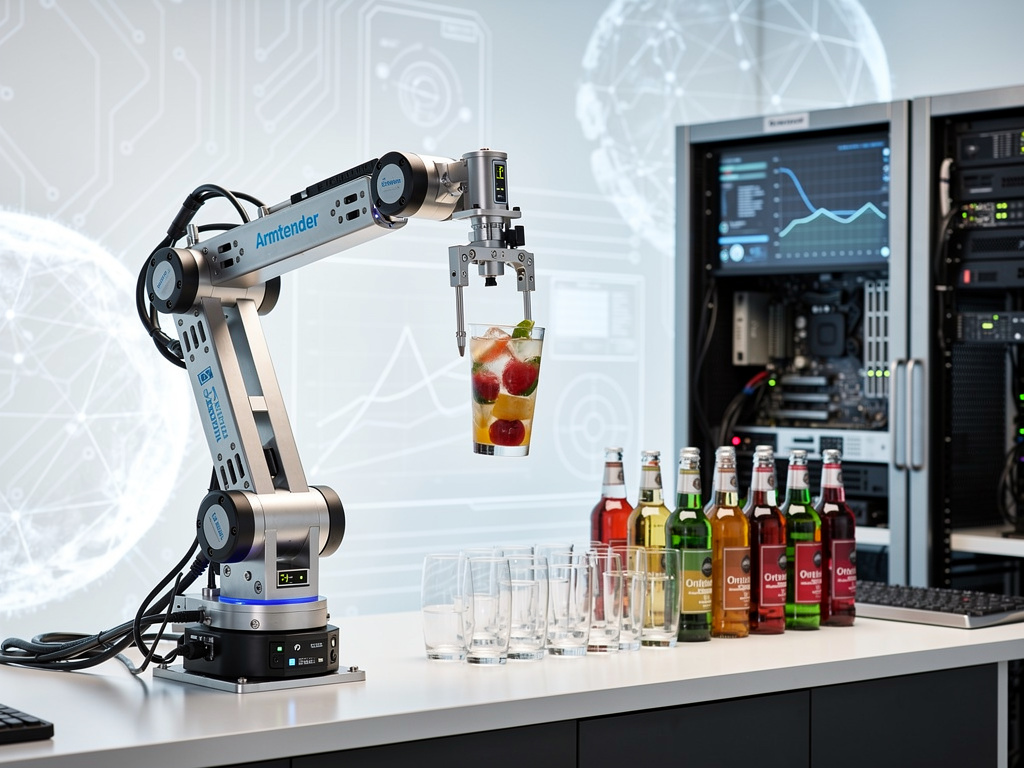
In the high-stakes arena of teen-led hackathons, a 16-year-old from Chapel Hill, North Carolina, has emerged as a standout innovator. Emme McDonald, a senior at the North Carolina School of Science and Mathematics, teamed up with two peers to create “Armtender,” an AI-powered robotic arm that mixes drinks with precision. The project clinched first place at the Prototype hackathon in Silicon Valley, organized by Hack Club in partnership with AMD, earning each team member a $20,000 scholarship and an invitation to the Consumer Electronics Show in Las Vegas.
The trio—McDonald, 17-year-old Rosanna Gaboyana from Cleveland, Ohio, and 18-year-old Afia Ava from Beaver Dam, Wisconsin—met during a summer Hack Club event. They spent a month brainstorming via group chat before converging for the January event. Their creation, powered entirely by an AMD Ryzen AI laptop processor, uses machine learning to grasp and serve soda cans, addressing the caffeine-fueled demands of hackathon culture. WRAL detailed how the arm’s performance improved through relentless data collection, with McDonald noting the initial runs were “very shaky” until more recordings refined its accuracy.
From Hackathon Brainstorm to Silicon Valley Triumph
Hack Club, a global network for young coders, drew over 15,000 high school students in a national campaign with AMD Gaming, challenging them to integrate AI into mechanical arms. Top teams advanced to Prototype, where McDonald’s group pulled all-nighters training their bot. AMD CEO Lisa Su spotlighted them during her CES keynote, “AI Everywhere, For Everyone,” praising the intensity: “It’s actually incredible to see what these students could build in just one weekend.” The recognition came before thousands at the world’s largest tech conference.
McDonald, who started coding at 12, described the project’s origin in a WRAL interview: “We knew we made a good team from that hackathon. So, we were sort of brainstorming in our group chat… One of them was an idea where we could maybe have a robot serve drinks to people, because we knew that it’s not a hackathon unless it has some sort of energy drink or soda.” This practical twist turned a weekend sprint into national acclaim.
Mastering Machine Learning on a Tight Deadline
The technical core relies on machine learning, where the team recorded repeated actions to teach the arm object manipulation. More data meant better results, a fundamental principle McDonald grasped quickly despite it being her first foray into AI software. The AMD Ryzen AI processor handled the heavy lifting, enabling real-time learning without external servers. Judges at Prototype valued this edge-of-the-art integration, setting Armtender apart in a field of ambitious prototypes.
Beyond the barista gimmick, McDonald envisions broader impact, inspired by her mother’s role at the Cary Fire Department. “These robots are a lot more resistant to the elements than humans. There’s no risk of smoke inhalation for a robot,” she said. “So having a robot that could manipulate door handles to enter buildings and sweep the building without having to risk human lives would be really amazing.” This first-responder focus signals her ambitions in applied AI.
Scholarships Fuel Next Steps in STEM
The $20,000 scholarships per team member—totaling $60,000—provide a launchpad. McDonald plans to pursue computer science at North Carolina State University, building on NCSSM’s rigorous STEM curriculum. Hack Club’s model of 12- to 24-hour collaborative events fostered her skills, connecting her with like-minded peers nationwide. AMD’s involvement underscores corporate bets on youth innovation, with Su emphasizing empowerment: “Together, we’re giving young builders the tools and confidence to shape what’s next.”
Industry observers see this as emblematic of a surge in accessible AI hardware. While no direct competitors emerged in recent web searches for similar teen projects, the Prototype event highlights how partnerships like Hack Club and AMD are accelerating teen contributions to robotics. McDonald’s story, absent from broader X discussions or national outlets beyond local coverage, points to untapped potential in regional talent pools.
Broader Ripples in AI Robotics Education
NCSSM, a public residential school under the University of North Carolina system, specializes in STEM, preparing students like McDonald for elite paths. Her win amplifies calls for expanded programs, as AMD’s campaign engaged thousands. The CES stage appearance not only validated their effort but exposed them to venture capitalists and tech leaders, potentially fast-tracking future ventures.
Challenges persist: Hackathons demand endurance, with teams forgoing sleep to iterate. Yet successes like Armtender demonstrate returns on investment in youth coding networks. As AI processors like Ryzen become more powerful, expect more such breakthroughs from unexpected quarters, reshaping who leads technological progress.


 WebProNews is an iEntry Publication