
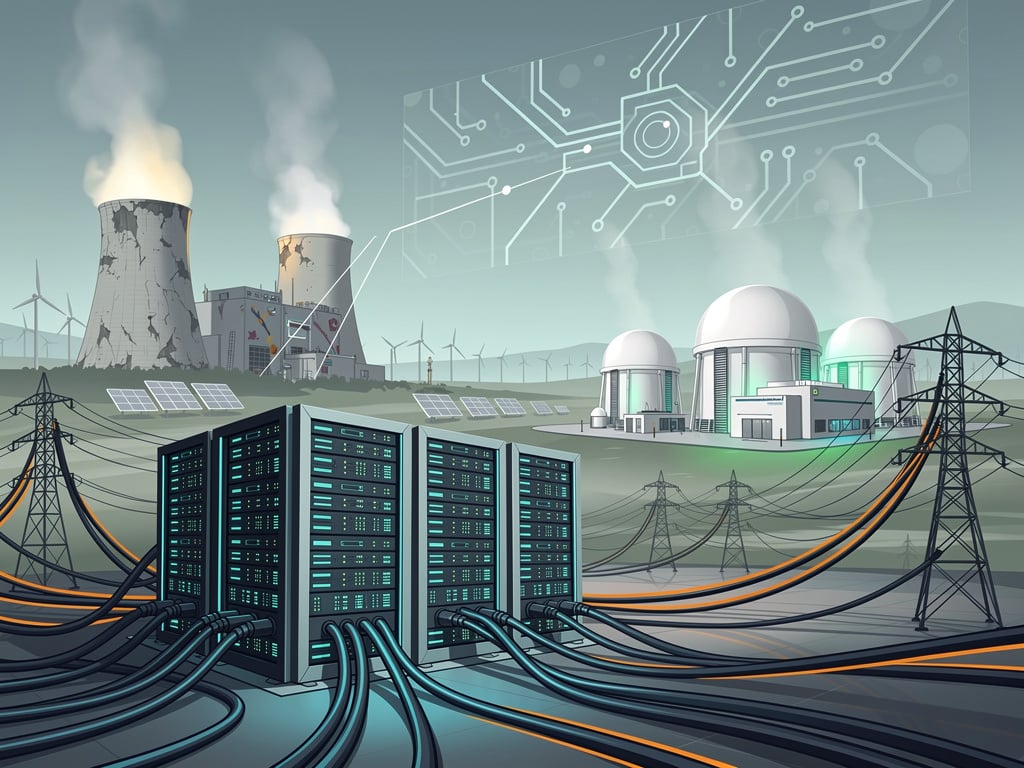
The numbers hit hard. AI training runs that once sipped electricity now devour it by the gigawatt. Data centers planned for the next decade could consume as much power as entire nations. And the grid? It simply can’t keep up.
Microsoft struck first. In a move that stunned energy markets, the company inked a 20-year agreement with Constellation Energy to restart the long-shuttered Three Mile Island nuclear plant. The deal, valued at roughly $16 billion, targets commercial operation by 2028 for the renamed Crane Clean Energy Center. Introl reported the facility’s 835 megawatts will flow straight toward Microsoft’s expanding AI infrastructure needs.
But Microsoft doesn’t stand alone. Google, Amazon, Meta. All have raced to lock in nuclear supply. Their collective actions signal a stark truth. Renewable credits and grid purchases no longer suffice. These firms want always-on, carbon-free baseload power. Nuclear fits the bill. Perfectly.
Projections paint an alarming picture. Electricity demand from data centers and AI could reach 12 percent of total U.S. consumption by 2028, according to recent workshops hosted by the Idaho National Laboratory. Goldman Sachs analysts forecast data center power needs quintupling by 2030. Shortages loom. Delays in new generation capacity stretch years. So tech executives turned to the one proven source that runs 24 hours a day, regardless of weather.
Three Mile Island carries heavy history. The 1979 partial meltdown defined nuclear fears for a generation. Unit 2 remains entombed. Yet Unit 1, closed in 2019 for economic reasons rather than safety, now gets new life. The U.S. Department of Energy approved a $1 billion loan to accelerate the restart. Constellation expects the plant back online ahead of the original 2028 schedule, possibly in 2027. Forbes detailed how this revival marks a broader shift in corporate energy strategy.
Microsoft’s commitment runs deeper than one plant. The company hired specialists in nuclear technology and regulatory acceleration. It trains AI models on licensing documents to speed approvals. Executives speak openly about placing data centers next to reactors for efficiency. Bobby Hollis, Microsoft’s vice president of energy, described existing nuclear assets as an untapped resource pushed offline by cheap renewables. Now the economics flip.
Amazon took a different path. It paid $650 million for a data center co-located at Talen Energy’s Susquehanna nuclear plant in Pennsylvania. The arrangement grants access to up to 960 megawatts initially. Later expansions pushed the deal to 1.92 gigawatts through 2042. Amazon also explores small modular reactors at the site. Direct connection bypasses transmission losses. It avoids grid congestion that plagues other projects.
Google pursued advanced designs. The company signed with Kairos Power for up to 500 megawatts of small modular reactors, with the first 50-megawatt Hermes 2 unit expected around 2030. A separate pact with the Tennessee Valley Authority funnels that power toward Google data centers in Alabama and Tennessee. These compact reactors promise factory construction and faster deployment. Yet skeptics point out most SMR projects remain years from commercial reality.
Meta’s moves came fast in early 2026. The social media giant announced three separate nuclear agreements totaling 6.6 gigawatts. Deals with Vistra, Oklo and TerraPower target its Prometheus AI data center campus in Ohio. One pact with Oklo, backed by OpenAI CEO Sam Altman, envisions a 1.2-gigawatt campus in Pike County. Another with TerraPower, founded by Bill Gates, advances next-generation designs. CBS News covered the announcements, noting the combined capacity could supply electricity equivalent to five million homes.
Such scale raises eyebrows. OpenAI and Microsoft have discussed a Stargate supercomputer project that could eventually require five gigawatts. That’s the output of five typical nuclear plants. The estimated price tag exceeds $100 billion. Sam Altman has pushed aggressive buildout plans reaching hundreds of billions. Critics on CNBC questioned whether these ambitions represent a bubble, given the capital already poured into related stocks.
Yet the demand appears real. Training ever-larger models demands exponential compute. Inference at global scale adds steady load. Hyperscalers report their AI infrastructure spending could surpass $800 billion in 2026 and top $1 trillion in 2027, per Bank of America estimates shared across industry discussions. Power has replaced chips as the binding constraint. Interconnection queues for new generation stretch five to seven years in many regions.
Nuclear brings clear advantages. It produces no greenhouse gases during operation. Plants run at over 90 percent capacity factors, far above solar or wind. Fuel costs remain low and stable. These traits matter when companies chase both growth and decarbonization pledges. Microsoft aims for carbon-negative status. Google pursues 24/7 carbon-free energy matching.
But risks persist. Construction timelines slip. Costs balloon. Regulatory hurdles multiply. The first wave of SMRs faces high expense as first-of-a-kind projects. Waste disposal questions linger. Public opposition can flare, especially near historic sites like Three Mile Island. Reuters explored these tensions in a December 2025 analysis, noting nuclear might cover only 10 percent of AI-related demand over time while renewables fill the rest. The Reuters report highlighted how small reactors struggle to arrive before the 2030s.
Policy makers took notice. The Department of Energy backed the Three Mile Island restart and similar efforts at Palisades in Michigan. Congress extended tax credits for nuclear. States compete to attract data centers and the accompanying generation investments. Tennessee leads with plans for multiple SMRs, a potential fusion project and microreactor manufacturing. Alabama and Virginia pursue their own large-scale nuclear initiatives.
Industry veterans describe the moment as a reckoning. For years utilities dismissed tech companies’ power forecasts as exaggerated. Now those forecasts look conservative. Data center operators experiment with everything from behind-the-meter nuclear to hydrogen backup to efficiency gains. Some explore locating facilities in regions with stranded nuclear assets or abundant hydro. Others eye international waters for floating compute with wave energy, though such concepts remain early stage.
Constellation Energy emerges as a clear winner. The operator of America’s largest nuclear fleet secured the Microsoft deal plus a separate 20-year pact with Meta for 1.1 gigawatts from its Clinton Clean Energy Center in Illinois. Shares reacted positively to each announcement. Other utilities with nuclear assets gained attention. NextEra Energy studies restarting the Duane Arnold plant in Iowa for similar purposes.
Fusion still sits on the distant horizon. Microsoft signed a power purchase agreement with Helion Energy years ago. Progress continues, yet commercial plants likely remain decades away. The near-term answer stays conventional and small modular fission. Even that path demands massive capital and patience.
So far the deals keep coming. Over 10 gigawatts of new nuclear capacity commitments flowed from big tech in the past year alone. The pace shows no sign of slowing. Meta issued requests for proposals targeting one to four additional gigawatts. Amazon’s investments at Susquehanna exceed $20 billion when counting the full campus conversion. These sums dwarf earlier renewable power purchase agreements.
Analysts at Deloitte suggest nuclear could eventually supply 10 percent of data center electricity by 2035. Kate Hardin, executive director of the firm’s energy research, sees the technology helping close the supply gap over time. Not tomorrow. But steadily. The combination of restarted reactors, new SMR fleets and continued renewables offers the only realistic path to meet projected loads without massive fossil fuel reliance.
Communities near these plants face mixed prospects. Jobs return to areas hit hard by closures. Tax bases grow. Yet safety concerns surface in public meetings. Proponents emphasize modern reactor designs and rigorous oversight. Opponents recall past accidents and question long-term waste plans. The debate plays out in state hearings and federal dockets.
One fact stands clear. The AI boom rewrote the energy equation. What began as search optimizations and chat tools evolved into infrastructure that reshapes entire sectors. Power no longer serves as background cost. It determines where companies build, how fast they scale, and whether they meet climate goals. Nuclear’s return after decades of stagnation proves the point. When the alternative is slowing innovation or burning more coal and gas, old reactors gain fresh appeal.
Microsoft’s Three Mile Island bet set the tone. Others followed quickly. The coming years will test whether these agreements deliver on schedule and budget. Success could trigger a full nuclear renaissance. Failure might force uncomfortable trade-offs in AI ambitions. Either way, the industry’s hunger for electricity will only grow. And the search for reliable supply has only just begun.


 WebProNews is an iEntry Publication