
Respiratory infections kill a million people a year. They drain $600 billion from the global economy annually. And they consume roughly 5% of a healthy person’s life in days spent sick with the common cold or flu. Yet society has long shrugged them off as inevitable.
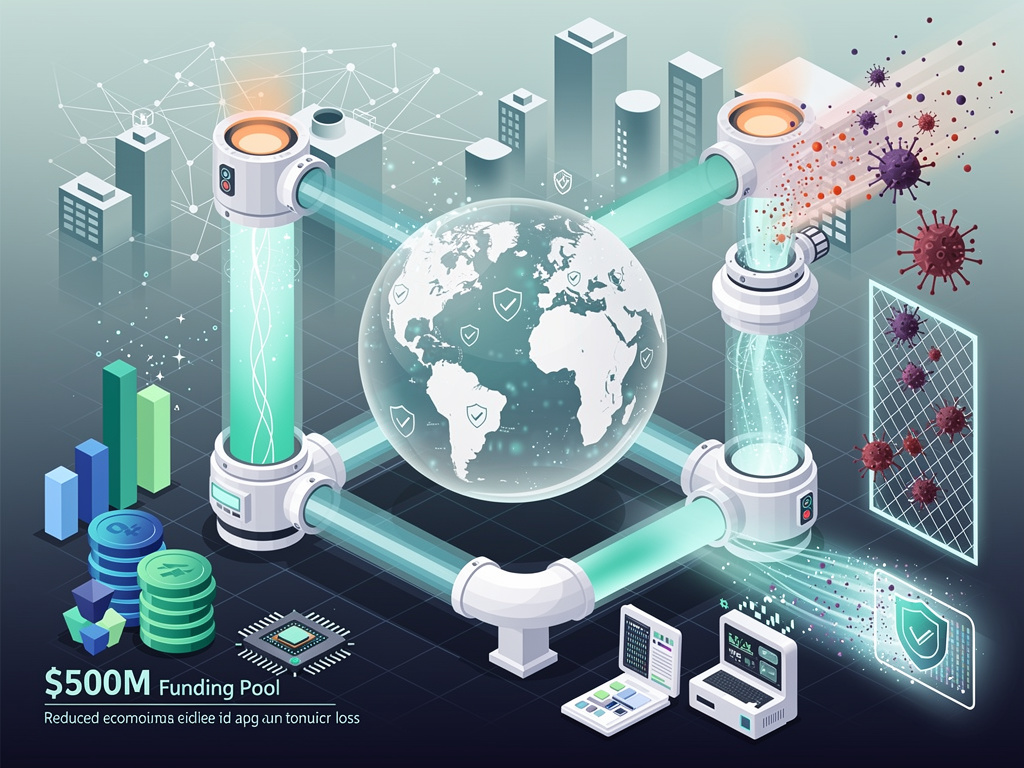
That may be about to change. Today a new nonprofit called Intercept launches with $500 million in philanthropic backing from some of the biggest names in technology and global health. MIT Technology Review first reported the effort, which counts Stripe, Anthropic, the OpenAI Foundation, Flu Lab, Bill Gates and traders from Jane Street among its supporters.
But this isn’t another moonshot dressed in hype. The organizers spent months convening scientists, pharma executives, investors and regulators. They concluded the problem isn’t just technical. It’s one of incentives and sustained funding. So they built a plan around two complementary approaches that could, in combination, slash transmission dramatically.
Broad-spectrum preventatives. Air cleaning technologies. Simple in concept. Formidable in execution.
Nan Ransohoff, who leads public goods efforts at Stripe and co-heads Intercept, put the case plainly. “I think we treat respiratory infections as a minor nuisance, but have really underweighted the burden that they impose on society.” People spend 15 to 25 days a year ill from these viruses. The downstream effects stretch further. Early-life infections correlate with higher risks of asthma, heart disease, dementia and even impacts on lifetime earnings.
The numbers add up fast. Twelve point eight billion infections globally in 2021 alone. Over 65 million progressing to serious lower respiratory disease each year. Seven percent of major-cause deaths in the U.S. tied to them. And that’s before accounting for pandemic potential or the growing threat of engineered pathogens.
Why hasn’t this been solved? The symposium Stripe hosted last year surfaced two core obstacles. Hundreds of distinct, rapidly mutating viral strains across multiple families make a one-size-fits-all solution elusive. And the economics don’t line up for traditional players. Pharma sees limited profit in broad preventatives for common ailments. Philanthropy and government funding have focused elsewhere, often on deadlier but narrower threats.
Public budgets reflect the gap. The National Institute of Allergy and Infectious Diseases spends about $6.5 billion annually on virus research, yet that figure has remained stagnant. COVID briefly flooded the field with resources. Then the money dried up as strain-specific vaccines took center stage.
David Veesler, a structural biologist at the University of Washington who helped advance COVID vaccines and antivirals, initially found the idea daunting. “The diversity of viruses is just too large and seems daunting, so people don’t even try.” But repeated conversations with Ransohoff changed his view. The toolkit has expanded. RNA drugs, monoclonal antibodies, computational protein design, even virus-grabbing proteins that could be sprayed in nasal passages. “The growing tool kit available to scientists” now makes broad countermeasures newly plausible, he told MIT Technology Review.
Intercept’s strategy leans on that momentum. It will deploy grants and investments to push at least two broad-spectrum preventative candidates through Phase 2 clinical trials. These could take the form of shots, nasal sprays or pills designed to block rhinoviruses, influenza, coronaviruses and others simultaneously. The bar is high: more than 75% prevention of symptomatic infections, easy administration, minimal side effects, and a realistic path to 60% population uptake.
The approaches under consideration range widely. T-cell vaccines that elicit lung-resident immunity. Nucleic acid degraders targeting conserved viral RNA. Engineered interferons that trigger antiviral states without excessive inflammation. Host-directed therapies that interfere with human proteins viruses exploit. Physical barriers like nasal gels loaded with high-affinity viral binders. Each carries trade-offs between breadth, safety and durability.
But preventatives alone won’t suffice. Even optimistic uptake leaves too many gaps given the high contagiousness of these pathogens. Effective reproduction numbers need to drop below one for elimination. That’s where air cleaning technologies enter the picture.
Think of them as the indoor equivalent of municipal water treatment. Layered onto existing ventilation systems, they aim to cut infectious aerosols by more than 75% in schools, offices, transit hubs and other dense spaces. The portfolio includes high-efficiency filtration, far-UVC antimicrobial lights that inactivate viruses without harming human skin or eyes, and carefully studied antimicrobial vapors.
Many of these tools already exist with growing evidence bases. What they lack is rigorous real-world clinical data at scale, clear regulatory endorsements, and the demand signal needed to drive costs down. Intercept plans to supply all three. It will convene a customer advisory board of potential large buyers to shape product development and de-risk market adoption. Clinical and regulatory experts will help compress timelines and secure recommendations that spur uptake.
Advisors to the effort include Peter Marks, the former top FDA official overseeing biologics, and Moncef Slaoui, who led Operation Warp Speed. Their presence signals seriousness about navigating the approval maze for products intended for healthy populations.
The analogy to historical public health victories runs through Intercept’s materials. A century ago, waterborne diseases like cholera and typhoid exacted a similar toll. Pharmaceuticals and clean water infrastructure changed the equation within decades. “We believe we will look back in 20 years and think it’s crazy that civilization didn’t address this problem sooner,” the organization states on its site.
Recent scientific literature supports the underlying logic. A perspective published this year in the Proceedings of the National Academy of Sciences argues for AI foundation models in epidemic science that could integrate genomic surveillance, mobility data, serology and more to predict and respond faster across pathogens. While not directly tied to Intercept, such tools could accelerate the precise design of broad-spectrum interventions.
Today’s announcement also arrives amid heightened awareness of biological risks. OpenAI and Anthropic, two of Intercept’s backers, recently signed a letter urging stricter screening of synthetic DNA orders to prevent misuse for bioweapons. The same capabilities that power protein design for good could, in wrong hands, accelerate pathogen engineering. Broad respiratory defenses would serve as both everyday protection and a bulwark against future threats.
Stripe has form here. The payments company, founded by Patrick and John Collison, previously committed $1.8 billion to Frontier, a carbon removal effort that similarly tackled a problem technically feasible but commercially unattractive. The Collisons also poured hundreds of millions into the Arc Institute to apply AI to biological research. Their bet on Intercept fits a pattern of patient, high-conviction funding for foundational scientific challenges.
Yet success is far from assured. Developing preventatives safe enough for widespread use in healthy people demands enormous trials. Air cleaning technologies must prove cost-effective and acceptable in everyday environments. Uptake targets, even combined, remain ambitious. Regulatory pathways for novel modalities are uncertain. And the viral landscape never stops shifting.
Still, the organizers argue the moment is ripe. Explosive growth in biological datasets. AlphaFold and its successors unlocking protein structures at unprecedented scale. Lessons from COVID platforms that stalled but demonstrated proof of concept. AI tools that can now explore vast design spaces for antivirals and barriers.
Charlie Petty and Devin Sok join Ransohoff in leading the initiative. They emphasize a portfolio approach across multiple modalities rather than single bets. Grants for early research. Investments where commercial paths emerge. Continuous feedback from potential customers and regulators. A theory of change that treats both technical development and market formation as solvable engineering problems.
Critics might question whether tech billionaires should set priorities in global health. Others will note that $500 million, while substantial, pales against the $600 billion annual economic burden or the trillions lost to COVID. But Intercept doesn’t claim to solve everything alone. It seeks to catalyze progress where incentives have failed, then hand off to markets and governments once products prove viable.
The timing feels pointed. As AI labs race forward, concerns about dual-use biotechnology grow louder. Respiratory viruses sit at the intersection of everyday misery, long-term health impacts, pandemic risk and biosecurity. Addressing them could yield returns far beyond the immediate health gains.
Veesler captured the shift in perspective. “Most people just accept these viruses as a fact of life, and that got us thinking: Do we have to accept it? The more we thought about it, the more we realized that many of these problems have not been worked on with modern technologies.”
Intercept bets that applying those technologies systematically, with patient capital and clear metrics, can move the needle. Not overnight. But over the next decade and beyond. If it works, the common cold might one day join polio and smallpox in the category of problems humanity chose not to tolerate anymore.
Whether that future arrives depends on execution. On the science holding up. On adoption following development. On the strange coalition of AI companies, payment processors, quant traders and global health veterans maintaining focus where others have faltered. The ambition is clear. The details will determine the outcome.


 WebProNews is an iEntry Publication