
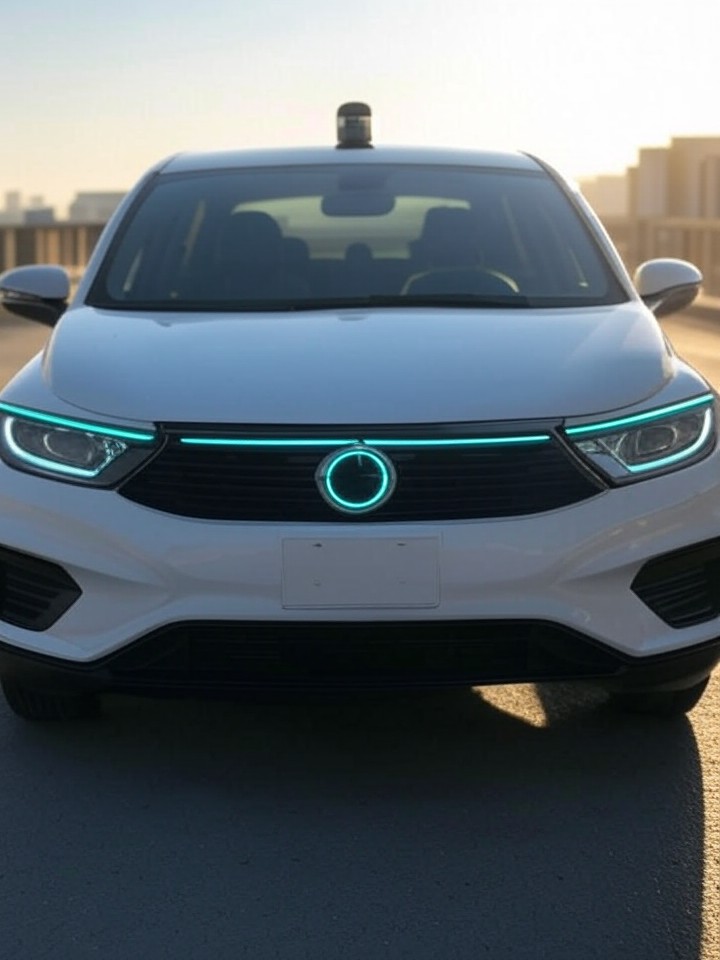
The Teal Beacon: Illuminating Autonomy’s Next Frontier
In the evolving world of automotive technology, a subtle yet significant change is on the horizon: self-driving cars are set to adopt a distinctive teal glow to signal when they’re operating in autonomous mode. This development, driven by new industry standards, aims to enhance road safety by clearly communicating a vehicle’s status to other drivers, pedestrians, and law enforcement. According to recent reports, the Society of Automotive Engineers (SAE) has finalized regulations that mandate blue-green exterior lights for vehicles engaged in automated driving, a move that’s already sparking discussions among automakers and regulators alike.
The push for this visual cue stems from years of incidents where confusion over a vehicle’s operational mode has led to accidents or near-misses. For instance, in high-profile cases involving companies like Tesla and Waymo, bystanders and other motorists have struggled to discern whether a car is under human or machine control. The teal light, often described as a turquoise or blue-green hue, is designed to be unmistakable, differentiating it from existing automotive lighting like white headlights, amber turn signals, or red brake lights. This isn’t just aesthetic; it’s a critical safety feature intended to reduce uncertainty on increasingly crowded roadways.
Industry experts argue that this standardization could accelerate the adoption of autonomous vehicles (AVs) by building public trust. As AV technology matures, clear signaling becomes essential, especially in mixed traffic environments where human-driven and self-driving cars coexist. The SAE’s marker lamp regulation, as detailed in a recent article from MotorTrend, outlines how these lights will activate only when the automation system is fully engaged, providing a visual confirmation that’s visible from multiple angles.
Regulatory Evolution and Industry Alignment
The journey to this new standard has been methodical, involving collaboration between automakers, tech giants, and regulatory bodies. The National Highway Traffic Safety Administration (NHTSA) has been instrumental in pushing for such measures, recognizing the need for uniform indicators as AV deployments ramp up. In fact, drafts of the SELF DRIVE Act, discussed in recent congressional hearings, propose expanding exemptions for driverless vehicles from 2,500 to 90,000 annually, which could further necessitate clear signaling like the teal light to manage increased on-road presence.
Drawing from coverage at CES 2026, where autonomous driving took center stage, companies like Nvidia showcased how AI integration could complement these visual cues. Nvidia’s CEO Jensen Huang highlighted robotics, including self-driving cars, as a key growth area, with plans to power robotaxi fleets by 2027. This aligns with broader industry shifts, as noted in a Reuters piece, where AI is invigorating AV progress amid past setbacks like high costs and safety concerns.
Moreover, partnerships between chipmakers and auto suppliers are rekindling enthusiasm for self-driving tech. Nvidia’s collaborations, as reported in another Reuters article, emphasize AI-driven systems that could seamlessly integrate with the new lighting standards, ensuring that vehicles not only signal their autonomy but also perform reliably in diverse conditions.
Technological Underpinnings of the Teal Signal
Delving deeper into the technology, the teal light isn’t arbitrary; it’s chosen for its visibility and distinctiveness under various lighting conditions, from bright daylight to foggy nights. SAE guidelines specify that these lights must be positioned on the vehicle’s exterior, often on the roof or sides, emitting a steady glow rather than flashing to avoid confusion with emergency vehicles. This design draws from human factors research, ensuring the color stands out without overwhelming the visual field.
Innovations in sensor technology are also playing a role. For example, Tesla’s recent patents, as discussed in posts on X, detail advancements in glare reduction and sensor cleanliness, which could enhance how AVs perceive and respond to their environment while displaying the teal indicator. These include micro-cone technologies that mitigate light interference, ensuring that the vehicle’s “vision” remains clear even as it signals its autonomous state to others.
Beyond Tesla, other manufacturers are preparing for implementation. Mercedes-Benz, which received early approval for turquoise lights in some regions, serves as a precursor. According to a Kelley Blue Book report, the standard will apply to future models, with retrofitting possible for existing fleets like robotaxis from Waymo or Cruise.
Market Implications and Adoption Challenges
As the industry gears up for this change, market dynamics are shifting. At CES 2026, as covered by Business Insider, demonstrations of robotaxis and near-autonomous vehicles highlighted how teal lights could become a staple in urban mobility. Nvidia’s push into physical AI, detailed in a BBC article, underscores the convergence of software and hardware, where signaling lights are just one piece of a larger ecosystem.
However, adoption isn’t without hurdles. Regulatory variations across states and countries could complicate rollout. For instance, California’s DMV is discussing emergency protocols for AVs, as mentioned in X posts, which might influence how teal lights are used in conjunction with human oversight. Additionally, the Trump administration’s plans to ease self-driving rules in 2026, as noted in various online discussions, aim to streamline federal standards, potentially accelerating the integration of these lights.
Cost remains a factor too. Retrofitting existing vehicles or designing new ones with compliant lighting systems adds to development expenses, especially for startups in the AV space. Yet, proponents argue that the safety benefits outweigh these costs, potentially reducing liability in accidents by providing clear evidence of operational mode.
Global Perspectives and Future Trajectories
Looking internationally, the United Nations’ draft regulations for Automated Driving Systems (ADS), referenced in X posts, set a global benchmark requiring AVs to match human driver safety levels. This framework includes mandates for safety management systems, which could incorporate visual signals like the teal glow to enhance transparency.
In the U.S., vehicles approaching full autonomy in 2026, as listed in a U.S. News overview, are already inching closer to Level 4 and 5 capabilities, where teal lights would be most relevant. Companies like Ford are exploring affordable AV options, as highlighted in CES coverage from Gizmodo, blending AI with human support to bridge the gap.
The teal signal also raises questions about public education. Most drivers, as the MSN article points out in its title, don’t yet know what this new color means. Initiatives from automakers and regulators will be crucial to inform the public, perhaps through awareness campaigns or integration into driver’s education programs.
Innovations Enhancing Signal Reliability
Advancing beyond basic lighting, emerging tech is ensuring these signals are foolproof. Nvidia’s plans for robotaxi testing by 2027, as reported in a CNBC story, include software that could dynamically adjust light intensity based on environmental factors, improving visibility.
Posts on X have buzzed about Tesla’s adaptive front lighting systems (AFS), which use matrix LED technology to prevent glare while maintaining high visibility. Such innovations could extend to teal indicators, making them more effective in adverse weather.
Furthermore, the integration of AI world models, like Nvidia’s Alpamayo VLA showcased at CES, promises AVs that navigate complex scenarios with precision, all while clearly signaling their autonomy to reduce human error in interpretation.
Economic and Societal Ripples
Economically, the teal light standard could catalyze growth in the AV sector. Investors are betting big on AI-driven autonomy, as per Reuters analyses, with partnerships rekindling progress after years of stagnation. This might lead to job shifts, from traditional driving roles to tech maintenance and oversight positions.
Societally, the glow represents a step toward safer roads. By demystifying AV operations, it could alleviate fears, encouraging wider acceptance. Yet, ethical considerations linger: how do we ensure equitable access to this technology in underserved areas?
Bloomberg’s coverage of Nvidia’s CES pitch, in a Bloomberg article, illustrates competing visions, with Nvidia edging into territories traditionally held by Tesla, potentially diversifying the market.
Pioneering Pathways Ahead
As we approach widespread deployment, pilot programs will test the teal light’s efficacy. California’s expansion of automated enforcement in 2026, as discussed on X, includes cameras that could interact with AV signals, enforcing rules more stringently.
Industry insiders predict that by 2027, teal-glowing vehicles will be commonplace in cities like San Francisco and Las Vegas, where robotaxi services are proliferating. This visual language could extend to other autonomous systems, like delivery drones or shuttles.
Ultimately, the teal beacon isn’t just a light—it’s a symbol of trust in an automated future, bridging human intuition with machine precision. As standards solidify, the road ahead looks brighter, one glow at a time.


 WebProNews is an iEntry Publication