
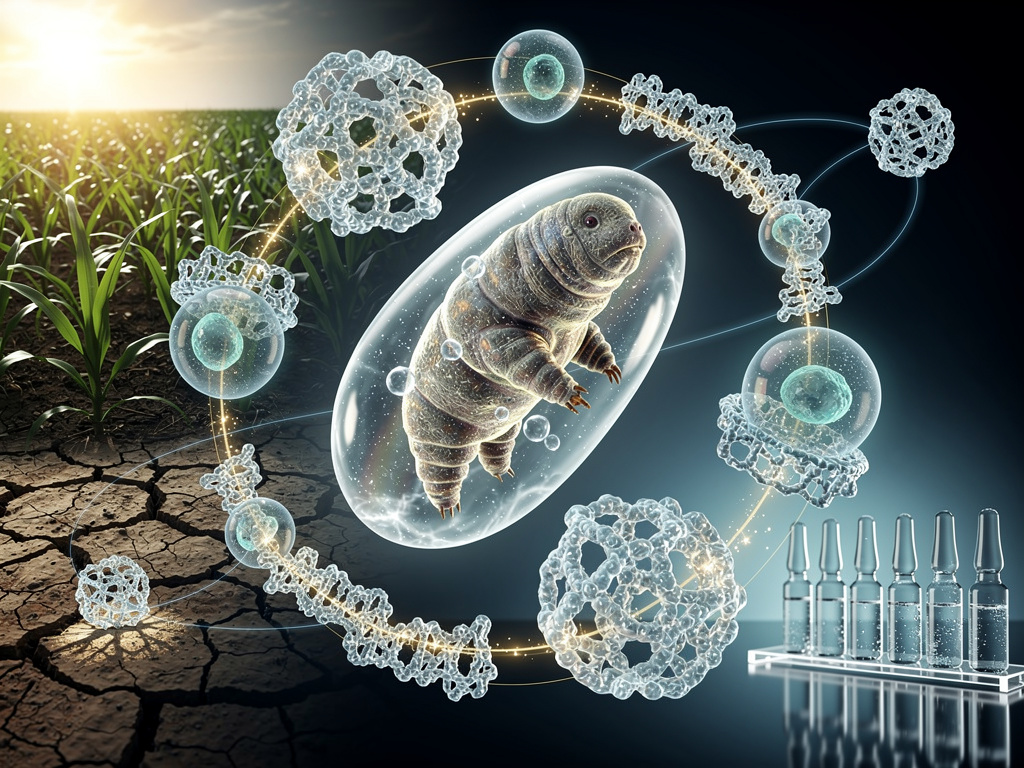
Scientists have long puzzled over the precise mechanisms that allow certain bacteria to survive extreme conditions, from scorching heat to crushing pressure. A recent study published by Ars Technica sheds new light on one particularly hardy group of microbes known as tardigrades, often called water bears for their distinctive appearance under a microscope. These microscopic animals can endure environments that would kill most other life forms, entering a state of suspended animation when faced with drought, radiation, or freezing temperatures. Researchers examining their unique biology have uncovered molecular adaptations that explain this remarkable resilience.
The investigation focused on proteins that tardigrades produce in large quantities during periods of stress. These molecules, dubbed tardigrade-specific intrinsically disordered proteins, or TDPs, appear to form a protective shield around cellular components. When water becomes scarce, the proteins solidify into a glass-like matrix that prevents delicate structures inside the cell from collapsing or reacting with harmful chemicals. This process, known as vitrification, essentially freezes biological machinery in place until conditions improve and the organism can safely rehydrate.
Laboratory experiments detailed in the report demonstrated how these proteins function across different species of tardigrades. Teams extracted TDPs from several varieties collected from mossy forest floors and deep-sea sediments. When introduced to human cells grown in culture, the proteins conferred similar protective effects, suggesting potential applications beyond basic biology. Cells exposed to the tardigrade proteins showed markedly higher survival rates when subjected to drying, high salt concentrations, or intense ultraviolet radiation.
One striking finding involved the way TDPs interact with other cellular proteins. Rather than binding to specific targets like many conventional enzymes, these disordered proteins create broad networks of weak interactions. The resulting gel-like substance stabilizes everything from DNA to mitochondria without interfering with normal operations once water returns. Electron microscopy images accompanying the study revealed intricate meshworks forming inside desiccated tardigrades, structures that dissolve cleanly upon rehydration.
The research builds upon earlier observations that tardigrades can survive exposure to the vacuum of space. In 2007, specimens flown aboard the European Space Agency’s FOTON-M3 mission endured ten days of direct solar radiation and extreme cold before returning to Earth and resuming normal activity. Scientists had suspected protective compounds were at work but lacked detailed molecular explanations until recent advances in proteomics and structural biology made closer examination possible.
Further analysis traced the evolutionary origins of these special proteins. Genetic comparisons suggest TDPs evolved independently in at least three separate lineages of tardigrades, pointing to strong selective pressure favoring desiccation tolerance. The genes responsible appear unique to these animals, with no clear counterparts in other organisms. This genetic distinctiveness raises interesting questions about how such complex traits can arise multiple times through convergent evolution.
Practical implications of the discovery extend into several fields. Agricultural researchers see opportunities to develop drought-resistant crops by transferring tardigrade genes into staple plants. Early trials with modified rice plants expressing TDPs have shown promising results, with yields maintained during extended dry periods that would normally cause significant losses. The modified plants also displayed enhanced tolerance to soil salinity, a growing problem in many farming regions affected by climate change.
Medical applications appear equally compelling. Preserving delicate biological materials remains a persistent challenge in organ transplantation, vaccine distribution, and regenerative medicine. Current techniques rely on careful freezing with cryoprotectants that can themselves cause cellular damage. The tardigrade proteins offer an alternative approach that works at room temperature and avoids toxic chemicals. Pharmaceutical companies have already begun testing whether TDPs can stabilize vaccines against heat, potentially eliminating the need for refrigeration in remote areas.
The study also examined how tardigrades repair cellular damage accumulated during dormant periods. Even with protective proteins in place, some DNA breaks occur during prolonged desiccation. Upon rehydration, the animals activate a suite of DNA repair enzymes at remarkably high levels. Transcriptome sequencing revealed that hundreds of repair-related genes turn on within minutes of water exposure, allowing rapid recovery even after years in the tun state.
Comparative studies with other extremophiles provided additional context. While some bacteria produce similar glass-forming compounds, none match the effectiveness of tardigrade TDPs. Certain brine shrimp and nematodes employ comparable strategies, yet their protective mechanisms differ at the molecular level. The unique disordered nature of tardigrade proteins appears particularly well-suited to creating flexible protective matrices that accommodate the irregular shapes of cellular contents.
Technical challenges complicated the research process. Tardigrades measure less than a millimeter in length, making it difficult to obtain sufficient biological material for biochemical assays. Researchers developed innovative culturing methods that allowed them to grow thousands of individuals under controlled conditions. Advanced mass spectrometry techniques then identified the specific proteins activated during stress responses with unprecedented precision.
The findings challenge previous assumptions about the limits of animal survival. For decades, scientists considered certain bacteria the undisputed champions of extremophile life due to their ability to withstand radiation doses thousands of times higher than those lethal to humans. Tardigrades now demonstrate that multicellular organisms can achieve comparable feats through sophisticated molecular adaptations rather than simple cellular architecture.
Public interest in these creatures has surged following the publication. Educational videos demonstrating tardigrades walking on moss have garnered millions of views online. Their cartoonish appearance, complete with eight stubby legs and a somewhat bear-like head, makes them appealing subjects for both scientific outreach and popular media. Several biotechnology startups have emerged specifically to explore commercial applications of tardigrade-derived proteins.
Environmental surveys continue to reveal new species with varying levels of stress tolerance. Some tardigrades thrive in temporary rock pools that dry out completely each summer, while others inhabit permanently moist environments and show little desiccation resistance. This diversity offers rich opportunities for comparative genomics to identify which genetic elements prove most critical for survival.
Questions remain about the long-term stability of vitrified cellular components. While tardigrades can survive decades in the dry state, the upper limit of their endurance stays unclear. Some museum specimens revived after 120 years suggest extraordinary longevity, though genetic degradation eventually sets boundaries. Understanding these temporal constraints could inform strategies for long-term storage of biological materials.
The research team emphasized that their work represents only an initial step toward fully understanding tardigrade biology. Many other molecules likely contribute to their hardiness, including antioxidants that neutralize free radicals and specialized membranes that maintain integrity during extreme dehydration. Future studies will need to examine how these various components work together in coordinated fashion.
Funding for the project came from multiple sources, including government grants focused on climate adaptation and private foundations interested in synthetic biology. The collaborative effort involved laboratories across three continents, combining expertise in genetics, structural biology, and materials science. Such interdisciplinary approaches have become increasingly common as complex biological questions require diverse technical capabilities.
Looking forward, scientists anticipate further discoveries as sequencing costs continue to drop and analytical tools grow more sophisticated. The complete genome of several tardigrade species has already been mapped, revealing unexpectedly large numbers of genes compared to other small invertebrates. Many of these genes remain poorly characterized, suggesting additional protective mechanisms waiting to be discovered.
The study serves as a reminder that nature often solves difficult problems in unexpected ways. Rather than developing rigid armor or complex behavioral adaptations, tardigrades rely on elegant molecular tricks that transform their internal environment into a stable, glass-like state. This approach proves both energy-efficient and remarkably effective across different types of stress.
As researchers continue exploring these microscopic survivors, their findings may reshape approaches to conservation, medicine, and biotechnology. The ability to stabilize biological systems against environmental extremes could prove valuable as climate patterns grow more unpredictable and human activities place increasing pressure on natural systems. Through careful study of organisms that have perfected survival strategies over hundreds of millions of years, scientists gain insights that extend far beyond academic curiosity.
The work also highlights the continued importance of basic research into obscure life forms. While tardigrades might seem unlikely subjects for major scientific breakthroughs, their unique adaptations offer solutions to practical problems that more conventional model organisms cannot address. This pattern repeats across biology, where seemingly strange creatures frequently reveal fundamental principles with broad applications.
Teams plan to expand their investigations to include other microscopic animals with similar capabilities. Rotifers and certain mites show comparable tolerance to drying, though through different biochemical pathways. Comparing these various strategies could reveal common principles underlying desiccation resistance while highlighting the diverse evolutionary solutions that have emerged.
The publication has sparked renewed discussion about the search for life on other planets. If organisms can survive the harsh conditions of interplanetary space, as tardigrades have demonstrated, then the possibility increases that microbial life could travel between worlds on meteorites or spacecraft. This concept, known as panspermia, gains credibility from experimental evidence showing tardigrades can endure the types of conditions encountered during cosmic journeys.
Educational institutions have begun incorporating tardigrade research into curricula at multiple levels. Elementary students learn about microscopic life through simple observation kits, while university programs use these organisms to teach concepts ranging from protein folding to evolutionary biology. The accessibility of tardigrades, which can be found in backyard moss samples, makes them excellent subjects for hands-on scientific exploration.
Technical innovations emerging from the study include new methods for producing large quantities of disordered proteins through bacterial expression systems. Previous attempts to manufacture similar molecules had proven difficult due to their tendency to aggregate unpredictably. Optimized protocols now allow consistent production at scales suitable for industrial applications.
The complete picture of tardigrade resilience likely involves multiple overlapping mechanisms working in concert. Heat shock proteins, antioxidant enzymes, and specialized pigments all appear to play supporting roles alongside the primary vitrification proteins. Disentangling these complex interactions represents a significant challenge for future research but also promises richer understanding of how life maintains integrity under duress.
As this field advances, the boundary between basic discovery and practical application continues to blur. What began as pure scientific curiosity about an unusual group of animals has developed into a promising avenue for addressing real-world problems in agriculture, medicine, and materials science. The story of tardigrade research demonstrates how patient observation of nature’s solutions can lead to innovations that benefit human society in unexpected ways.


 WebProNews is an iEntry Publication