
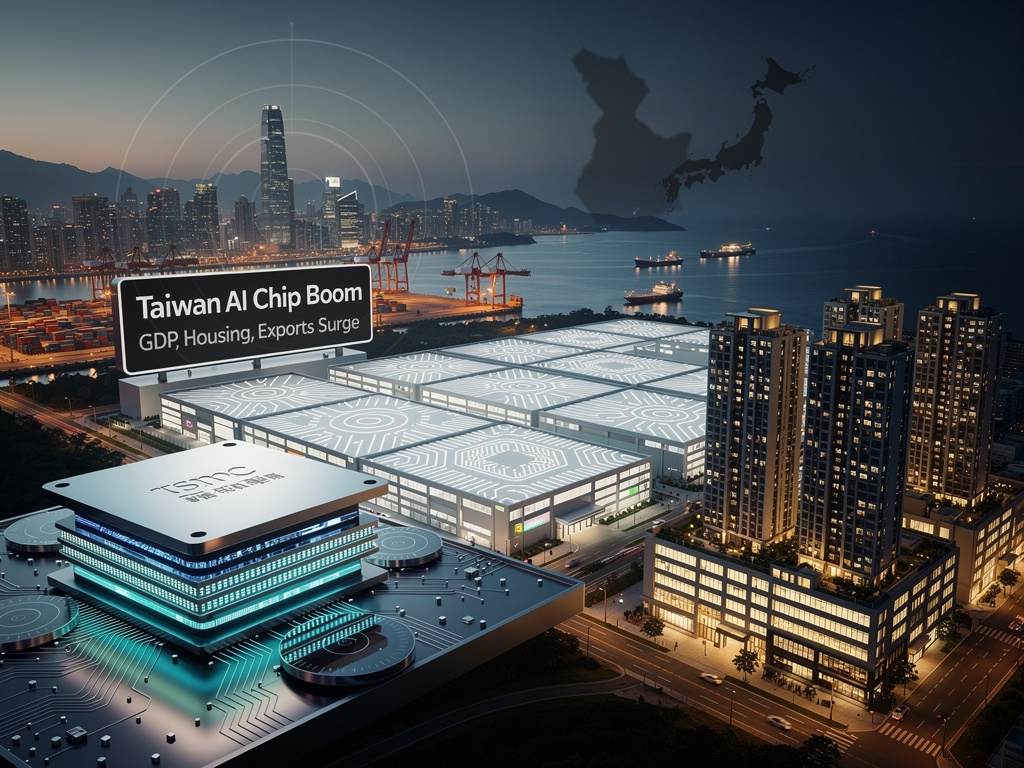
In Taipei, real estate agent Jason Sung is making a calculated wager. He believes that home prices surrounding a high-tech industrial park in northern Taiwan are poised to climb even further, driven by an artificial intelligence revolution that has transformed the island’s economic fortunes in ways not seen in decades. His confidence is emblematic of a broader euphoria sweeping Taiwan — one that has minted new wealth, supercharged exports, and elevated the island’s geopolitical significance to unprecedented heights. But beneath the exuberance lies a familiar tension: the specter of a bubble, and the ever-present threat from Beijing.
Taiwan’s economy, long anchored by its dominance in semiconductor manufacturing, has entered a new phase of acceleration thanks to the global surge in demand for AI chips. The island’s GDP growth has outpaced expectations, its stock market has reached record highs, and its real estate market — particularly in areas surrounding science and technology parks — has become red hot. As Yahoo Finance reported, the AI boom is reshaping not just Taiwan’s tech sector but the very fabric of its economy, from property values to consumer confidence to government tax revenues.
TSMC and the Engine of an AI-Fueled Miracle
At the center of this transformation stands Taiwan Semiconductor Manufacturing Company (TSMC), the world’s largest contract chipmaker and the indispensable supplier of the advanced processors that power AI systems built by Nvidia, Apple, AMD, and a growing roster of global tech giants. TSMC’s dominance in fabricating cutting-edge chips — particularly those at the 3-nanometer and 5-nanometer nodes essential for AI training and inference — has made it arguably the most strategically important company on the planet. In 2024, TSMC reported record revenues, and its stock price surged to all-time highs, pushing Taiwan’s benchmark Taiex index past the 20,000 mark for the first time in history.
The ripple effects have been enormous. As detailed by Yahoo Finance, the wealth generated by TSMC and its sprawling supply chain has cascaded through the broader economy. Engineers and executives at TSMC and its satellite companies are earning record bonuses, fueling a consumption boom in luxury goods, automobiles, and dining. Local governments in regions hosting TSMC facilities — particularly Hsinchu, Tainan, and Kaohsiung — are reporting surging tax receipts. And in the real estate market, the effects have been especially pronounced.
Property Prices Soar Near Tech Hubs as Speculators Pile In
Jason Sung, the Taipei real estate agent profiled by Yahoo Finance, represents a new breed of property bull. Areas near Taiwan’s science parks — the carefully planned industrial zones where chipmakers and their suppliers cluster — have seen property values jump by double-digit percentages in recent years. In some districts near TSMC’s newest fabrication plants, prices have risen 30 to 50 percent in just two to three years, according to local market data. Young engineers flush with stock options and bonuses are snapping up apartments, while speculative investors from across the island are piling in, betting that the AI boom has years left to run.
The frenzy has drawn comparisons to previous technology-driven property bubbles, both in Taiwan and abroad. Some economists have warned that the concentration of wealth and economic activity around a single industry — and, to a significant degree, a single company — creates vulnerabilities. If global AI spending were to slow, or if TSMC were to face unexpected competitive or geopolitical challenges, the downstream effects on property markets and consumer confidence could be severe. Taiwan’s central bank has already implemented several rounds of credit controls aimed at cooling speculative real estate activity, including raising reserve requirements for mortgage lending and tightening loan-to-value ratios for second and third homes.
Record Exports and a GDP Surge That Defies Regional Trends
Beyond real estate, the macroeconomic numbers tell a striking story. Taiwan’s export orders — a leading indicator of future shipments — have been running at elevated levels, driven overwhelmingly by demand for semiconductors and related components. In the first quarter of 2025, Taiwan’s exports to the United States surged as American tech companies raced to secure AI chip supplies ahead of potential tariff disruptions. The island’s GDP growth rate has consistently outperformed forecasts, placing Taiwan among the fastest-growing advanced economies in the Asia-Pacific region.
Government coffers have swelled in tandem. Corporate tax revenues from TSMC alone account for a significant share of Taiwan’s national tax intake — a concentration that is both a blessing and a point of concern for fiscal planners. The government of President Lai Ching-te has sought to channel some of this windfall into social programs and infrastructure, including investments in renewable energy, public transportation, and affordable housing initiatives designed to address the very inequality that the tech boom has exacerbated.
The Bubble Question: Is Taiwan’s AI Boom Sustainable?
For all the optimism, seasoned observers are asking hard questions about sustainability. The global AI investment cycle, while still in its early innings according to most industry analysts, is not immune to the boom-and-bust dynamics that have characterized previous technology waves. Capital spending by hyperscale cloud providers — the primary customers for TSMC’s most advanced AI chips — has reached staggering levels, with companies like Microsoft, Google, Amazon, and Meta collectively committing hundreds of billions of dollars to AI infrastructure. But some analysts have begun to question whether the returns on these investments will materialize quickly enough to justify the spending, raising the possibility of a pullback that would reverberate through the supply chain back to Taiwan.
Within Taiwan, there are also concerns about economic overconcentration. The semiconductor industry accounts for a disproportionate share of the island’s GDP, exports, and stock market capitalization. While the government has made efforts to diversify — promoting biotech, green energy, and advanced manufacturing — the reality is that Taiwan’s economic fortunes remain tightly coupled to the cyclical dynamics of the global chip market. A downturn in AI spending, a technological disruption that shifts chip demand away from TSMC’s strengths, or even a major earthquake affecting fabrication facilities could have outsized consequences.
Beijing’s Long Shadow Over the Taiwan Strait
Then there is the geopolitical dimension, which looms over every aspect of Taiwan’s economic story. China’s territorial claims over Taiwan and its increasingly assertive military posture in the Taiwan Strait represent an existential risk that no amount of economic growth can fully mitigate. The People’s Liberation Army has continued to conduct military exercises near the island, and Beijing’s rhetoric regarding unification has, if anything, hardened in recent years. For global investors and multinational corporations, the so-called “Taiwan risk” remains one of the most consequential geopolitical uncertainties in the world.
The AI boom has paradoxically both increased and complicated this risk. On one hand, Taiwan’s centrality to the global AI supply chain has deepened the interest of the United States and its allies in the island’s security — a dynamic sometimes referred to as the “silicon shield.” Washington has strengthened its military and diplomatic engagement with Taipei, and the CHIPS Act has spurred TSMC to build fabrication plants in Arizona, partly as a hedge against cross-strait contingencies. On the other hand, Taiwan’s growing strategic importance could make it an even more attractive target for Beijing, which views the island’s chip industry as both a national security asset and a lever of geopolitical influence.
A Workforce Under Pressure and the Human Cost of the Boom
The AI-driven economic surge has also created significant pressures on Taiwan’s labor market. TSMC and its competitors are locked in an intense battle for engineering talent, driving up salaries for semiconductor professionals to levels that are distorting compensation across other industries. Universities are struggling to produce enough graduates with the requisite skills, and the government has relaxed immigration rules to attract foreign engineers — a politically sensitive move in a society that has historically been cautious about large-scale immigration.
At the same time, the boom has widened inequality. While tech workers and property owners in science park corridors have seen their wealth multiply, many ordinary Taiwanese — particularly in the service sector and in regions far from the tech hubs — have experienced stagnant wages and rising living costs. Housing affordability has become a major political issue, with younger generations increasingly vocal about being priced out of the property market by speculative investment and tech-sector wealth.
What Comes Next for the Island at the Center of the AI Age
Taiwan finds itself at a remarkable inflection point. The island’s mastery of advanced semiconductor manufacturing has placed it at the very heart of the AI revolution, generating wealth and strategic importance on a scale that would have been difficult to imagine even five years ago. But the concentration of economic activity in a single sector, the frothy dynamics of its property market, the unresolved threat from Beijing, and the social strains of rapid, uneven growth all present challenges that will test the island’s resilience and the wisdom of its policymakers in the years ahead.
For now, agents like Jason Sung continue to show apartments to eager buyers near Taiwan’s gleaming tech parks, confident that the AI tide will keep lifting prices. Whether that confidence proves justified — or whether it marks the kind of exuberance that precedes a reckoning — may ultimately depend on forces far beyond any single island’s control: the trajectory of global AI investment, the decisions made in Washington and Beijing, and the inherent unpredictability of technological change.


 WebProNews is an iEntry Publication