
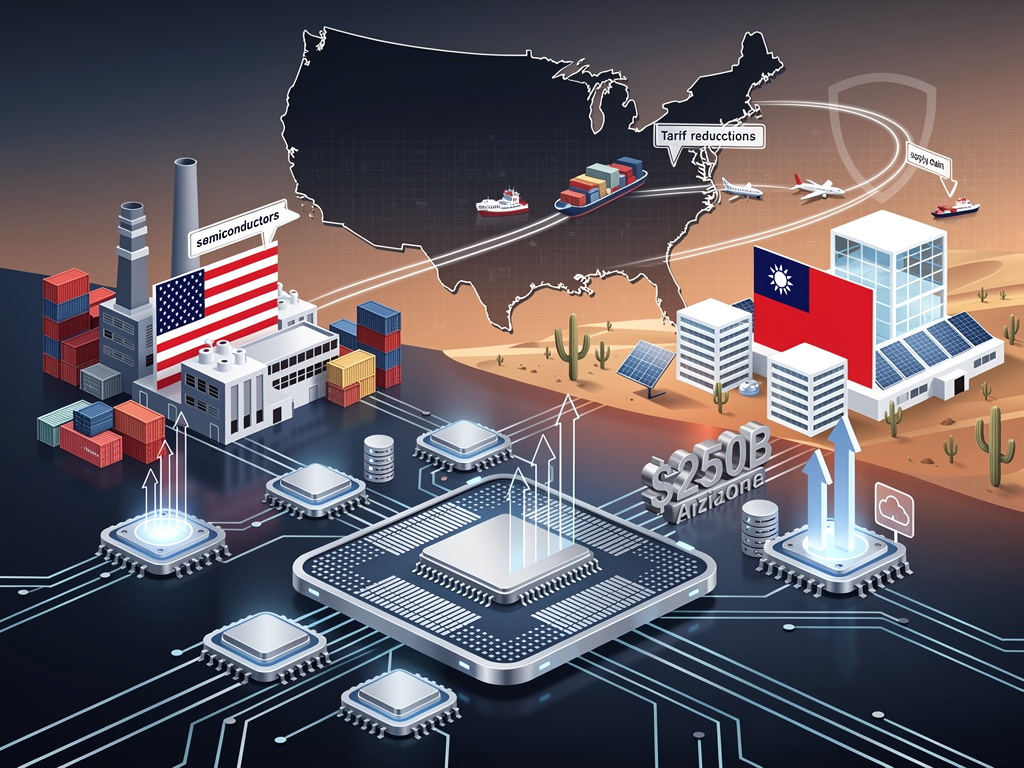
The U.S. and Taiwan have forged a landmark trade pact that commits Taiwanese firms to pour at least $250 billion into American semiconductor production, a move set to bolster U.S. manufacturing independence amid escalating tensions with China. Announced by the Department of Commerce on January 15, 2026, the agreement slashes tariffs on Taiwanese exports to 15% from higher proposed levels, while securing massive investments in chip factories, research and supply chains.
Taiwan Semiconductor Manufacturing Co., or TSMC, stands at the forefront, accelerating its Arizona expansion with plans for additional fabrication plants following its prior $165 billion commitment. The deal also includes $250 billion in credit guarantees from Taiwan’s government to support the semiconductor ecosystem, targeting artificial intelligence, energy systems and advanced computing.
The Trade-Off: Tariffs for Factories
In exchange for the investments, the U.S. exempts key Taiwanese goods like generic pharmaceuticals, aircraft components and natural resources from reciprocal tariffs. Companies with U.S. production gain duty-free import quotas under Section 232 rules. ‘This is the largest foreign direct investment in American industrial infrastructure in modern history,’ stated a Department of Commerce release, as reported by BitcoinWorld.
President Donald Trump’s administration framed the pact as a strategic win, building on prior CHIPS Act incentives and TSMC’s Arizona fabs. Posts on X from industry watchers like Brian Sullivan of CNBC highlighted TSMC’s land acquisitions in Arizona, signaling rapid scaling to five more facilities.
TSMC’s Arizona Acceleration
TSMC’s chief financial officer confirmed post-earnings that the company’s U.S. push isn’t slowing, with Arizona investments now tied to the trade deal. ‘TSMC is set to accelerate its multibillion-dollar expansion in Arizona,’ noted CNBC, citing strong quarterly results and the new agreement.
Prior TSMC pledges included $65 billion for three Arizona plants under CHIPS Act deals, creating tens of thousands of jobs by decade’s end, per White House statements echoed in X posts from 2024. The fresh $250 billion escalates this, with most funds flowing to Arizona for cutting-edge nodes.
Geopolitical Stakes with China Looming
The pact risks Beijing’s ire, as Taiwan—producing over 90% of advanced chips—shifts capacity stateside. ‘The deal… risks infuriating China,’ warned Reuters, noting U.S. efforts to diversify from Taiwan’s vulnerability.
Taiwan aims to relocate 40% of its semiconductor supply chain to the U.S., per government objectives cited in X discussions. This addresses national security gaps, with investments spanning fabs, R&D and packaging.
Supply Chain Shifts and Job Creation
Beyond TSMC, the deal encompasses Taiwan’s broader tech sector, including suppliers for energy and AI infrastructure. AP News detailed how the agreement cuts tariffs initially set at 32%, now capped at 15%.
Expected outcomes include thousands of high-tech jobs, reduced reliance on Asian manufacturing and enhanced U.S. competitiveness. X sentiment from accounts like StockMKTNewz underscores the momentum from earlier $100 billion TSMC announcements in 2025.
Economic Multipliers and Risks
The $250 billion direct investment, plus matching guarantees, could multiply through U.S. subsidies and private capital. Commerce officials project transformation in AI and defense tech, as outlined in TechCrunch.
Challenges persist: U.S. fabs lag in yields, labor shortages loom and costs exceed Taiwan’s. Yet, Trump’s tariff strategy compelled the shift, per analyses on X tying it to EU and Japan pacts.
Global Repercussions Unfold
China’s response remains watched, with potential retaliation via Taiwan Strait tensions. CNBC reported the deal stabilizes U.S.-Taiwan ties while pressuring Beijing. Industry insiders on X, including Lord Bebo, hailed it as bringing ‘high tech chips’ home.
For semiconductors, this cements a bipolar world: U.S.-aligned production versus China’s push. TSMC’s role evolves from Taiwan-centric to global balancer.
Implementation Roadmap Ahead
Investments target 2028 rollout, with Arizona as epicenter. Engadget specified exemptions boosting Taiwanese firms’ U.S. foothold. Ongoing X buzz from Diane Mantouvalos links it to TSMC’s ‘blowout’ earnings and land buys.


 WebProNews is an iEntry Publication