
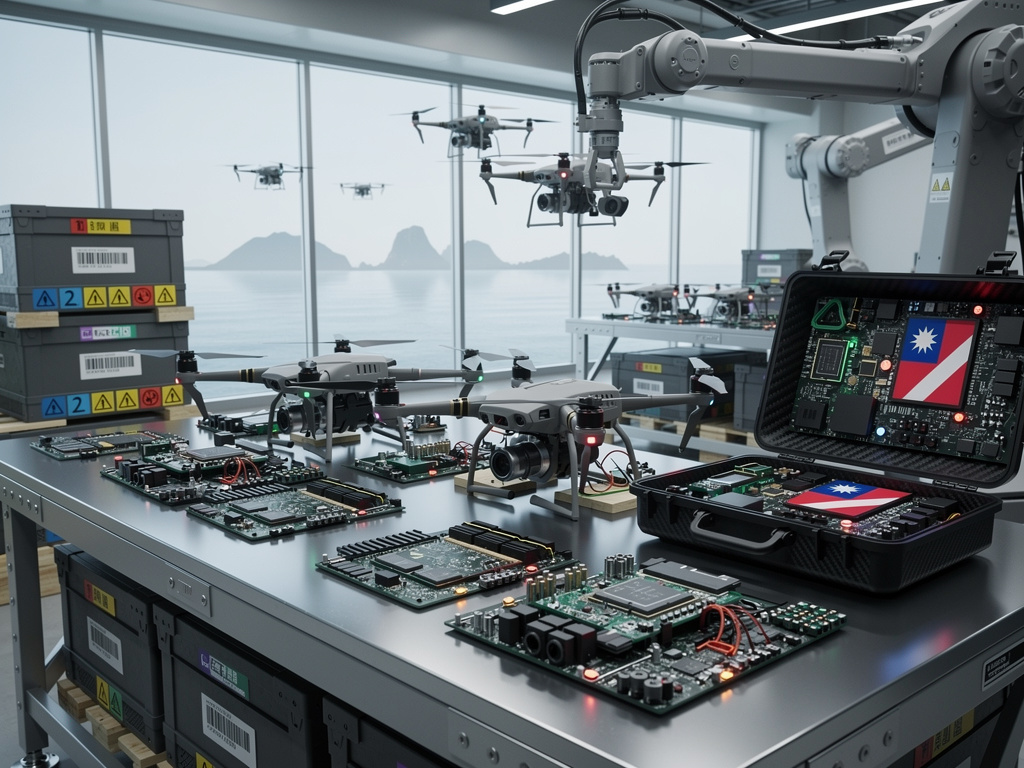
Taiwan’s Drone Surge: Enlisting Tech Titans to Fortify Skies Amid Geopolitical Tensions
Taiwan is accelerating its efforts to become a major player in drone technology, driven by the urgent need to enhance its defense capabilities in the face of escalating tensions with China. A former U.S. commerce official has emphasized that for Taiwan to succeed in this endeavor, it must involve its dominant technology industries more deeply. According to a report from Business Insider, Alan Estevez, who previously served as undersecretary of commerce for industry and security, highlighted during a recent event that Taiwan’s plans for drone production face significant hurdles without broader participation from its tech giants.
Estevez pointed out that while Taiwan’s government has prioritized drone development, the current ecosystem relies heavily on smaller firms and state-backed initiatives. He argued that integrating powerhouse companies like those in semiconductors could provide the scale and innovation needed to overcome economic and supply chain challenges. This perspective comes at a time when Taiwan is actively seeking to reduce dependencies on Chinese components, as noted in various industry analyses.
The push for domestic drone production is not just about military readiness but also about creating a resilient supply chain free from potential disruptions. Recent developments show Taiwan swapping out parts sourced from the People’s Republic of China to mitigate risks, especially with Beijing’s stated readiness goals looming by 2027.
Strategic Alliances and Supply Chain Shifts
Taiwan’s defense institute has partnered with research centers to boost the drone sector, signaling a concerted effort to advance technological capabilities. For instance, the Metal Industries Research and Development Centre signed a memorandum with the National Chung-Shan Institute of Science and Technology, as reported by Digitimes. This collaboration aims to foster innovation in drone manufacturing, drawing on Taiwan’s strengths in precision engineering and electronics.
Moreover, Taiwan is positioning itself as a hub for non-Chinese drone supply chains, attracting international interest amid surging defense demands. Ian Hsu, CEO of drone firm Earthbook, stated in a Digitimes article that governments are increasingly turning to Taiwan for secure procurement options. This shift is partly fueled by global concerns over supply chain vulnerabilities exposed by conflicts like the one in Ukraine, where drones have proven pivotal.
U.S. involvement is crucial in this equation. The U.S. has approved sales of drones and related systems to Taiwan, including a recent deal worth $360 million for over 1,000 small armed drones, as mentioned in posts on X from accounts like The Spectator Index. These transactions underscore Washington’s commitment to bolstering Taiwan’s asymmetric warfare capabilities.
Overcoming Industry and Economic Barriers
Despite these advancements, challenges persist in scaling up production. Estevez, in his comments covered by DNYUZ, stressed the need for Taiwan’s big businesses to get involved, noting that the drone industry currently lacks the economic muscle provided by sectors like semiconductors. Taiwan’s tech giants, such as TSMC, have global influence but have been cautious about diving into defense-related manufacturing due to potential geopolitical repercussions.
Economic hurdles include high development costs and the need for specialized talent. Taiwan’s government is addressing this through incentives and partnerships, but insiders argue that without broader industry buy-in, progress could stall. A report from Army Recognition details how Taiwan is accelerating domestic production to fix supply chain risks tied to China, including forming new units dedicated to drone operations.
Furthermore, international cooperation is expanding. The U.S. and Taiwan are exploring joint development of military drones, with plans accelerating in 2026, according to another Digitimes piece. This includes opportunities for Taiwanese manufacturers in key technologies, potentially integrating with U.S. firms like Anduril.
Defense Priorities and Technological Integration
Taiwan’s new administration has made security and surveillance top priorities, creating openings for U.S. drone companies, as outlined in a Trade.gov market intelligence report. This environment is fostering collaborations that could transform Taiwan into a key player in unmanned systems.
Legislators in Taiwan have even launched an international drone alliance, aiming to turn the sector into the island’s next “silicon shield,” per Taiwan News. This initiative seeks to leverage Taiwan’s technological prowess to deter aggression, much like its semiconductor dominance has done.
On the U.S. side, there’s a push to build a Pacific drone industrial base to counter China’s economic might, as discussed in Breaking Defense. Allies view unmanned systems and shared production as essential for interoperability and offsetting China’s scale.
Innovation in Unmanned Ecosystems
Recent exhibitions, such as the Taipei Aerospace & Defense Technology Exhibition 2025, have showcased Taiwan’s full-spectrum unmanned ecosystem, with state developers and private firms displaying advanced UAVs. Posts on X from users like Owen Gregorian highlight Taiwan’s plan for 50,000 UAVs to deter China, drawing inspiration from modern warfare tactics.
The Pentagon is supporting Taiwan’s vision of turning the Taiwan Strait into a “drone hellscape,” with swarms of attack drones for detection, jamming, and striking invaders. This concept, inspired by lessons from Ukraine, is gaining traction, as noted in X posts from accounts like WAR.
Additionally, specific deals are materializing, such as Color Optics manufacturing Edge Autonomy’s Penguin C Mk2.5 VTOL drone, reinforcing China-free supply chains, according to a post from Taiwan in New York on X. This supports defense, rescue, and surveillance needs.
Geopolitical Context and Future Prospects
Broader geopolitical dynamics are influencing these developments. A recent update from the Institute for the Study of War, available at ISW, discusses China’s temporary suspension of rare earth export controls as a de-escalation tactic amid long-term strategies to hinder U.S. tech progress.
Another ISW update from December 19, 2025, at ISW, notes the People’s Liberation Army’s cooperation with Russia to enhance invasion capabilities, underscoring the urgency for Taiwan’s drone buildup.
Industry experts, like those from DSET Taiwan, emphasize in X posts the elevation of UAV and USV procurement through Taiwan’s $40 billion defense push and the U.S. 2025 NDAA, covering co-production and lessons from Ukraine’s naval drones.
Challenges Ahead for Scalability
Scaling drone production involves not just technology but also workforce development. Taiwan must train engineers and technicians specialized in unmanned systems, a gap that collaborations with U.S. firms could help fill.
Economic incentives are key. Government subsidies and tax breaks are being considered to lure tech giants into the fold, but concerns over intellectual property and international sanctions remain.
Moreover, integrating drones into Taiwan’s overall defense strategy requires interoperability with existing systems, a point raised in various analyses. This includes software for swarm intelligence and AI-driven autonomy.
Global Implications and Collaborative Efforts
The U.S.-Taiwan drone cooperation extends beyond hardware to include tactical mission networks, with recent approvals for sales worth over $1 billion, as seen in X posts from Ainvest Push News.
Such partnerships are vital for countering Beijing’s aggression, aligning with America’s Indo-Pacific strategy. They prioritize allies upholding democratic values, per sentiments in X discussions.
As Taiwan emerges as a drone hub, the involvement of its tech industries could redefine regional power dynamics, providing a model for other nations facing similar threats.
Sustaining Momentum in Drone Advancements
To maintain momentum, Taiwan is investing in research and development, with partnerships like those between local firms and international players accelerating innovation.
For example, Redwire’s Edge Autonomy licensing its Penguin drone for production in Taiwan, as mentioned in X posts from Space Investor, enhances long-endurance ISR capabilities for coastline monitoring.
Ultimately, the success of Taiwan’s drone push hinges on blending its technological strengths with strategic alliances, ensuring a robust defense posture in an increasingly volatile region. This multifaceted approach, drawing on insights from officials like Estevez and ongoing international collaborations, positions Taiwan to navigate the complexities of modern warfare effectively.


 WebProNews is an iEntry Publication