
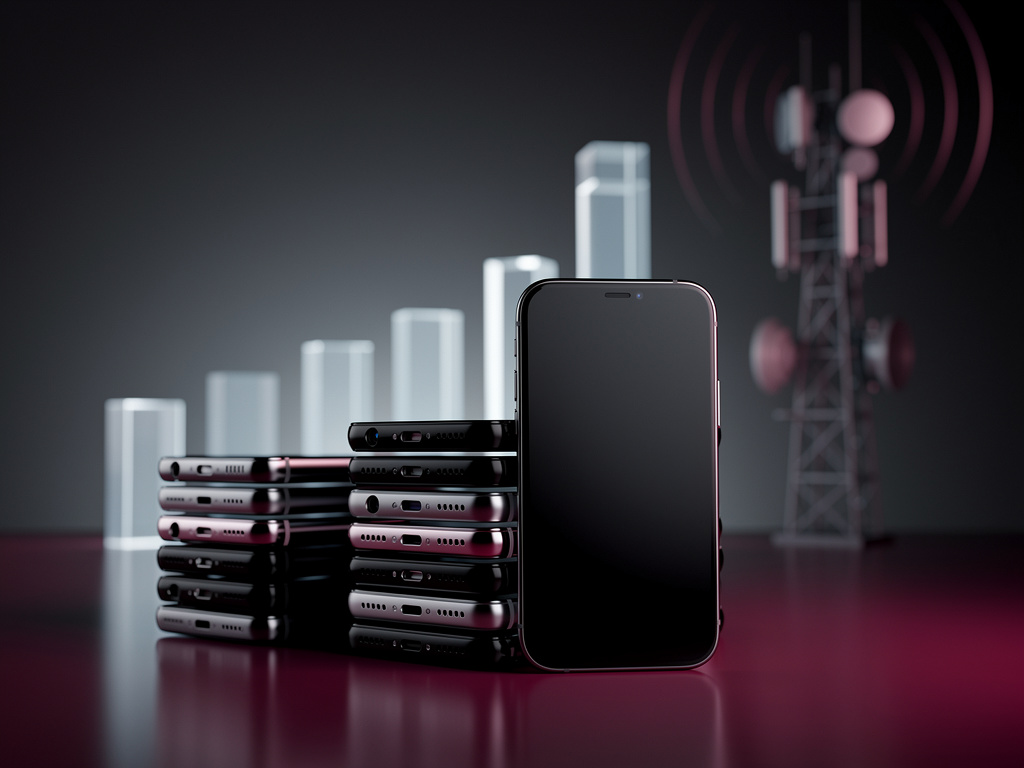
For years, T-Mobile US Inc. built its brand on being the uncarrier — the scrappy disruptor that lured tens of millions of subscribers away from AT&T and Verizon with provocative promotions and, most famously, free phones. That era appears to be ending, not with a bang but with a policy change buried in the fine print.
T-Mobile has quietly eliminated its most aggressive device promotions for existing customers, pulling back on the “free phone” trade-in offers that became synonymous with its identity under former CEO John Legere and, more recently, under current chief Mike Sievert. The shift, first reported by Yahoo Finance, represents a significant strategic pivot for the nation’s second-largest wireless carrier — one that prioritizes profitability over the subscriber-at-any-cost mentality that defined the company’s meteoric rise.
The timing isn’t accidental.
T-Mobile now has more than 100 million postpaid subscribers, a figure that would have seemed fantastical a decade ago when it trailed far behind its two larger rivals. With that scale comes a different calculus. The company no longer needs to buy its way into customers’ pockets with $1,000 device credits. It can afford to be selective, and Wall Street has been rewarding carriers that demonstrate pricing discipline rather than growth-at-all-costs aggression.
Under the revised promotion structure, existing T-Mobile customers looking to upgrade their devices will find far less generous trade-in values. New customers can still access premium deals — a classic acquisition strategy — but the days of loyal subscribers walking into a T-Mobile store and walking out with a flagship Samsung Galaxy or Apple iPhone essentially free are fading fast. The change affects millions of subscribers who had grown accustomed to upgrading every two to three years at minimal cost, often trading in devices with cracked screens or degraded batteries for full credit toward the latest model.
The Profitability Pivot and What It Means for 100 Million Subscribers
T-Mobile’s decision sits at the intersection of several forces reshaping the wireless industry simultaneously. Device subsidies have always been an expensive proposition for carriers. When T-Mobile offers a “free” iPhone 16 Pro Max — a device with a retail price of $1,199 — someone absorbs that cost. The carrier typically spreads the credit over 24 or 36 monthly bill credits, effectively locking the customer into a long-term commitment while eating the difference between the trade-in’s actual resale value and the promotional credit offered. At scale, across millions of upgrades per quarter, these promotions represent billions in foregone revenue.
Sievert has been telegraphing this shift for several quarters, telling analysts on earnings calls that T-Mobile intends to grow its average revenue per user, or ARPU, a metric that Wall Street watches obsessively. The company reported strong first-quarter 2025 results, with postpaid phone net additions of 532,000 — solid but not the blockbuster numbers it posted during its most aggressive promotional periods. The message from management has been consistent: sustainable, profitable growth over raw subscriber additions.
That’s a very different T-Mobile than the one Legere built.
When Legere took over in 2012, T-Mobile was hemorrhaging customers and widely considered a takeover target with no independent future. His uncarrier strategy — abolishing contracts, eliminating overage charges, offering free international roaming, and eventually subsidizing devices at unprecedented levels — was born of desperation as much as vision. It worked spectacularly. T-Mobile went from roughly 33 million customers to completing a merger with Sprint in 2020 that created a combined entity rivaling AT&T and Verizon in scale.
But the competitive dynamics that justified those promotions have fundamentally changed. The U.S. wireless market is mature. Nearly every American adult has a smartphone. The three major carriers — T-Mobile, AT&T, and Verizon — plus cable operators like Comcast’s Xfinity Mobile and Charter’s Spectrum Mobile, are largely fighting over each other’s existing customers rather than converting new users. In that environment, the return on investment for aggressive device promotions diminishes. You’re spending more to acquire customers who are increasingly likely to churn back to a competitor offering their own free phone deal in 18 months.
AT&T and Verizon have been on similar trajectories, gradually tightening their own promotional terms. Verizon’s recent earnings calls have emphasized “value over volume,” and AT&T has been quietly raising prices on legacy plans while steering customers toward more expensive unlimited tiers. The entire industry is moving toward extracting more revenue from existing subscribers rather than endlessly chasing new ones. T-Mobile is simply being the most transparent about the shift — or rather, the least transparent, given how quietly the change was implemented.
Consumer reaction has been predictably negative. Social media posts and wireless industry forums have lit up with complaints from long-time T-Mobile customers who feel the company is abandoning the ethos that attracted them in the first place. On X, users have shared screenshots of dramatically reduced trade-in offers, with some reporting that devices that would have fetched $800 or more in promotional credit a few months ago now qualify for $300 or less. The frustration is understandable. These aren’t customers who signed up for a traditional carrier experience. They chose T-Mobile specifically because it promised to be different.
And yet the financial logic is hard to argue with. T-Mobile’s stock has outperformed both AT&T and Verizon over the past year, driven in part by improving margins and strong free cash flow generation. The company has been aggressively buying back shares — it authorized a $19 billion repurchase program — and raising its dividend, moves that require consistent cash generation. Every dollar not spent on device subsidies flows more directly to the bottom line.
There’s also a competitive moat argument. T-Mobile’s 5G network, built on the mid-band spectrum it acquired through the Sprint merger, is widely considered the best in the country by independent testing firms like Ookla and Opensignal. If your network is genuinely superior, you don’t need to give away phones to attract customers. The product sells itself — or at least, that’s the bet Sievert is making.
The risk is real, though. Brand loyalty in wireless is notoriously thin. Customers who came for the deals may leave when the deals disappear, especially if AT&T or Verizon sense an opportunity to poach subscribers with their own limited-time promotions. Cable MVNOs, which operate on Verizon’s network, continue to offer aggressively priced plans that bundle wireless with broadband service. And newer entrants like Dish Network’s Boost Mobile, despite its struggles, could target the value-conscious segment T-Mobile may be abandoning.
So where does this leave the average T-Mobile customer? In a more expensive relationship with their carrier, most likely. Not dramatically so — monthly plan prices haven’t spiked — but the total cost of ownership over a two-year device cycle will increase meaningfully for anyone who relied on generous trade-in promotions to offset the ever-rising price of flagship smartphones. Apple’s iPhone 16 Pro starts at $999. Samsung’s Galaxy S25 Ultra hits $1,299. Without a $800 trade-in credit smoothing the upgrade path, those prices start to bite.
T-Mobile will likely argue that it still offers competitive value, pointing to its plan pricing, network quality, and perks like Netflix on Us. And for new customers, the welcome mat still has a few freebies on it. But the carrier’s relationship with its installed base is being renegotiated in real time, whether those customers realize it yet or not.
The wireless industry has always operated in cycles of aggression and consolidation. Carriers spend heavily to acquire subscribers, then tighten the screws to monetize them, then loosen up again when growth stalls. T-Mobile is entering the tightening phase with more confidence than its rivals ever could — backed by a superior network, massive scale, and a stock price that rewards discipline. Whether its customers will stick around for this less generous version of the uncarrier remains the open question. The answer will show up in churn numbers over the next several quarters.
For now, the free phone era at T-Mobile is over. The company just didn’t bother to announce it.


 WebProNews is an iEntry Publication