
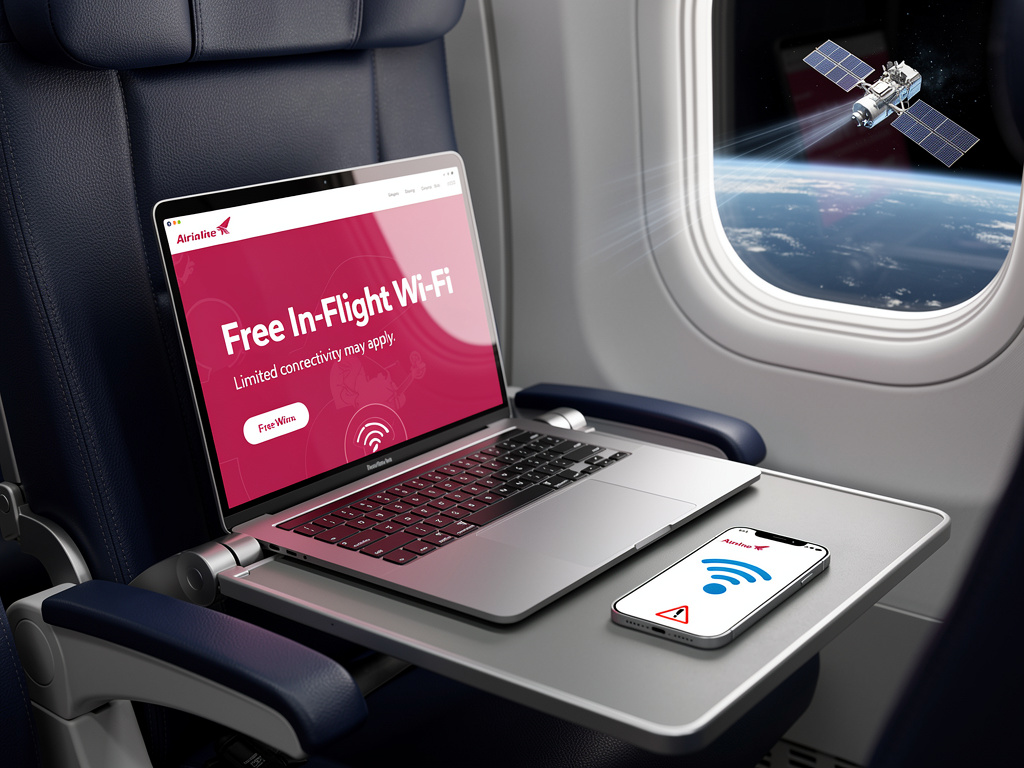
When T-Mobile announced its partnership with SpaceX’s Starlink to deliver free in-flight Wi-Fi to all passengers aboard select airlines, it was heralded as a game-changing moment for air travel connectivity. The Un-carrier’s bold marketing campaign promised a seamless, complimentary internet experience at 30,000 feet — the kind of perk that could reshape how travelers choose their wireless provider. But as the service rolls out across United Airlines flights, a growing chorus of customers and industry observers are raising pointed questions about whether T-Mobile’s claims match reality.
The crux of the controversy centers on what “free” actually means in T-Mobile’s formulation, and whether the carrier’s advertising crosses the line from aspirational marketing into misleading territory. As reported by Android Police, T-Mobile has been promoting its in-flight Wi-Fi as a signature benefit, but the actual experience for many passengers has fallen short of the carrier’s sweeping promises.
The Gap Between Marketing and the Middle Seat Experience
T-Mobile’s marketing materials paint a picture of effortless connectivity. The carrier has prominently featured its Starlink-powered in-flight Wi-Fi in advertising campaigns, positioning it as a key differentiator in the fiercely competitive wireless market. CEO Mike Sievert has personally championed the initiative, framing it as another chapter in T-Mobile’s long-running “Un-carrier” strategy of disrupting industry norms that frustrate consumers.
Yet the reality passengers encounter is considerably more complicated. According to the Android Police investigation, T-Mobile’s free tier of in-flight Wi-Fi comes with significant limitations that the carrier’s headline marketing fails to adequately communicate. The free service is restricted to basic browsing and messaging, while activities that most modern internet users consider routine — streaming video, video calls, and large downloads — require passengers to pay for a premium tier regardless of their T-Mobile plan status.
What T-Mobile Actually Offers Versus What Customers Expect
The disconnect between expectation and delivery is particularly acute because of how T-Mobile has framed the benefit. When the carrier announces “free Wi-Fi for all” on flights, consumers reasonably interpret that as full, unrestricted internet access. The fine print tells a different story. T-Mobile customers on qualifying plans receive a basic connectivity tier at no charge, but the bandwidth caps and content restrictions mean the experience is far from the robust connection the marketing suggests.
This tiered approach is not inherently problematic — airlines and connectivity providers have long offered stratified service levels. The issue, critics argue, is the mismatch between T-Mobile’s bold, unqualified claims and the hedged reality. It’s the difference between advertising “free dinner” and delivering a complimentary bread basket while charging full price for the entrée. For an industry that has built its brand on transparency and consumer advocacy, the optics are particularly unflattering.
The Starlink Factor and the Technology Behind the Promise
The technical backbone of T-Mobile’s in-flight offering is SpaceX’s Starlink satellite constellation, which represents a genuine leap forward in aviation connectivity. Traditional in-flight Wi-Fi systems, often powered by aging air-to-ground networks or older satellite technology, have long been the bane of air travelers — slow, unreliable, and expensive. Starlink’s low-Earth orbit satellites promise dramatically faster speeds and lower latency, and early reviews of the hardware’s performance have been largely positive.
United Airlines has been the primary launch partner for the Starlink-equipped fleet, with the carrier progressively retrofitting aircraft with the new satellite terminals. The airline itself has been more measured in its claims, positioning the Starlink upgrade as a premium connectivity improvement across the board. But T-Mobile’s marketing engine has seized on the partnership to drive subscriber acquisition and retention, sometimes outpacing what the service currently delivers to everyday users.
Industry Observers and Consumer Advocates Weigh In
The scrutiny of T-Mobile’s claims comes at a sensitive time for the wireless industry, where carriers are increasingly bundling ancillary benefits — from streaming subscriptions to travel perks — to justify premium plan pricing. T-Mobile’s Go5G Plus and Go5G Next plans, which command monthly rates well above the carrier’s entry-level offerings, are the plans most closely associated with the in-flight Wi-Fi benefit. This creates a dynamic where the “free” Wi-Fi is effectively baked into the cost of an expensive wireless plan, further complicating the carrier’s value proposition.
Consumer advocacy groups have long warned about the wireless industry’s tendency to use asterisk-laden promotions that obscure material limitations. The Federal Trade Commission has historically taken action against carriers for misleading advertising — T-Mobile itself paid $48 million in 2014 to settle FTC charges related to cramming unauthorized charges on customer bills. While the current in-flight Wi-Fi situation is far less egregious, it follows a pattern that regulators and consumer watchdogs monitor closely.
How Rivals Are Approaching the Same Challenge
T-Mobile’s competitors are watching the in-flight Wi-Fi controversy with keen interest. AT&T and Verizon have both explored partnerships with aviation connectivity providers, though neither has made claims as sweeping as T-Mobile’s. The cautious approach of T-Mobile’s rivals may reflect lessons learned from the backlash that accompanies overpromising on emerging technology benefits.
Delta Air Lines, for its part, announced its own free Wi-Fi initiative powered by Viasat’s satellite network, offering complimentary connectivity to all passengers regardless of wireless carrier. Delta’s approach — making the benefit universal and airline-branded rather than tying it to a specific wireless provider — has drawn favorable comparisons, as it avoids the confusion inherent in T-Mobile’s carrier-specific model. When the airline itself provides the benefit, passengers don’t need to navigate the question of which wireless plan qualifies them for which tier of service.
T-Mobile’s Track Record of Bold Claims and Course Corrections
T-Mobile’s corporate DNA has always favored aggressive, attention-grabbing announcements. Under former CEO John Legere and continuing under Sievert, the company has thrived by making audacious promises and then working to fulfill them — sometimes adjusting the details after the initial splash. The carrier’s 5G rollout followed a similar trajectory: early claims of transformative nationwide coverage gave way to a more nuanced reality of varying speeds and availability depending on location and network band.
This pattern suggests that T-Mobile may eventually align its in-flight Wi-Fi marketing more closely with the actual customer experience, either by improving the free tier’s capabilities or by tempering its advertising claims. The Starlink technology itself continues to improve, and as more aircraft are equipped and the satellite constellation grows denser, the gap between promise and performance could narrow organically.
What This Means for the 80 Million Passengers Who Fly Annually
For the millions of Americans who fly regularly and carry T-Mobile service, the practical implications are straightforward but important: read the fine print before assuming your flight will feature the robust, free connectivity that T-Mobile’s ads suggest. Check whether your specific plan qualifies, understand the bandwidth limitations of the free tier, and budget for the premium tier if you need to do anything beyond basic messaging and light browsing.
The broader lesson extends beyond T-Mobile and in-flight Wi-Fi. As wireless carriers increasingly compete on lifestyle benefits rather than raw network performance, the gap between marketing promise and delivered experience becomes a critical consumer issue. T-Mobile’s in-flight Wi-Fi is a genuinely innovative offering that represents real progress for air travel connectivity. But innovation loses its luster when it arrives wrapped in claims that set expectations the product cannot yet meet. The Un-carrier built its brand on straight talk and consumer empowerment. Its customers — and its credibility — deserve nothing less at cruising altitude.


 WebProNews is an iEntry Publication