
T-Mobile has spent years chasing a simple idea. Put customers in control. Cut the friction. Make wireless feel personal. The vehicle for that vision? Its T-Life app.
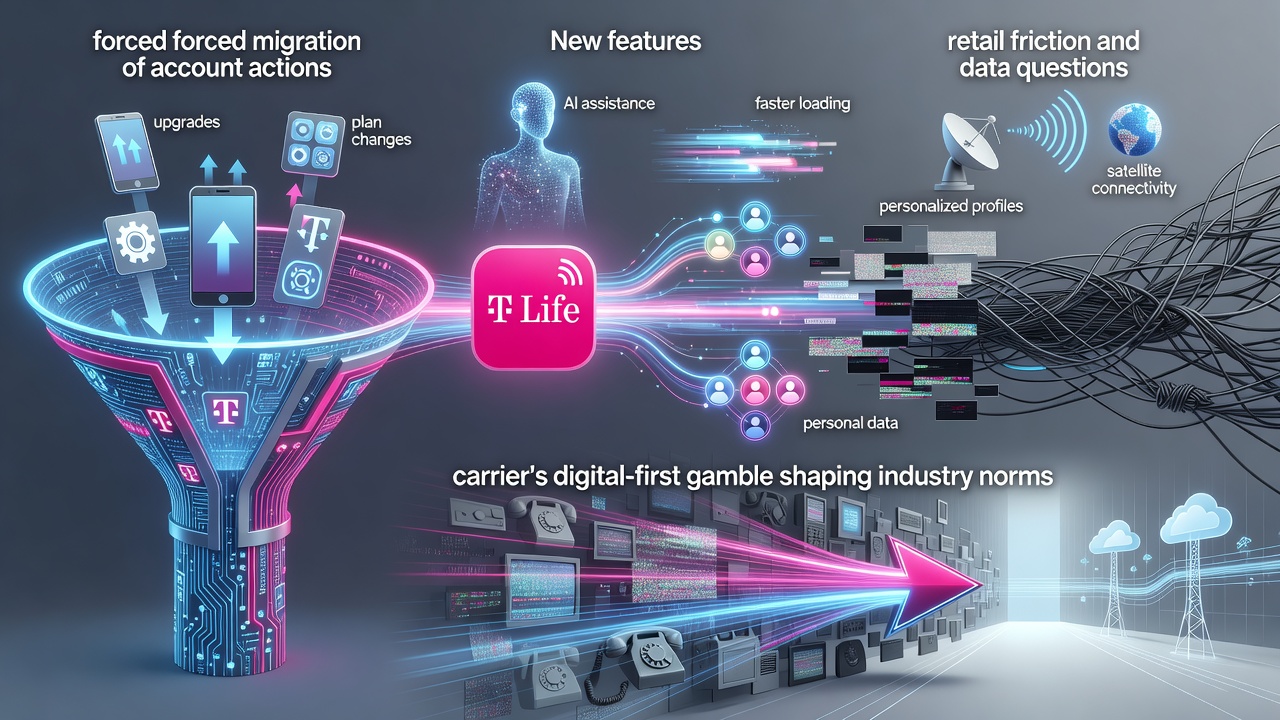
Once a rewards program called T-Mobile Tuesdays, the app now stands as the carrier’s central command center. More than 100 million installs. Millions of daily users. And a hard deadline: by August 1, 2026, nearly every upgrade, line addition and major account move must happen inside it.
The shift marks a decisive turn toward digital self-service. Stores won’t vanish. But their role narrows. Phone support shrinks. The app becomes the default path for almost everything. Some customers welcome the speed. Others see friction, especially those with older devices or urgent needs.
Customer data now shapes every interaction
Executives describe the strategy as listening first. Omar Tazi, T-Mobile’s EVP and chief product and digital officer, put it plainly in a November 2025 blog post. “T-Life is a perfect embodiment of our mission to be the best in the world at connecting customers to their world,” he said. (T-Mobile Newsroom)
That mission shows up in concrete changes. Last November the app gained an always-on AI assistant. Customers can ask it about device upgrades, plan comparisons or current promotions using natural language. Think shopping with a knowledgeable friend available 24/7. The same update brought tighter home internet controls, easier device recycling for any phone and integration with T-Satellite connectivity via Starlink. Users in remote areas can now run navigation, messaging and weather apps even without cell signal. (T-Mobile Newsroom)
March 2026 delivered another wave. The app loads 30 percent faster. Sign-in issues dropped. Customers can now change their phone number directly, compare plans side-by-side and switch carriers in about 15 minutes using an Easy Switch guided flow. New customers get 90 days to pick a device after porting. Same-day delivery options appear at checkout, tracked through DoorDash with a free year of DashPass for qualifying plans. (T-Mobile Newsroom)
Sailesh Chaudhary, senior vice president of product management, highlighted the feedback loop. “You’ve been clear about what you want next: fewer steps and more control. We heard you,” he wrote. The updates organize Metro by T-Mobile features more intuitively and group perks such as Amazon Prime and Refer a Friend. (T-Mobile Newsroom)
Yet the pace has exposed cracks. In May 2026 an internal email from COO Jon Freier set the final timeline. Legacy sales systems would lose access after July 31. From August 1 every upgrade and add-a-line transaction defaults to T-Life, including inside big-box partners like Costco. New customer activations follow in October. “Every upgrade and add-a-line transaction whether done in a store, over the phone, from the couch, wherever, will be done exclusively in T-Life as of August 1,” Freier stated. (TMO Report)
Retail staff report pressure to hit usage quotas. Some walk-in customers with older phones get turned away or redirected to Apple Stores because they cannot install the app on the spot. Android Authority documented cases where broken devices left owners unable to transact without first borrowing another phone. T-Mobile responded that exceptions exist and the company continues refining the experience. (Android Authority, published May 27, 2026)
A fresh blog post today adds another layer. T-Mobile plans richer account profiles built on interest-based preferences. The carrier says this will surface tailored benefits, recognize birthdays and create more personal touches. Android Authority immediately asked whether the data feeds marketing efforts. The question remains open. (Android Authority)
The personalization push arrives alongside record engagement numbers. Daily, weekly and monthly active users hit new highs after the app became mandatory for in-store transactions. T-Mobile releases more than 10 features monthly. Tuesdays bring fresh perks. Spanish-language support expanded. Cart edits no longer require starting over. Trade-in values update in seconds.
But not everyone cheers. Some legacy plan holders received notices this week that T-Mobile will automatically migrate them to current offerings, sometimes with modest price bumps. Notifications arrive via text or the T-Life app itself. Those affected can switch plans or carriers but cannot stay on the old terms. CNET reported the move affects thousands of individual lines and some small businesses. (CNET, published two days ago)
Outages have stung too. In February the app and supporting systems went dark, blocking account access and 611 support for hours. Users flooded social channels with frustration. T-Mobile restored service quickly but the episode underscored reliance on a single digital front door.
Analysts see the strategy as logical yet risky. Wireless carriers face rising customer acquisition costs. Digital tools can cut call-center volume by 30 percent and speed upgrades by 25 percent, according to T-Mobile’s internal figures. Fewer clicks mean lower abandonment. Yet forcing adoption creates friction for segments least comfortable with apps: older adults, low-income users, those facing emergencies.
T-Mobile insists feedback guides every release. The company points to net promoter scores and engagement data. It promises continued improvements to switching, shopping and account views. Metro customers receive dedicated tweaks. Home internet troubleshooting lives in the same place as wireless billing.
And the environmental angle? In-app recycling of any device, broken or not, supports the carrier’s 2040 net-zero goal. That feature drew praise from sustainability watchers even as privacy questions linger around richer profiles.
So where does this leave the industry? Verizon and AT&T watch closely. Both have invested in their own apps but stopped short of such aggressive mandates. If T-Mobile proves the model works without massive churn, rivals may follow. Success hinges on execution. The app must stay fast, intuitive and reliable. Exceptions for edge cases must remain generous. Data practices must stay transparent.
Customers already vote with downloads. Over 100 million installs suggest many like the direction. Record active-user numbers reinforce the point. But the true test comes after August 1, when choice narrows and the app becomes the only practical path for millions.
T-Mobile bets that convenience will outweigh the complaints. Shorter lines. Faster switches. Personalized offers that actually match needs. An AI assistant that feels helpful rather than scripted. Satellite connectivity that works in the backcountry. All from one screen.
The bet looks smart on paper. Implementation will decide whether it feels like progress or just another obligation. For now the carrier keeps shipping updates every Tuesday. Customers keep their phones handy. And the wireless experience, for better or worse, flows increasingly through a single app named T-Life.


 WebProNews is an iEntry Publication