
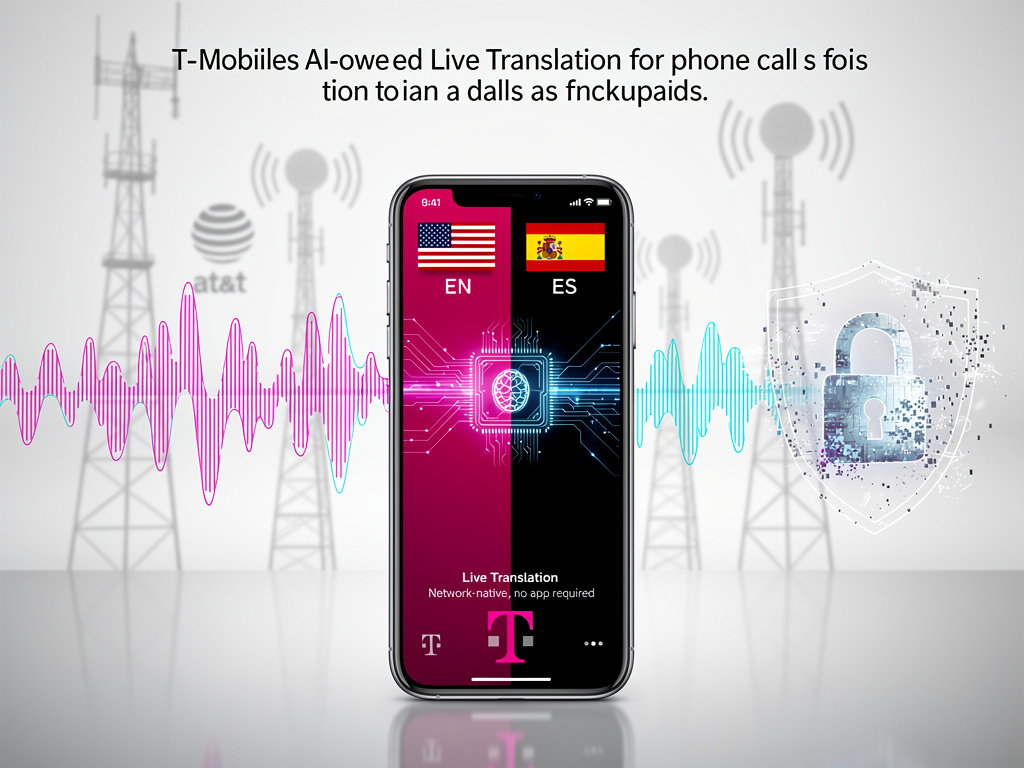
In a move that could fundamentally reshape how millions of Americans communicate across language divides, T-Mobile has begun rolling out a real-time translation feature for phone calls that works natively on its network—no app download required. The capability, which leverages artificial intelligence to translate conversations on the fly, represents one of the most ambitious deployments of AI technology by a major U.S. wireless carrier and signals a new front in the intensifying competition among telecom giants to differentiate their services beyond mere connectivity.
The feature, called T-Mobile Live Translation, was first announced at CES 2025 in January and has now entered a broader rollout phase. As reported by Android Authority, the service translates voice calls in real time between English and Spanish, with additional languages expected to follow. What makes the offering particularly notable is its network-level integration: the translation happens without requiring either party on the call to install a third-party application, removing a significant friction point that has historically limited adoption of translation tools in voice communication.
How the Technology Works Under the Hood
T-Mobile’s Live Translation operates through an AI-driven system that intercepts the audio stream during a phone call, transcribes the spoken words, translates them into the target language, and then converts the translated text back into synthesized speech—all in near real time. The entire process occurs with minimal latency, a technical achievement that required significant investment in both AI model optimization and network infrastructure. According to Android Authority, the feature is being powered by a combination of T-Mobile’s own technology stack and partnerships with AI firms specializing in natural language processing.
The initial language pair—English and Spanish—is a strategically calculated choice. The United States is home to more than 41 million native Spanish speakers and an additional 12 million bilingual speakers, according to U.S. Census data, making it the second-largest Spanish-speaking country in the world by some measures. For T-Mobile, which has historically cultivated a strong customer base among Hispanic and Latino communities through its Metro by T-Mobile brand and targeted marketing initiatives, the feature addresses a genuine and widespread consumer need rather than serving as a mere technological novelty.
A Carrier-Level Play That Bypasses the App Economy
What distinguishes T-Mobile’s approach from existing translation solutions—such as Google Translate’s conversation mode, Apple’s Translate app, or dedicated devices like the Pocketalk translator—is the network-native implementation. Users do not need a smartphone with specific hardware capabilities, nor do they need to navigate to an app mid-conversation. The translation is embedded into the call experience itself, which means it can theoretically work across device types, including older phones that lack the processing power to run sophisticated AI models locally.
This carrier-level integration represents a philosophical shift in how wireless companies view their role. For years, the major U.S. carriers—T-Mobile, AT&T, and Verizon—have largely functioned as infrastructure providers, building and maintaining the networks over which third-party services operate. T-Mobile’s CEO Mike Sievert has repeatedly signaled his intention to move beyond this model, positioning T-Mobile as a technology company that delivers unique experiences on top of its network. Live Translation is perhaps the most tangible manifestation of that ambition to date.
The Competitive Implications for AT&T and Verizon
Neither AT&T nor Verizon has announced a comparable feature, though both carriers have been making their own investments in AI-driven services. AT&T has focused its AI efforts primarily on network optimization and customer service automation, while Verizon has explored AI applications in enterprise solutions and edge computing. T-Mobile’s consumer-facing deployment of real-time translation gives it a first-mover advantage in a category that could prove to be a meaningful differentiator, particularly in markets with large multilingual populations such as Southern California, South Florida, Texas, and the New York metropolitan area.
The timing of the rollout is also significant. The wireless industry is in a period where the major carriers are finding it increasingly difficult to compete on network quality alone. With 5G coverage becoming more ubiquitous and speed differentials narrowing, carriers are searching for value-added services that can reduce churn and justify premium pricing. T-Mobile’s translation feature fits neatly into this strategy, offering a tangible benefit that customers can immediately understand and appreciate—a rarity in an industry often criticized for marketing abstract technical specifications.
Privacy Concerns and the AI Trust Deficit
The deployment of AI-powered call translation inevitably raises questions about privacy and data security. For the system to function, T-Mobile’s AI must process the audio content of phone calls—a prospect that may unsettle consumers already wary of corporate surveillance and data collection. T-Mobile has stated that the translation processing is designed with privacy protections in mind, though the company has not yet provided exhaustive technical details about how call data is handled, stored, or potentially used for model training purposes.
Privacy advocates have noted that any system that processes call audio in real time creates potential vulnerabilities, whether from internal misuse, external hacking, or government surveillance requests. The Electronic Frontier Foundation and similar organizations have long warned about the risks of carrier-level data processing, and T-Mobile’s history includes a massive data breach in 2023 that affected tens of millions of customers. The company will need to demonstrate robust safeguards and transparent policies to earn consumer trust for a feature that, by its very nature, requires access to the substance of private conversations.
The Broader AI Arms Race in Telecommunications
T-Mobile’s Live Translation is part of a much larger trend of AI integration across the telecommunications sector globally. Deutsche Telekom, T-Mobile’s parent company, has been investing heavily in AI across its European operations, and competitors worldwide are exploring similar capabilities. In Asia, carriers like SK Telecom in South Korea have already deployed AI-powered call assistants that can screen spam calls, summarize voicemails, and even conduct basic conversations on behalf of users.
Google and Apple, meanwhile, continue to build translation capabilities directly into their mobile operating systems. Google’s Pixel phones offer real-time translation features through the Google Assistant, and Apple has been expanding its on-device translation capabilities with each iOS release. The question for T-Mobile is whether a network-level solution can maintain its relevance as device-side AI becomes increasingly powerful. The carrier’s advantage lies in universality—its feature works regardless of the device brand—but that advantage could erode as smartphone AI chips become more capable and translation models become small enough to run entirely on-device with high accuracy.
What Comes Next: Beyond Spanish and Into Enterprise
T-Mobile has indicated that Spanish is merely the starting point, with plans to add additional languages over time. The expansion roadmap has not been publicly detailed, but industry analysts expect Mandarin Chinese, French, Korean, Vietnamese, and Tagalog to be among the likely additions, given the demographic composition of the U.S. population. Each new language pair adds complexity, as translation quality varies significantly depending on the linguistic distance between languages and the availability of high-quality training data.
Perhaps more intriguing is the potential enterprise application of the technology. Businesses that operate call centers, conduct international sales, or serve multilingual customer bases could find enormous value in a carrier-integrated translation service. T-Mobile’s business division could package the feature as part of enterprise wireless plans, creating a new revenue stream while simultaneously deepening its penetration in the business market—an area where it has historically trailed AT&T and Verizon.
A Defining Moment for the Un-Carrier
T-Mobile has built its brand identity around the “Un-carrier” concept—the idea that it exists to challenge the conventions and pain points of the traditional wireless industry. From eliminating contracts to including international roaming at no extra charge, the company has repeatedly introduced consumer-friendly policies that forced competitors to respond. Live Translation has the potential to be another such moment, particularly if the technology delivers on its promise of seamless, accurate, real-time communication across language barriers.
The stakes, however, are high. If the translation quality proves unreliable—producing awkward phrasing, missing nuance, or introducing errors in sensitive conversations—the feature could become a liability rather than an asset. Real-time translation remains one of the most challenging problems in AI, requiring not just linguistic accuracy but cultural sensitivity, contextual awareness, and the ability to handle accents, dialects, slang, and crosstalk. T-Mobile is betting that its AI infrastructure is ready for prime time. The millions of multilingual Americans who stand to benefit will be the ultimate judges of whether that bet pays off.


 WebProNews is an iEntry Publication