
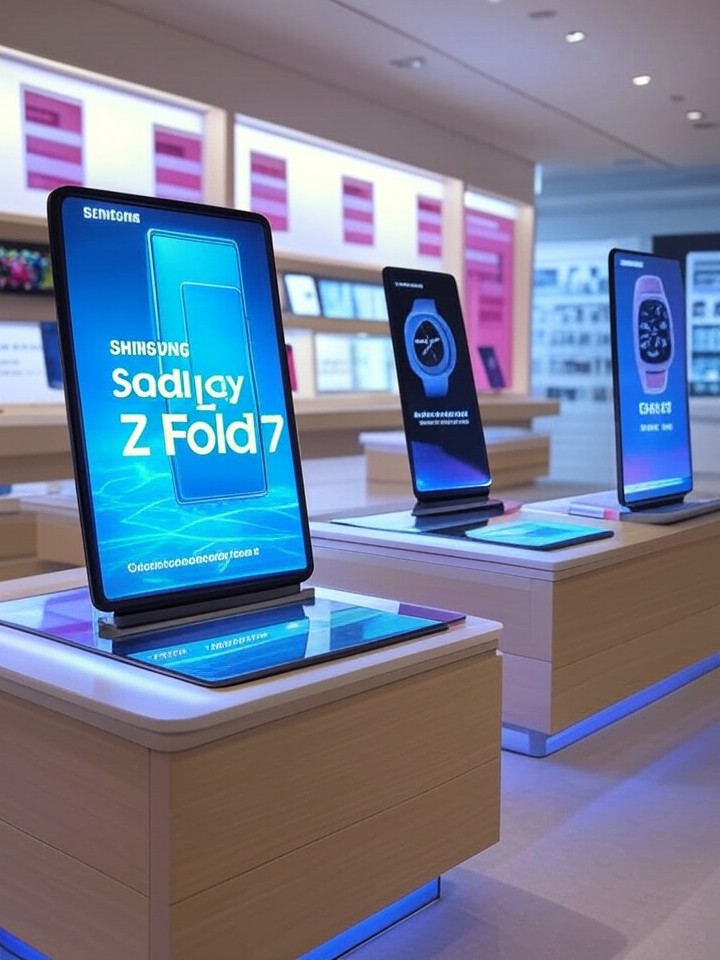
Holograms in the Aisle: T-Mobile’s Futuristic Push to Redefine Retail with Samsung’s 3D Tech
In the competitive arena of mobile retail, where carriers vie for consumer attention amid a sea of sleek devices and flashy promotions, T-Mobile is taking a leap into the future. The company has announced a pilot program to deploy holographic displays in select stores, aiming to showcase Samsung’s latest gadgets in a way that transcends traditional 2D screens. This initiative, set to highlight the Galaxy Z Fold 7 and Galaxy Watch 8, could mark a significant shift in how smartphones and wearables are marketed and sold.
The technology behind these displays comes from HYPERVSN, a firm specializing in 3D holographic projections that create immersive, floating visuals. According to reports, these setups promise to draw ten times more attention than conventional signage, with engagement rates soaring by 66%. T-Mobile’s move isn’t just about novelty; it’s a calculated strategy to boost foot traffic and sales in an era where online shopping dominates.
Early tests are slated for high-traffic markets like New York City and Seattle, with potential for wider rollout if successful. Industry observers note that this aligns with broader trends in retail innovation, where augmented reality and interactive displays are becoming tools to combat showrooming—the practice of browsing in-store before buying online.
The Tech Driving the Hype
At the heart of T-Mobile’s experiment is HYPERVSN’s hologram technology, which renders three-dimensional images of devices, complete with animations of key features like foldable screens or health tracking interfaces. This isn’t mere gimmickry; it’s backed by data suggesting heightened consumer interest. As detailed in a piece from Android Police, the displays aim to “drive engagement beyond static or 2D displays,” potentially transforming store visits into experiential events.
Samsung, no stranger to cutting-edge visuals, has been teasing holographic elements in its own ecosystem. A 2025 announcement from the company’s global newsroom highlighted immersive projections as part of Galaxy AI advancements, as covered in Samsung Global Newsroom. This collaboration with T-Mobile builds on that foundation, integrating Samsung’s device prowess with HYPERVSN’s projection tech.
For insiders, the real intrigue lies in the backend: these holograms use advanced LED fan systems to create illusions of depth without the need for special glasses. This accessibility could democratize 3D marketing, making it feasible for widespread adoption in retail environments.
Samsung’s Long Road to Holographic Reality
Samsung’s journey into holographics dates back years, with prototypes emerging as early as 2020. Researchers at the Samsung Advanced Institute of Technology (SAIT) published groundbreaking work on slim-panel holographic video displays, as explored in an interview on Samsung Global Newsroom. The thesis, featured in Nature Communications, addressed challenges like viewing angles and resolution, paving the way for practical applications.
More recently, innovations like combining OLEDs with metasurfaces have pushed boundaries further. A breakthrough from the University of St Andrews, reported in ScienceDaily, suggests holographic capabilities could soon fit into smartphones themselves, miniaturizing the tech for everyday use.
T-Mobile’s pilot leverages these advancements, focusing on Samsung’s foldable lineup. The Galaxy Z Fold 7, with its expansive screen and multitasking features, benefits immensely from 3D visualization, allowing customers to “interact” with the device in mid-air.
Market Implications and Consumer Response
The retail sector has long sought ways to enhance in-store experiences, and T-Mobile’s holographic bet could set a new standard. Posts on X (formerly Twitter) reflect growing excitement, with users speculating on how such tech might evolve smartphone displays by 2026. One prominent account highlighted Samsung’s patents for holographic tech dating back to 2018, underscoring the long-term investment.
Competitors are watching closely. If successful, this could pressure rivals like Verizon or AT&T to innovate similarly, potentially sparking a wave of AR-enhanced retail. Analysts point to the 66% engagement boost as a key metric; in a market where device sales often hinge on hands-on demos, holograms offer a sanitary, scalable alternative post-pandemic.
Consumer sentiment, gleaned from social media buzz, leans positive. Discussions on X praise the immersive potential, with some envisioning holograms replacing physical mockups to reduce inventory costs.
Challenges on the Horizon
Despite the promise, hurdles remain. Holographic displays require precise lighting and space, which could complicate rollout in smaller stores. Cost is another factor; while HYPERVSN’s tech is more affordable than laser-based systems, scaling it nationwide demands significant investment.
Technical limitations persist, as noted in older reports like a 2020 New Scientist article on Samsung’s prototypes. Issues with resolution and energy efficiency must be addressed for sustained use.
Moreover, consumer adoption isn’t guaranteed. Will shoppers find holograms engaging or overwhelming? Early feedback from pilot markets will be crucial, with T-Mobile likely monitoring metrics like dwell time and conversion rates.
Broader Industry Ripples
Looking beyond retail, this initiative ties into Samsung’s CES 2026 showcases, where the company unveiled AI companions and advanced displays. Coverage from Samsung Global Newsroom describes a vision of AI-integrated living, with holographics playing a supporting role.
X posts from tech enthusiasts at CES highlighted stretchable Micro LED displays that morph from 2D to 3D, hinting at future integrations. This convergence of AI, holograms, and mobile tech could redefine user interfaces, making interactions more intuitive.
For T-Mobile, partnering with Samsung strengthens its position as an innovator. The carrier’s history of bold moves, like aggressive 5G rollout, positions it well to lead in experiential retail.
Innovation Meets Practicality
Drilling deeper, the holographic tech’s roots trace to SAIT’s eight-year research odyssey, as detailed in their 2020 interviews. Principal researchers emphasized holograms’ potential to replicate reality, from medical imaging to entertainment.
Recent developments, such as the University of St Andrews’ OLED-metamaterial fusion, promise compact holograms. This could extend to wearables like the Galaxy Watch 8, where 3D projections illustrate fitness data in real-time.
T-Mobile’s strategy also addresses retail pain points. With e-commerce giants like Amazon dominating, physical stores need differentiators. Holograms provide that wow factor, potentially increasing impulse buys.
Strategic Alliances and Future Visions
The T-Mobile-Samsung alliance isn’t isolated; it’s part of a ecosystem push. Samsung’s 2021 explorations into holographic TVs, as blogged by futurist Matthew Griffin on Fanatical Futurist, foreshadowed this retail application.
On X, leaks about the Galaxy S26 series tout advanced displays like COE technology, which could complement holographics for brighter, more efficient screens.
As 6G looms, enabling supercharged data for real-time holograms, the tech’s potential expands. Life-sized projections, once sci-fi, are nearing reality, with Samsung targeting 2028 launches.
Economic and Competitive Angles
Economically, this pilot could yield high returns. If holograms boost sales by even a fraction of the projected engagement, T-Mobile stands to gain market share. Industry reports suggest mobile retail is evolving toward hybrid experiences, blending physical and digital.
Competitive dynamics are shifting too. Posts on X from CES 2026 attendees noted Samsung’s Odyssey G9 3D monitor, signaling gaming applications that could cross over to mobile.
For insiders, the key takeaway is integration: how holograms fit into Samsung’s AI roadmap, enhancing features like voice-activated projections.
Toward a Holographic Horizon
As T-Mobile rolls out these displays, the initiative serves as a litmus test for holographic retail. Success could accelerate adoption across sectors, from automotive showrooms to fashion boutiques.
Samsung’s ongoing R&D, including patents for pocket-sized holograms, points to a future where devices project 3D interfaces anywhere.
Ultimately, this collaboration underscores a pivotal moment: when cutting-edge tech meets everyday commerce, potentially reshaping how we shop for the digital age. With pilots underway, the industry awaits data that could validate holograms as the next big thing in retail innovation.


 WebProNews is an iEntry Publication