
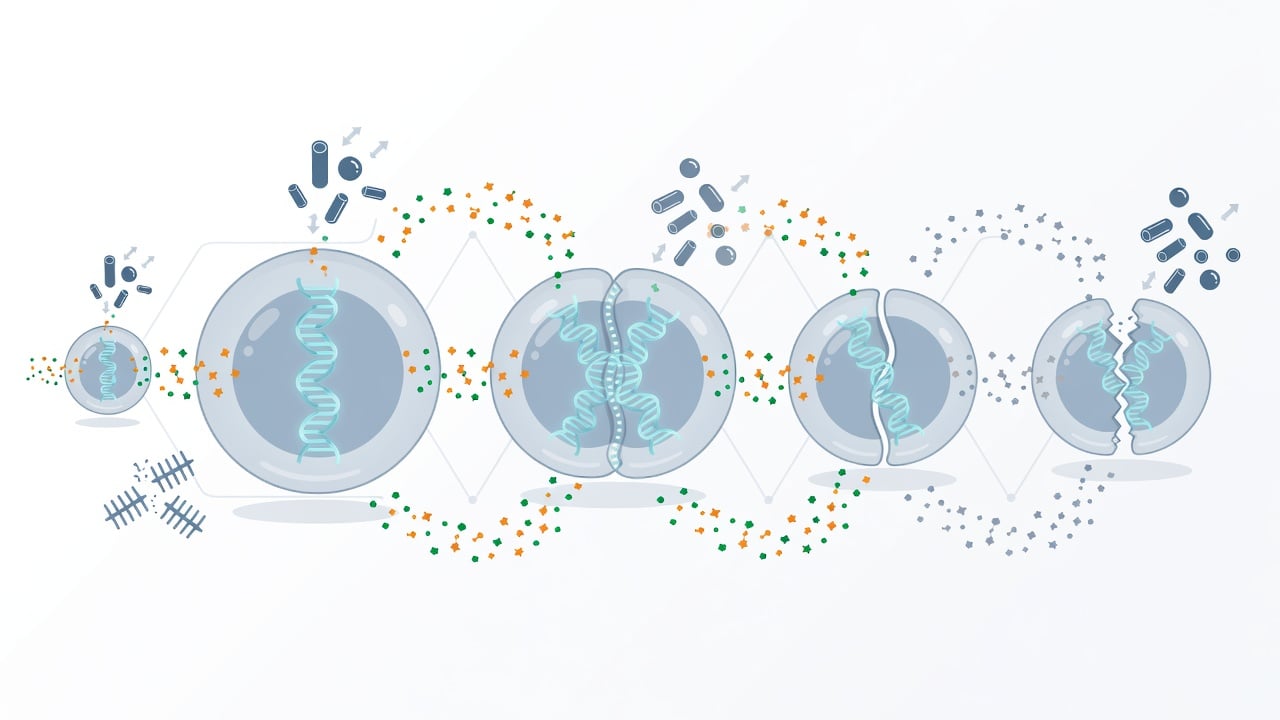
Researchers at the University of Minnesota have built a synthetic cell from scratch that feeds, grows, copies its DNA and divides for a handful of generations. The achievement marks a concrete advance in bottom-up synthetic biology. It shows that key functions of life can operate in a container assembled entirely from non-living chemicals.
The system, nicknamed SpudCell, relies on a minimal genome of about 90,000 base pairs spread across seven circular DNA molecules. That genome encodes enough information to produce a pore protein for nutrient uptake, a viral polymerase for transcription and components that enable membrane fusion with supplied nutrient packets. Ars Technica reported the work, noting the cell’s dependence on externally supplied translation machinery purified from tagged proteins developed at the University of Tokyo.
Kate Adamala, who led the project with Aaron Engelhart, described the effort as one of the most exciting of her career. “This is likely the most exciting project I’ve ever worked on,” she told the University of Minnesota news service. “We’ve replicated in chemistry what only used to be possible in biology: the complete set of behaviors of a cell. It proves that the most fundamental functions of life, like growth and replication, do not need a mysterious magical spark.”
University of Minnesota News detailed how SpudCell acquires resources through feeding. Small molecules pass through the engineered pore. Larger components, including ribosomes and other proteins, arrive inside separate lipid vesicles. Tags on the pore protein promote fusion between the cell membrane and the food vesicle, dumping fresh material inside while expanding the boundary. The added volume drives growth.
Division happens without the cytoskeletal machinery that natural cells deploy. Proteins crowd at the membrane surface until mechanical stress causes the vesicle to pinch and separate. The process is imperfect. After roughly five generations each lasting about 12 hours at 30 degrees Celsius, most daughter cells lack at least one of the seven genome segments. Yet those generations proved long enough to observe natural selection at work.
By tuning the genome to increase production of the fusion-mediating pore protein, researchers created variants that grew faster under nutrient limitation. Within five rounds the faster-growing type outcompeted the parent population. The result, reported in a preprint manuscript hosted at biotic.org, demonstrates that selection and competition can occur in a fully synthetic chemical system.
News outlets picked up the story quickly. CNN highlighted that SpudCell contains only 150 to 200 distinct molecule types, a far cry from the millions or billions in a living bacterium. Drew Endy of Stanford offered a measured view. “We don’t totally understand life — far from it. … I would say Kate has constructed a cell. I don’t think she’s created life.” He noted the system still requires constant external feeding of ribosomes and other large components.
Yuval Elani, a synthetic biologist not involved in the project, saw broader potential. “Building a cell from scratch means you are no longer tied to the constraints and evolutionary baggage of natural biology. It opens up the possibility of designing systems and programming them to do things that living cells may not do easily, or may not do at all.” His comments appeared in the same CNN coverage.
The Quanta Magazine account added color from Adamala herself. She recalled reaching a point where DNA replication and growth seemed sufficient. “I was almost ready to say ‘Done’ and ‘We’re going to publish it,’” Adamala said. Division remained the missing piece. After observing the first successful splits under the microscope she hesitated to believe the images. “I wasn’t allowing myself to believe it for a while,” she continued. “It was like, ‘Holy shit, did I actually make a dividing cell?’ … At some point, you’ve been checking enough that [you think], ‘OK, now it’s real.’”
Jack Szostak, a Nobel laureate who has worked on protocells for years, called the Minnesota effort impressive. “I don’t know of any other effort to put together an artificial cell from biological components that has progressed so far.” Sijbren Otto, whose lab explores chemical evolution, described it as “a big step forward to this holy grail of making a living thing out of dead components.” Both comments came via Quanta Magazine.
Earlier this year another team reported a synthetic cell that integrates DNA self-replication with lipid biosynthesis inside phospholipid vesicles. That February paper in Nature Communications demonstrated transcription, translation and membrane growth but stopped short of repeated division cycles. The Minnesota work builds on such modular progress yet pushes further by coupling growth to actual physical splitting and limited heredity.
Limitations remain obvious. SpudCell does not synthesize its own ribosomes. It cannot mutate spontaneously at high enough rates to drive open-ended evolution. The genome distribution is random rather than regulated. Human researchers must supply fresh materials and maintain precise conditions. Adamala acknowledges these constraints. She has launched Biotic, a public-benefit institution intended to standardize the SpudCell chassis so other labs can add modules and scale engineering efforts.
So what does this system teach us? It offers a test bed for questions that have lingered since the first experiments on protocells. How might early membranes have imported nutrients without modern transport proteins? What minimal mechanisms could ensure equitable genome partitioning? Can selection sculpt function in the absence of billions of years of prior optimization?
Practical payoffs could arrive later. The platform might yield designer therapeutic molecules that incorporate amino acids never used by evolved life. It could support materials grown at biological temperatures rather than forged in industrial heat. Carbon-capture systems or novel chemical factories remain distant but no longer fanciful.
Tom Ellis, a synthetic biologist at Imperial College London, captured the fundamental appeal. “Making a synthetic cell helps us understand the exact minimum requirements for life and how life might have emerged from chemistry — that’s a cool thing to try to understand.”
Elizabeth Strychalski at the National Institute of Standards and Technology called the work “important and impressive” and “tremendously useful.” Others withheld full judgment until peer review completes. The preprint has circulated widely and sparked discussion on platforms including X, where synthetic-biology watchers noted the gap between this engineered system and true autonomous life.
Adamala compares modern cells to a Boeing Dreamliner. Her team built something closer to the Wright brothers’ first flyer. Short flight. Simple design. Yet it leaves the ground. Future iterations will add error-prone replication, internal ribosome production and regulated chromosome segregation. Each addition will shrink the gap between chemistry and biology.
For now the SpudCell stands as proof that a handful of well-chosen molecular parts can sustain a basic cycle of growth and division. The work does not end the search for life’s origins. It sharpens the questions and hands researchers a new tool to probe them. And that, for the moment, counts as real progress.


 WebProNews is an iEntry Publication