
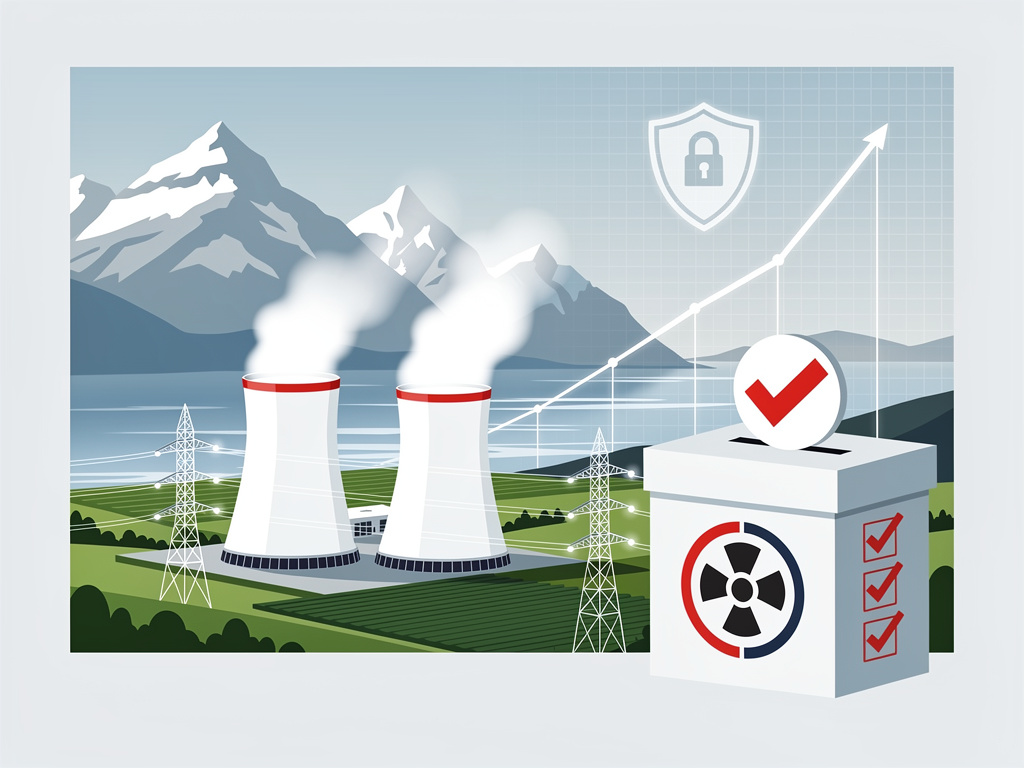
BERN, Switzerland — After nearly a decade of policy aimed at shutting the door on atomic energy, Switzerland’s parliament has voted to lift the ban on new nuclear power plants. The decision, finalized in the summer parliamentary session, marks a striking reversal driven by fears of electricity shortages, winter import dependence and the push for net-zero emissions by 2050.
But don’t expect shovels in the ground anytime soon. Any new reactor faces years of licensing, massive capital costs, public scrutiny and an almost certain referendum. Still, the vote itself sends a clear signal. Technology-neutral energy planning is back on the table.
The National Council joined the Council of States in backing the Federal Council’s indirect counterproposal to the “Stop the Blackout” initiative. The move repeals provisions in the Nuclear Energy Act that had barred general permits for new plants since January 2018. Blue News reported that parliament’s relevant committee had adopted the proposal narrowly, 13-12, with opponents warning of financial risks and damage to renewable momentum.
Energy Minister Albert Rosti stressed the need to keep options open. He told lawmakers the government wants flexibility to guarantee long-term supply. The plan does not approve any specific project. It simply removes the legal prohibition. Operators must still secure financing, navigate rigorous safety reviews and win political approval at every stage.
This shift traces back to the emotional aftermath of the 2011 Fukushima disaster. Swiss voters approved a gradual phase-out in 2017. The Energy Strategy 2050, which took effect in 2018, banned new builds while allowing the four existing reactors — Beznau 1 and 2, Gösgen and Leibstadt — to run as long as safety standards are met. Those plants still produce roughly one-third of the country’s electricity.
Yet circumstances changed. Russia’s invasion of Ukraine exposed Europe’s energy fragility. Rising demand from electrification, data centers and artificial intelligence has pushed projected consumption above 90 terawatt-hours by 2050. Renewable expansion, particularly wind and solar, has lagged behind targets amid permitting delays and local opposition. Winter electricity imports have become a vulnerability.
The parliamentary vote reflects a pragmatic recalibration rather than outright enthusiasm for nuclear revival.
In August 2025 the Federal Council formally presented draft legislation after a public consultation. World Nuclear News detailed how the counterproposal focused on amending the Nuclear Energy Act instead of changing the constitution. The Swiss Nuclear Forum welcomed the step. Its president, Hans-Ulrich Bigler, warned that gas plants offered no sustainable path and that renewables alone could not close the gap. “Electricity demand will increase to over 90 TWh by 2050 — just think of electrification, digitalisation, and artificial intelligence,” he said. “Given climate targets and the geopolitical situation, gas-fired power plants are not a sustainable option, and the expansion of renewables is stalling. It is high time for technology-neutral planning.”
Recent polls show public sentiment tilting toward nuclear. A June 2026 survey cited by several outlets found 55% support for new plants as a backup. That marks a notable swing from the post-Fukushima era. And yet opposition remains fierce.
The Greens immediately announced plans for a referendum. They need 50,000 signatures within 100 days to force a nationwide vote. Greens president Lisa Mazzone did not mince words. The parliamentary decision, she said, “sabotages the rapid development of renewable energies, climate protection and our energy sovereignty.” Euronews captured the divide clearly: one side sees nuclear as an insurance policy against blackouts; the other views it as a costly distraction from faster renewable buildout.
Even supporters tread carefully. The approved text requires that any new plant demonstrate secure financing before licensing proceeds. No utility has announced concrete plans. Existing operators have long stated they have no immediate intention to build. The first new reactor, if ever approved, would likely not operate before the 2040s given the regulatory timeline.
But the vote carries weight beyond construction schedules. It alters the policy conversation. For years Swiss energy strategy treated nuclear as a legacy technology destined for retirement. Now it sits alongside hydro, solar, wind and potentially small modular reactors as a legitimate low-carbon tool.
Industry observers point to similar moves elsewhere in Europe. Belgium, France and the Netherlands have extended reactor lives or planned new capacity. The United Kingdom and United States have restarted or supported nuclear projects to meet data-center demand. Switzerland’s decision fits a broader pattern: when supply security and decarbonization collide with renewable limits, governments reopen the nuclear file.
Challenges remain formidable. Capital costs for large reactors run into billions. Waste disposal, though managed in Switzerland, stirs debate. Public trust, damaged by Fukushima, must be rebuilt through transparent regulation. And any project will trigger fierce local and cantonal resistance.
So the path forward stays uncertain. A successful referendum could reverse parliament again. Financing models — whether private, state-backed or through long-term power purchase agreements — have yet to emerge. Siting new plants near existing facilities might ease some hurdles but would still face environmental impact reviews.
Yet the ban’s removal itself changes incentives. Developers can now explore designs, including advanced reactors with passive safety features. Research institutes like the Paul Scherrer Institut can plan more openly. The signal to investors and engineers is unmistakable: nuclear technology is no longer legally off-limits.
Parliament’s action also highlights tensions in direct democracy. The 2017 phase-out vote reflected immediate fear. Today’s debate incorporates nine years of experience with higher winter prices, stalled renewable projects and geopolitical shocks. Public opinion appears to have evolved with the evidence.
Analysts expect the referendum battle to dominate Swiss energy politics through 2027. Both sides will deploy familiar arguments — safety and reliability versus cost and speed. The outcome will shape not just electricity supply but Switzerland’s credibility on climate targets.
For now, the four aging reactors keep running. Beznau 1, commissioned in 1969, has an operating license until at least 2033. Others follow later. Their continued output buys time. But without new capacity or dramatically accelerated renewables, the risk of shortages grows.
Parliament has lifted the ban. The real test lies ahead — in financing, regulation, public approval and, ultimately, the ballot box. Switzerland’s energy future just became more flexible. Whether it becomes more secure remains to be seen.


 WebProNews is an iEntry Publication