
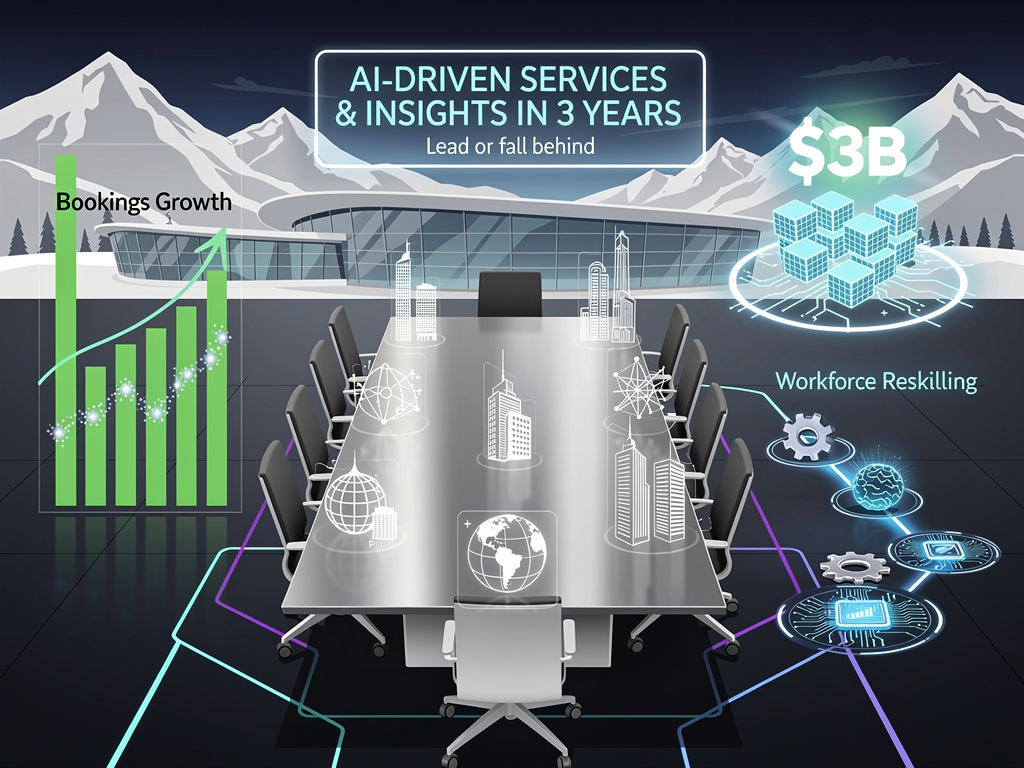
DAVOS, Switzerland—Accenture Plc Chair and CEO Julie Sweet issued a stark challenge to her fellow executives at the World Economic Forum: In three years, every CEO should confidently declare that their company delivers distinct services and insights powered by artificial intelligence. Speaking on Bloomberg Television, Ms. Sweet warned, “If leaders don’t understand AI, they can’t lead the company through the changes. In three years, you should be able to say, ‘My company has different services and has different insights.’ That requires a depth of learning from leaders first, and then you have to bring everybody along the way. So leader-led learning is absolutely critical.”
The remarks, delivered amid Davos discussions on AI’s global impact, underscore Ms. Sweet’s conviction that executive comprehension is the linchpin for enterprise transformation. Drawing from Accenture’s playbook, she highlighted a client stalled until its 300 leaders “touch[ed] keyboards and [saw] what AI could do.” Accenture itself kicked off training for its top 50 executives post-November 2022, a move that “unlock[ed] the possibilities,” she said. This hands-on mandate extends beyond corporations to regulators, whom she cautioned: “It’s also critical for regulators and regulated industries: if regulators block AI, they won’t be able to scale or succeed.”
Accenture’s Aggressive AI Push Pays Dividends
Ms. Sweet’s directive aligns with Accenture’s transformation under her leadership since 2019. The firm committed $3 billion over three years to AI, ballooning its data and AI staff to 80,000, as detailed in a Microsoft WorkLab podcast. Recent fiscal first-quarter 2026 results showed $21 billion in bookings, including 33 clients exceeding $100 million each, with 5% local-currency revenue growth at the high end of guidance. Advanced AI bookings hit $11.5 billion across 11,000 projects, though Ms. Sweet announced an end to separate reporting as AI integrates enterprise-wide, per the earnings release on Accenture’s investor site.
Accenture’s reinvention includes folding strategy, consulting, technology, operations, and Song into Reinvention Services, reversing five decades of structure to meet AI demands. This shift, announced in earnings calls, supports clients like Pfizer with agentic AI for efficiencies. Ms. Sweet emphasized growth over mere productivity: “Most CEOs I talk to feel like their organizations have over-tilted toward productivity … and they’re missing the growth opportunities from AI,” she told Fortune.
Workforce Overhaul: Upskilling or Exit
To fuel this, Accenture invests $1 billion annually in upskilling via LearnVantage, reskilling 550,000 on generative AI fundamentals. Yet, a $865 million six-month optimization program targets exits for those without viable reskilling paths amid compressed timelines. “We are exiting on a compressed timeline, people where reskilling…is not a viable path for the skills we need,” Ms. Sweet stated on the Q4 2025 call, covered by CNBC. Headcount still rises overall, with AI/data pros nearly doubling to 77,000.
Partnerships amplify capabilities: Nvidia for training tens of thousands, Palantir for federal AI software. Clients praise Ms. Sweet’s focus, like Telstra CEO Vicki Brady: “In every conversation I had with Julie, she was completely in that conversation,” per Fortune. Fiscal 2026 guidance projects 2-5% revenue growth (3-6% excluding federal drags), with margins expanding to 15.7-15.9%.
From Davos to Boardrooms: Scaling AI Globally
Ms. Sweet’s Davos push echoes broader strategies. Governments need data centers for sovereign AI, she told Bloomberg: “This isn’t about the data center today, it’s about a strategy.” Responsible AI, pioneered pre-hype, builds trust for scaling, as in HR agents embedding policies. Examples abound: L’Oréal’s Noli platform for personalized skincare via Accenture, and $2 billion cost cuts with AI modernization for another client, noted in Columbia Business School insights.
Challenges persist—many AI projects falter on data readiness, model choices—but Ms. Sweet positions Accenture as the scaler. “CEOs have identified that AI is simple to try and hard to scale, and that’s why they come to Accenture,” she said in a TIME interview. Her path from Cravath partner to CEO exemplifies reinvention: relentless, empathetic leadership via Gallup-tested traits.
Regulatory and Sectoral Imperatives
Extending to public sectors, Ms. Sweet urges leader-led learning for governments and non-profits. In regulated fields, AI fluency prevents stifled innovation. Accenture’s Q1 2026 beat—$18.74 billion revenue, $3.94 EPS—validates bets, with AI revenue surging 120%, per Investing.com. GenAI bookings hit $4.1 billion year-to-date earlier, revenues $1.8 billion.
Ms. Sweet envisions “physical AI” exploding, urging pivots from efficiency to expansion. For insiders, her blueprint is clear: Leaders first, hands-on immersion, then organization-wide rollout—or risk obsolescence in AI’s remaking of enterprise value.


 WebProNews is an iEntry Publication