
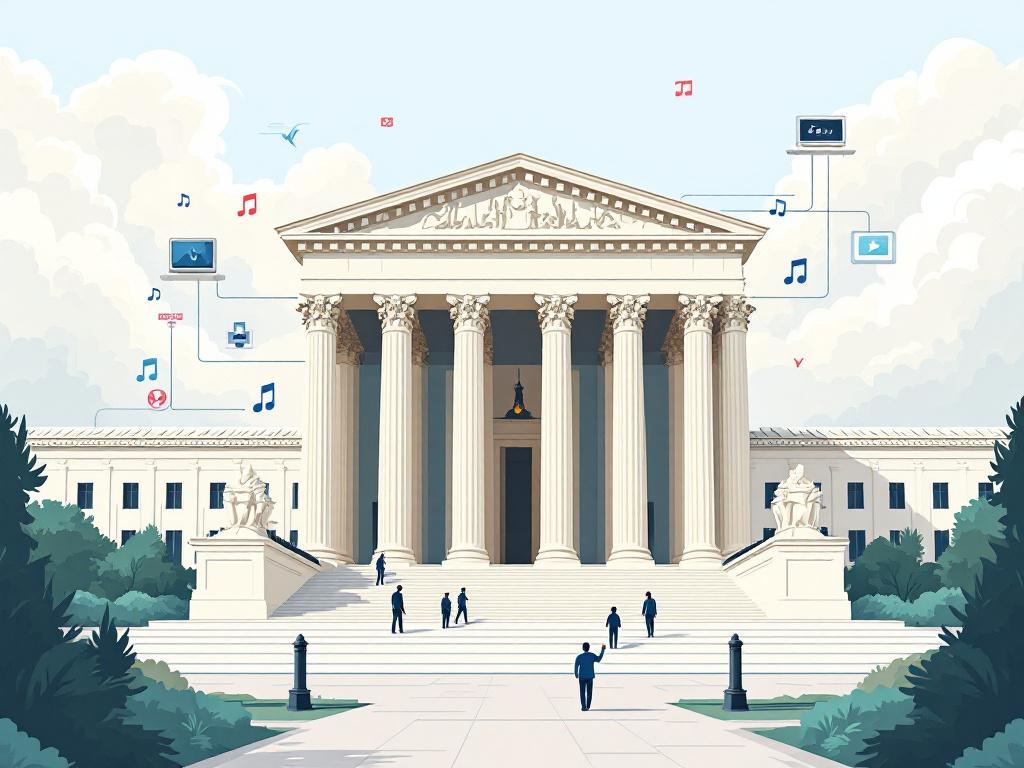
High Notes and Legal Discord: Unpacking the Supreme Court’s Music Piracy Showdown
The U.S. Supreme Court recently stepped into a high-stakes dispute that could reshape how internet service providers handle copyright infringement, pitting major record labels against telecom giant Cox Communications. At the heart of the case is whether ISPs like Cox can be held financially liable for users who repeatedly pirate music online, with potential damages soaring into the billions. Oral arguments unfolded on December 1, 2025, revealing justices grappling with the balance between protecting intellectual property and avoiding undue burdens on internet access. This isn’t just another legal skirmish; it’s a pivotal moment that echoes the early days of digital file-sharing battles, potentially affecting millions of users and the broader online ecosystem.
The lawsuit stems from a 2018 complaint by Sony Music Entertainment, Universal Music Group, and Warner Music Group against Cox. The labels accused the ISP of failing to crack down on subscribers who infringed copyrights on over 10,000 songs through peer-to-peer networks. A Virginia jury initially awarded the labels $1 billion in damages in 2019, but an appeals court partially overturned that, prompting Cox’s appeal to the Supreme Court. The core question revolves around “contributory infringement”—whether Cox knowingly contributed to piracy by not terminating repeat offenders’ accounts despite receiving thousands of infringement notices.
Cox argues that liability should require proof of “willful blindness” or direct inducement, not just general knowledge of infringement. The company’s lawyers contend that holding ISPs accountable for user actions could lead to overzealous policing, potentially disconnecting innocent customers and stifling internet freedom. On the other side, the record labels assert that Cox profited from high-speed services used for piracy while ignoring clear evidence of violations, essentially turning a blind eye to protect revenue.
Arguments Echo Through the Courtroom
During the hearing, justices expressed skepticism toward Cox’s position, with several questioning why the ISP didn’t act on detailed notices from copyright holders. Justice Sonia Sotomayor highlighted the “two extremes” in the case, warning that a ruling too favorable to ISPs might encourage lax enforcement, while one too strict could harm everyday users. This sentiment was echoed in coverage from Newsweek, which noted the potential for Cox to face up to $1.5 billion in damages if the lower court’s decision stands.
The debate drew parallels to landmark cases like the 1984 Sony Betamax ruling, which shielded device makers from liability for user infringement unless they promoted illegal uses. Cox’s team leaned on this precedent, arguing that internet access is a neutral tool, much like a VCR. However, the labels countered that modern ISPs have far more control and data about user behavior than hardware manufacturers did decades ago. As reported by Reuters, the justices appeared divided, with some probing the feasibility of ISPs monitoring vast networks without invading privacy.
Public sentiment on platforms like X reflects a mix of concern and cynicism. Users have posted about fears that a win for the labels could lead to broader crackdowns on all forms of online sharing, potentially extending to gaming, anime, and other media. One post highlighted a related lawsuit by Universal Music Group aiming to force ISPs to disconnect pirates, underscoring growing anxiety among digital consumers. Yet, these online discussions also reveal support for artists, with some arguing that unchecked piracy undermines creative industries.
Broader Implications for Digital Rights
The case’s ripple effects could extend beyond music to video streaming, software, and even emerging technologies like AI-generated content. If the Supreme Court sides with the labels, ISPs might implement stricter policies, such as automated account suspensions after multiple notices, which could inadvertently affect households sharing connections. This concern was detailed in an article from USA Today, which emphasized the stakes for everyday internet users who might face service disruptions over minor or mistaken claims.
Industry insiders point out that the Digital Millennium Copyright Act (DMCA) of 1998 already provides safe harbors for ISPs that respond to takedown notices, but this lawsuit tests the limits of those protections. Cox claims it followed DMCA protocols by forwarding notices but argues that terminating service isn’t required unless infringement is proven in court. The labels, however, see this as a loophole that allows ISPs to profit from piracy without consequence. According to ABC News, a decision against Cox could embolden similar suits against other providers, potentially leading to higher broadband costs as companies pass on legal risks to consumers.
On the flip side, a ruling for Cox might weaken copyright enforcement, making it harder for content creators to combat piracy in an era of lightning-fast downloads. The music industry has long battled online theft, from Napster’s heyday to today’s torrent sites. As one X post recalled, past efforts like the CASE Act aimed to streamline small claims for copyright violations, but they haven’t fully stemmed the tide. This Supreme Court case could either reinforce or dismantle key deterrents.
Skepticism from the Bench
Justices like Elena Kagan and Neil Gorsuch pressed both sides on practicalities. Kagan questioned how ISPs could reasonably ignore “smoking gun” evidence of piracy, while Gorsuch worried about the burden of investigating every notice. These exchanges, as covered by The Washington Post, suggest the court is seeking a middle ground that upholds copyright without turning ISPs into digital sheriffs.
The hearing also touched on economic incentives. Cox allegedly earned millions from subscribers known for heavy data usage tied to file-sharing. The labels presented evidence of internal emails where Cox employees dismissed infringement complaints as nuisances. This narrative aligns with reports from Deadline, which noted Sony’s push for ISPs to bear responsibility for repeated offenses.
Meanwhile, amicus briefs from tech groups like the Electronic Frontier Foundation warn that expanded liability could chill innovation, forcing providers to monitor traffic more invasively. Posts on X echo this, with users speculating that VPN usage might surge if ISPs start policing content aggressively. Such shifts could alter how people access information online, raising privacy concerns in an already surveillance-heavy environment.
Echoes of Past Battles and Future Horizons
Looking back, this case revives debates from the early 2000s, when file-sharing services disrupted the music business. The Supreme Court’s 2005 Grokster decision held that companies inducing infringement could be liable, but it didn’t directly address ISPs. Now, with streaming dominating consumption, piracy persists through underground channels, costing the industry billions annually. An analysis from Billboard estimates the lawsuit’s value at $1 billion, underscoring the financial firepower involved.
For artists and labels, a favorable ruling would validate years of lobbying for stronger protections. Paul McCartney’s recent calls for AI copyright safeguards, mentioned in various online discussions, highlight the evolving threats to creators. Yet, critics argue that focusing on ISPs distracts from innovating business models, like affordable streaming, to reduce piracy incentives.
As the court deliberates—a decision is expected by June 2026—the outcome could influence global standards. European courts have imposed similar liabilities on ISPs, but the U.S. has traditionally favored lighter regulation to foster tech growth. Insights from Digital Journal suggest that whatever the ruling, it will prompt legislative tweaks to clarify ISP duties.
Navigating Uncharted Legal Waters
The justices’ questions also revealed concerns about “innocent” infringers, such as families where one member’s actions affect all. Justice Amy Coney Barrett pondered scenarios where minor violations lead to service cutoffs, potentially isolating vulnerable users. This human element was amplified in Music Business Worldwide, which reported skepticism toward Cox’s minimal-knowledge defense.
Tech experts foresee that a labels’ victory might accelerate adoption of advanced monitoring tools, blending AI with network analysis to flag suspicious activity. However, this raises red flags for net neutrality advocates, who fear discriminatory treatment of traffic. X posts from piracy communities warn of a “chilling effect” on free expression, drawing parallels to past crackdowns that drove users underground.
Ultimately, this case underscores the tension between innovation and protection in the digital age. As broadband becomes essential like electricity, holding providers accountable for misuse is fraught with complexity. The Supreme Court’s decision will likely set precedents for years, influencing not just music but the entire spectrum of online content distribution.
Voices from the Industry Frontlines
Record executives view the case as a bulwark against erosion of their rights, with one anonymous source noting that piracy diverts revenue needed for artist development. Conversely, ISP representatives argue that they’re conduits, not gatekeepers, and shouldn’t police the internet. Coverage from Bloomberg captures this divide, quoting justices who seemed unconvinced by Cox’s blanket immunity claims.
Online chatter on X includes calls for balanced reforms, with some users advocating for public domain expansions to ease access tensions. Historical parallels, like the Supreme Court’s recent ruling on timely infringement claims—as posted about in May 2024—remind us that copyright law evolves slowly but impactfully.
In the end, this showdown may redefine accountability in the streaming era, ensuring that the melody of progress doesn’t drown out the rights of creators or users alike. With billions at stake, the justices’ forthcoming opinion will resonate far beyond the courtroom.


 WebProNews is an iEntry Publication