
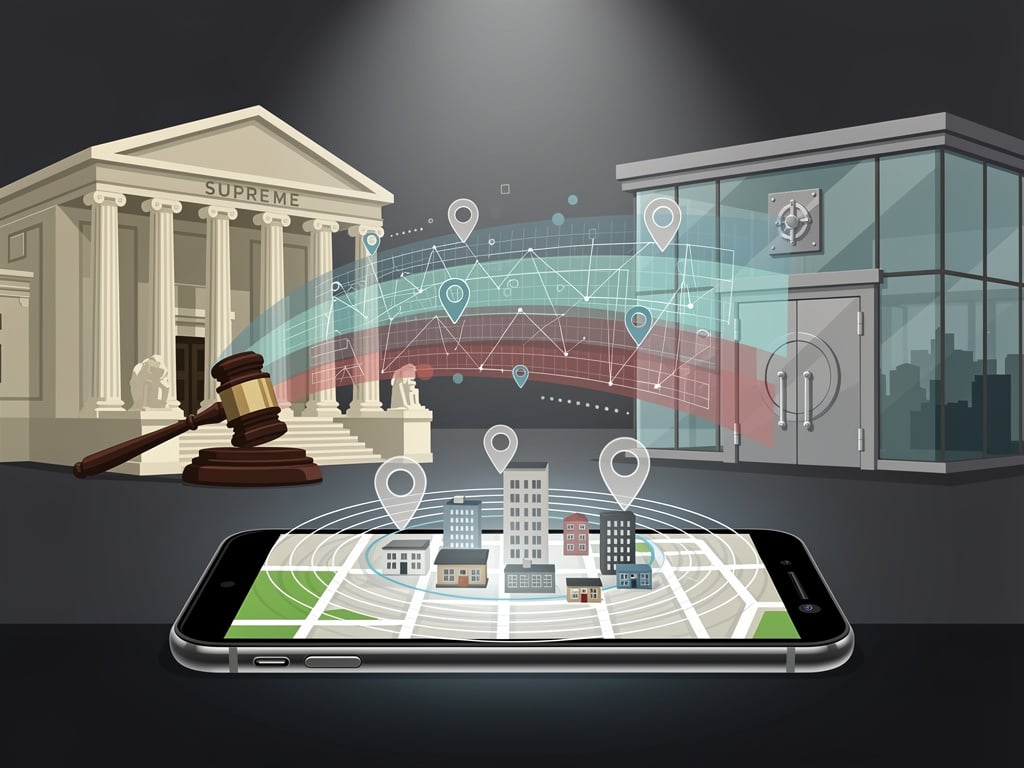
On May 20, 2019, a gunman stormed the Call Federal Credit Union in Midlothian, Virginia. He brandished a handgun, forced tellers to the floor, and emptied the vault of $195,000. Surveillance footage captured the robber checking his cellphone. Leads dried up after two months. Detective Joshua Hylton turned to Google. He secured a geofence warrant from a state magistrate, drawing a virtual boundary roughly the size of three football fields around the bank for the hour before and after the heist.
Google’s response was methodical. First, anonymized data on 19 devices. Police narrowed it to three accounts. One belonged to Okello Chatrie. A home search uncovered nearly $100,000 in banded cash, some marked by tellers. Chatrie pleaded guilty to armed robbery, drawing nearly 12 years in prison while preserving his constitutional challenge. The case, now Chatrie v. United States (No. 25-112), reached the Supreme Court. Oral arguments unfolded on April 27, 2026. A ruling looms by summer’s end.
Geofence warrants reverse traditional searches. No named suspect. Instead, police define a time and place; tech firms like Google scour databases for matching devices. Google’s Sensorvault, drawing from Location History opted into by hundreds of millions, pings positions every two minutes via Wi-Fi, Bluetooth, and cell towers. In 2019 alone, authorities served Google over 9,000 such requests, per district court findings in Chatrie’s trial. By 2020, that hit 11,500, as NPR reported.
Chatrie’s team calls it a digital dragnet. Lawyer Adam Unikowsky told justices: “At the Founding, people absolutely despised general warrants that would allow the police to search every single person’s house without any suspicion… So we argue in this case that the warrant was unconstitutional because it allowed the government to search every single person’s account for evidence of a crime.” The fence swept a nearby church. Innocent parishioners’ paths crossed the data haul. Broader still: one San Francisco request spanned 2.5 square miles over 48 hours; another engulfed 489 acres, ensnaring over 3,000 users, Google noted in its amicus brief.
Justice Sonia Sotomayor pressed the point. She asked government lawyer Eric Feigin if officers could rifle through Google-stored photos, emails, calendars without warrants. “So that means the government, police officer, randomly, who decides they don’t like that person, ‘let me just go look at their life to see if I can find a crime,’ that would be okay?” Justice Neil Gorsuch echoed: a government win here might extend to email. Chief Justice John Roberts countered practically: “If you don’t want the government to have your location history, you just flip that off.”
The Department of Justice pushes back hard. Deputy Solicitor General Feigin argued: “Petitioner here is asking for an unprecedented transformation of the Fourth Amendment into an impregnable fortress around records of his public movements that he affirmatively consented to allow Google to create, maintain and use.” Location data mirrors public sightings, they say. Users opt in, sharing with a third party. Turn off services if concerned. Warrants include safeguards: anonymization first, judicial narrowing, probable cause tied to crime specifics. Amici like the Local Government Legal Center cite successes—a Georgia stabbing, California murder, Michigan hit-and-run cracked cold cases—urging case-by-case review over bans, as in their brief.
Justice Samuel Alito voiced skepticism on the case’s weight. “I’m struggling to understand why we are hearing this case, other than the fact that at least four of us voted to take it.” Google shifted gears in 2023, storing Location History on devices, not servers—slashing geofence viability, as The Record observed. Yet principles endure. Lower courts split: Virginia’s en banc Fourth Circuit deadlocked 7-7 on whether a search occurred, affirming via good-faith exception; the Fifth Circuit deemed them overbroad.
Echoes of precedent. Carpenter v. United States (2018) demanded warrants for cell-site data spanning weeks, rejecting third-party doctrine for exhaustive tracks. But geofences hit snapshots, voluntary opt-ins. Riley v. California barred warrantless phone riflings incident to arrest. Now, cloud data blurs lines. Privacy groups warn of chilled speech—protests, clinics, lovers’ lanes exposed. Law enforcement, backed by 31 states, hails precision in evidence deserts like Jan. 6 probes.
Signals from bench? A majority seemed poised to require warrants for geofences, narrowing DOJ’s no-search claim, per law professor Andrew Guthrie Ferguson. But broad upending? Unlikely. Roberts and Alito eyed opt-outs; liberals pushed privacy frontiers. The Hill captured two hours of probing: digital age meets 18th-century parchment.
Outcomes branch three ways. Outright ban on geofences as general warrants. Validation with tweaks—stricter particularity, smaller fences. Dismissal, leaving status quo. Or duck entirely, as 9to5Mac pondered. Google’s pivot mutes urgency, but ripples hit Apple Maps, emerging trackers. Congress eyes Stored Communications Act fixes.
Chatrie’s fence closed on one robber. Thousands more lurk in data troves. Justices weigh: investigative lottery ticket or Big Brother sweep? Public movements digitized. Consent ambiguous. Fourth Amendment stretches. Boom. Decision drops soon.


 WebProNews is an iEntry Publication