
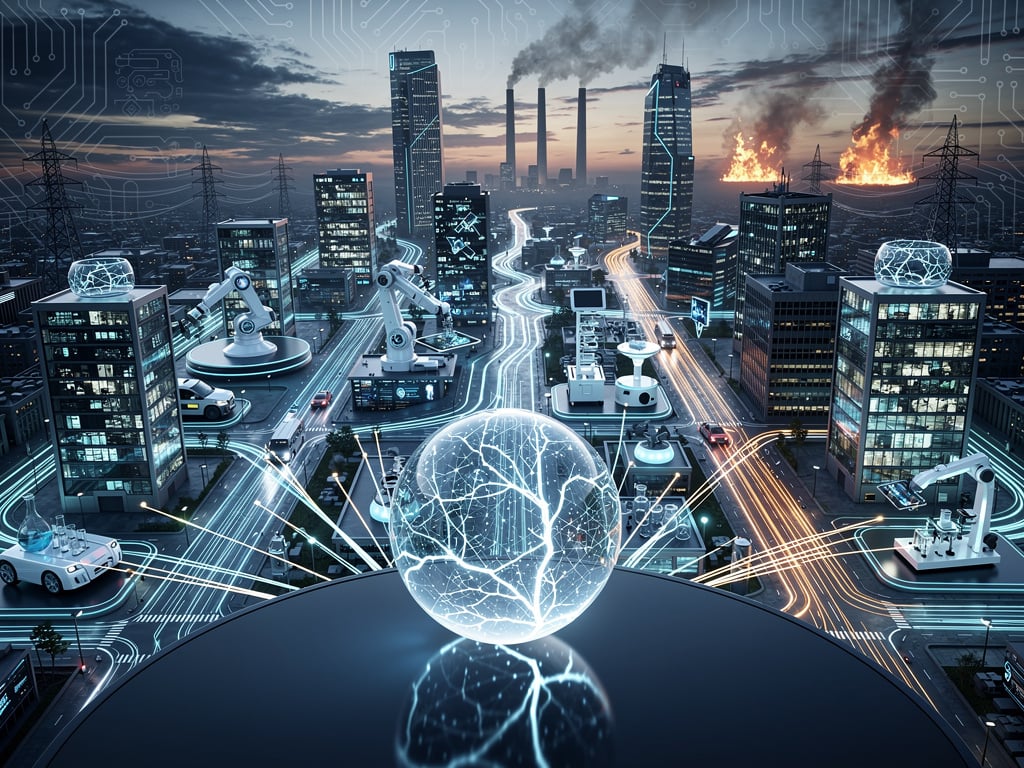
Google CEO Sundar Pichai once described artificial intelligence as more profound than electricity or fire, framing the technology as a foundational force that will shape human progress for generations. The statement, made during a period of rapid advancement in machine learning models, serves as a stark reminder that AI now functions as a critical resource in the modern world, comparable to energy, water, or raw materials in earlier industrial eras. This perspective highlights how organizations and societies increasingly depend on intelligent systems for everything from scientific discovery to daily decision-making.
Pichai’s comparison carries weight because electricity and fire represent two of humanity’s most transformative inventions. Fire enabled early humans to cook food, stay warm, and forge tools, fundamentally altering survival strategies and social structures. Electricity powered the second industrial revolution, illuminating cities, driving factories, and enabling mass communication. Both technologies became invisible backbones of civilization, so embedded in daily life that their absence would cause immediate collapse. AI, according to Pichai, follows this same trajectory but operates on a different plane because it augments cognitive capabilities rather than purely physical ones.
The implications stretch across multiple sectors. In healthcare, algorithms now analyze medical images with accuracy that rivals or exceeds human specialists in certain tasks. Researchers at institutions worldwide train models on vast datasets of patient records, genetic information, and clinical trials to predict disease outbreaks, personalize treatments, and accelerate drug discovery. What once required years of laboratory work can now be compressed into months through computational simulation guided by neural networks. This shift positions AI as an essential input, much like the electricity that powers the microscopes and centrifuges in those same laboratories.
Education systems also demonstrate growing reliance on intelligent tools. Adaptive learning platforms adjust content difficulty in real time based on student performance, creating personalized pathways that teachers alone could not scale across large classrooms. Language models assist with grading, content creation, and even tutoring in multiple languages simultaneously. While these applications raise questions about over-dependence and the potential erosion of critical thinking skills, they also address longstanding problems of access and equity in global education. Countries with teacher shortages increasingly view AI systems as necessary infrastructure rather than optional enhancements.
The economic dimension reveals AI’s status as a core resource most clearly. Companies treat computational power, high-quality training data, and specialized talent as strategic assets that determine competitive advantage. Nations race to secure semiconductor supply chains, build data centers, and establish regulatory frameworks that balance innovation with safety. Investment in AI-related infrastructure now rivals historical spending on railroads, highways, or electrical grids. According to analyses from TechRadar, Pichai’s remarks underscore this strategic importance, positioning AI not as a passing technological trend but as a permanent feature of economic and social organization.
Energy consumption patterns further illustrate the parallel with traditional resources. Training large language models requires enormous amounts of electricity, sometimes equivalent to the annual usage of small towns. Data centers housing these models consume water for cooling at scales that have prompted local governments to reconsider their utility agreements. This reality forces a reckoning with sustainability questions similar to those faced during the expansion of fossil fuel infrastructure in the twentieth century. Companies now explore more efficient architectures, specialized hardware, and renewable energy sources to mitigate environmental impact while maintaining the capabilities that make AI valuable.
Scientific research benefits perhaps most dramatically from AI’s cognitive augmentation. Materials scientists use generative models to predict new compounds with desired properties before synthesizing them in laboratories. Climate researchers employ AI to process satellite imagery and sensor data at speeds impossible for human teams, improving forecasts and identifying intervention opportunities. Astronomers analyze telescope feeds with machine vision systems that detect distant galaxies and exoplanets automatically. In each case, AI functions as a multiplier of human intellect, allowing researchers to explore larger solution spaces and identify patterns that would otherwise remain hidden.
Yet this profound capability brings equally significant responsibilities. As AI systems influence hiring decisions, loan approvals, criminal sentencing recommendations, and content moderation, questions of bias, transparency, and accountability move to the forefront. Organizations must develop governance structures that treat intelligent systems with the same seriousness once reserved for nuclear power or pharmaceutical safety. Regulatory bodies worldwide craft rules around data privacy, model explainability, and potential misuse, recognizing that the technology’s power demands corresponding safeguards.
The workforce implications appear equally transformative. Routine cognitive tasks face automation pressures similar to those experienced by manufacturing workers during earlier periods of mechanization. At the same time, new roles emerge around AI system design, data curation, ethical oversight, and human-AI collaboration. Educational institutions adjust curricula to emphasize skills that complement rather than compete with artificial intelligence, focusing on creativity, emotional intelligence, complex problem-solving, and ethical reasoning. This transition period requires thoughtful policy responses including retraining programs, social safety nets, and updated labor regulations.
Pichai’s observation also invites reflection on how societies allocate this critical resource. Access to advanced AI capabilities currently concentrates among well-funded corporations and wealthy nations, raising concerns about technological divides that could widen existing inequalities. Initiatives to democratize access through open-source models, public computing resources, and educational outreach aim to distribute benefits more broadly. The goal involves ensuring that AI serves as a public good rather than exclusively as a private advantage.
Technical challenges remain substantial despite rapid progress. Current systems still struggle with consistent reasoning, long-term planning, and genuine understanding of the physical world. Hallucinations, where models generate plausible but incorrect information, demonstrate the gap between pattern matching and true comprehension. Researchers pursue various approaches including hybrid symbolic-neural architectures, improved training methodologies, and better evaluation frameworks to address these limitations. Progress in these areas will determine how closely AI approaches the profound impact Pichai envisions.
Integration into existing infrastructure proceeds at different speeds across industries. Financial services deploy AI for fraud detection, algorithmic trading, and personalized banking at scale. Manufacturing facilities use predictive maintenance models to minimize downtime and optimize supply chains. Agricultural operations analyze soil conditions, weather patterns, and crop health through connected sensors and intelligent recommendations. Each implementation treats AI as essential operational technology rather than experimental software.
The comparison to fire and electricity also highlights AI’s dual nature. Just as fire can provide warmth or cause destruction, and electricity can power hospitals or enable weapons, artificial intelligence offers tremendous potential for human flourishing alongside serious risks. Misinformation campaigns powered by generative tools, autonomous weapons systems, and uncontrolled optimization processes that ignore human values represent genuine hazards. Responsible development therefore requires balancing acceleration with appropriate caution, innovation with ethical constraints.
Global cooperation becomes necessary as AI capabilities cross borders effortlessly. International agreements on research standards, safety protocols, and shared benefits could help manage competition while maximizing collective progress. Organizations already collaborate on technical benchmarks, safety research, and policy recommendations, recognizing that no single entity can address all implications alone. This coordination mirrors historical efforts to manage nuclear technology or regulate international aviation.
Looking forward, AI’s role as a critical resource seems likely to expand rather than diminish. As models become more capable and integrated into physical systems through robotics and Internet of Things applications, their influence on daily experience will grow. Smart cities will optimize traffic flow, energy distribution, and emergency response through coordinated intelligent agents. Personal assistants will evolve from simple task managers into comprehensive life planning partners. Scientific breakthroughs enabled by AI could address climate change, disease, and resource scarcity in ways currently difficult to imagine.
The profundity Pichai referenced stems from this universal applicability combined with cognitive enhancement. Previous general-purpose technologies amplified human muscle or sensory capabilities. AI amplifies thought itself, potentially accelerating discovery across all domains simultaneously. This meta-capability distinguishes it from prior inventions and explains why leaders in technology, government, and academia increasingly treat it with both excitement and gravity.
Organizations that recognize AI as infrastructure rather than merely a productivity tool position themselves advantageously for coming decades. This means investing in data quality, computational resources, talent development, and ethical frameworks with the same strategic focus once reserved for energy security or transportation networks. Governments similarly must view AI literacy, research funding, and regulatory capacity as foundational elements of national competitiveness and citizen wellbeing.
The statement from Google’s CEO therefore functions as both observation and call to action. By comparing AI to electricity and fire, Pichai emphasizes that society has moved beyond viewing the technology as interesting software. It has become a resource that powers modern civilization, requiring careful management, equitable distribution, and sustained attention to both opportunities and risks. As capabilities continue advancing, this perspective will likely guide decision-making at every level from individual learning paths to international policy negotiations.
Understanding AI in these terms encourages thoughtful engagement rather than either blind enthusiasm or reflexive fear. The technology’s profound nature demands that humans remain actively involved in shaping its development and deployment. By treating artificial intelligence as a critical resource comparable to the most fundamental discoveries in human history, leaders and citizens alike can work toward ensuring its benefits reach as widely as possible while minimizing potential harms. This balanced approach respects both the transformative power Pichai highlighted and the responsibility that accompanies such power.


 WebProNews is an iEntry Publication