
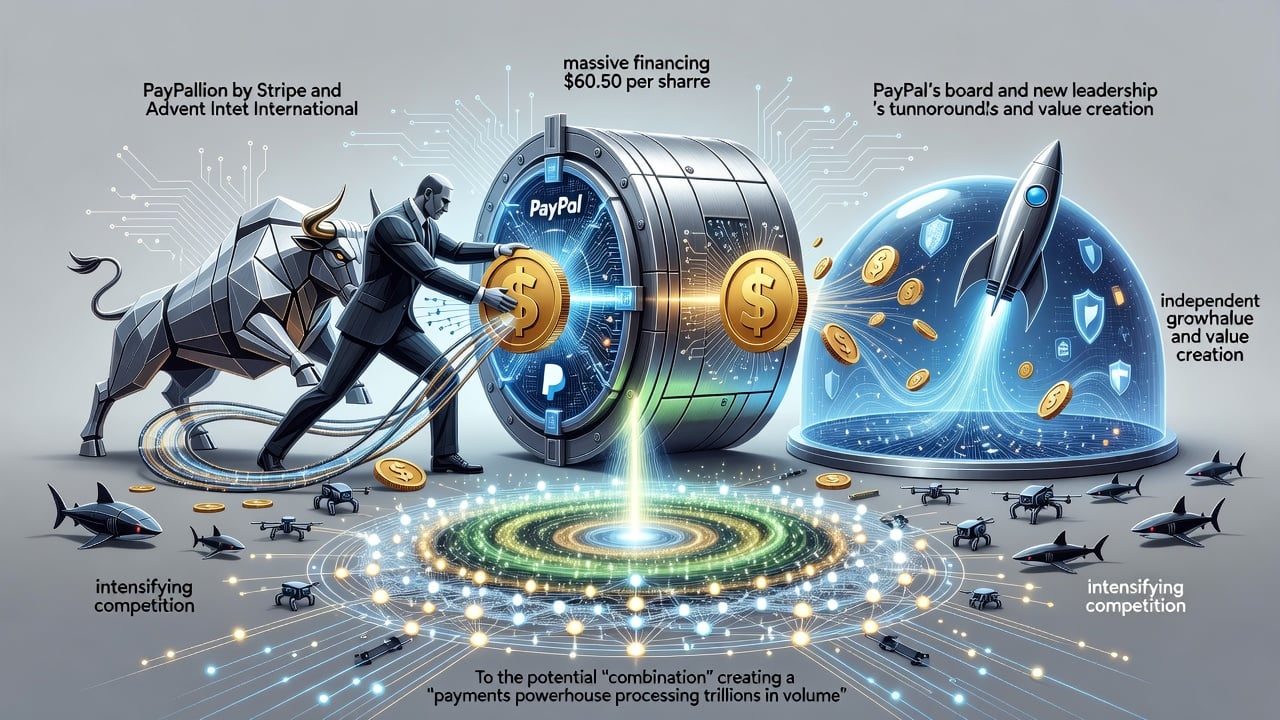
PayPal once commanded the online payments world. Its market value topped $360 billion in 2021. Today the company trades far below that peak. And now two unlikely partners have stepped forward with an offer to take it private.
Stripe and private equity firm Advent International jointly proposed buying the payments pioneer for $60.50 a share. That values PayPal at more than $53 billion. The bid landed earlier this month. It sits roughly 28 percent above where shares closed on July 14.
PayPal shares jumped nearly 17 percent on the news. Reuters first reported the offer. The Wall Street Journal soon confirmed key terms. The Journal noted the approach came in recent days after PayPal began a turnaround under new chief executive Enrique Lores.
But the story runs deeper. Sources told Reuters the buyers first approached PayPal in early April. They had studied the company since February. This wasn’t a spur-of-the-moment idea. It reflects years of convergence in a sector where scale now decides winners.
Financing stands ready. About $50 billion in committed bank debt backs the deal. Stripe, Advent and Block plan to contribute $17 billion in equity. Post-transaction, Stripe and Advent would own PayPal equally. No immediate breakup lies in the cards. The plan keeps the combined business intact. CNBC confirmed those equity details.
PayPal itself has prepared. The company hired Goldman Sachs and Evercore to review options. Those options include a full sale or breakup of units. Bloomberg reported the advisory relationships. A board meeting could occur as soon as July 20. Yet fresh word emerged Friday. PayPal’s directors view the bid as inadequate. They believe it undervalues the franchise. The Economic Times cited sources on the board’s stance.
Such resistance comes as no surprise. PayPal built an unmatched consumer network. More than 430 million active accounts. Venmo dominates peer-to-peer transfers among younger users. The PayPal button still powers countless checkouts. These assets give the company staying power even as growth slowed.
Competition intensified. Square, now Block, ate into merchant services. Apple Pay and Shopify Payments grabbed share. Cryptocurrency added new rivals. PayPal launched its own stablecoin, PYUSD. Results improved but not enough for some investors. Revenue rose 7 percent in the first quarter to $8.35 billion. Payment volumes gained 8 percent on a currency-neutral basis.
Lores took over in March. He replaced Alex Chriss after a short tenure. The new leader split operations into distinct units. Checkout for merchants. Venmo for consumers. A dedicated payments and crypto business. Artificial intelligence initiatives aim to cut duplication and save $1.5 billion over two to three years. Savings would fuel fresh growth spending.
Analysts remain divided. William Blair’s Andrew Jeffrey called the offer a low-ball. He suggested a serious counter could reach $70 a share. TD Cowen’s Bryan Bergin highlighted strategic logic. Stripe gains consumer relationships and distribution. It accelerates digital wallet adoption. Venmo and PayPal Checkout expand its toolkit. The deal also bolsters stablecoin ambitions by marrying networks.
Combined, the two processors handle staggering volume. Stripe moved $1.9 trillion in transactions over recent periods. PayPal added roughly $1.8 trillion. Together they approach 3 percent of global gross domestic product. That scale matters in an industry where data and network effects compound rapidly.
Yet hurdles exist. Regulatory scrutiny looms over any tie-up this large. Antitrust officials already watch payments giants. Integration challenges would test management. PayPal’s consumer brand carries different strengths than Stripe’s developer-first culture. Bridging those worlds takes time. And capital.
Private ownership could free PayPal from quarterly pressures. Public markets punished slower growth. A private structure might allow heavier investment in artificial intelligence, crypto and international expansion. Advent brings buyout expertise. The firm previously backed Nuvei in its $2.75 billion acquisition of Payoneer. That deal closed last year.
Broader sector consolidation accelerated. Global Payments bought Worldpay for $24.25 billion in 2025. Mastercard weighs options for its Vocalink unit. These moves signal a maturing market. Players seek efficiency and breadth as margins compress and technology shifts.
Stripe itself hit a $159 billion valuation earlier this year. The Collison brothers built a powerhouse serving businesses large and small. Their focus on product quality and global reach earned respect. Acquiring PayPal would catapult them into consumer finance. It would create a payments colossus few could challenge.
But PayPal’s board holds leverage. The bid remains non-binding. No formal response has emerged. Sources say talks could advance in coming weeks. Or they could stall. A higher offer might appear if other suitors surface. Breakup value calculations already circulate among analysts.
One thing feels clear. The payments industry stands at an inflection. Mobile wallets, embedded finance and tokenization change how money moves. Companies that combine merchant and consumer strengths gain an edge. Data from both sides of a transaction informs better risk models, fraud prevention and personalized offers.
Advent’s involvement adds financial discipline. Private equity often streamlines costs. It pushes for operational improvements. Whether that clashes with PayPal’s consumer-centric heritage remains to be seen. Lores has signaled willingness to reshape the company. His AI-driven efficiency plan aligns with buyout logic.
Investors reacted swiftly. The stock surge reflected both the premium and skepticism about standalone prospects. Some shareholders may push for a deal. Others see untapped potential in Venmo or crypto initiatives. A bidding war, however remote, could lift the price further.
History offers mixed lessons. Big fintech mergers carry execution risk. Cultural clashes. Customer attrition. Yet the strategic fit here looks compelling on paper. Stripe’s infrastructure meets PayPal’s distribution. One processes for businesses. The other connects millions of everyday users. Merge them. The resulting platform processes trillions while serving both sides of commerce.
Stablecoins represent another frontier. PayPal’s PYUSD already circulates. Stripe acquired Bridge, a crypto infrastructure player. Together they could push digital dollar adoption in payments. Regulators watch closely. Success depends on compliance as much as technology.
For now the ball sits in PayPal’s court. Its advisers will model scenarios. Standalone forecasts. Breakup sums. Synergies under new owners. The board must weigh short-term shareholder gains against long-term independence. Rejecting the bid signals confidence in Lores’ plan. Accepting it admits the turnaround needs outside help.
Either path carries consequences. A deal would reshape the competitive order. It might spur more consolidation. Independent players could seek partners. Technology vendors might accelerate artificial intelligence bets to stay relevant.
The offer also highlights Stripe’s ambition. Once content to build quietly, the company now eyes transformative scale. Its valuation gives it firepower. Private status lets it move faster than public rivals burdened by scrutiny.
PayPal’s journey from dot-com darling to potential takeover target shows how quickly fortunes shift. It dominated eBay auctions. Then expanded globally. Venmo captured social payments. Yet it missed some mobile shifts. Competition narrowed its lead.
Should this transaction close, it would rank among the largest in fintech history. It would test whether private capital can unlock value that public markets overlooked. And it would create a new giant in digital money movement. One with roots in both Silicon Valley ingenuity and established consumer trust.
Markets will keep watching. So will competitors. The coming weeks could bring counteroffers, regulatory signals or strategic updates from PayPal itself. Whatever happens, the bid already accomplished one thing. It forced a conversation about the future of payments that many had avoided. Scale matters. Networks endure. And in this business, standing still rarely works.


 WebProNews is an iEntry Publication