
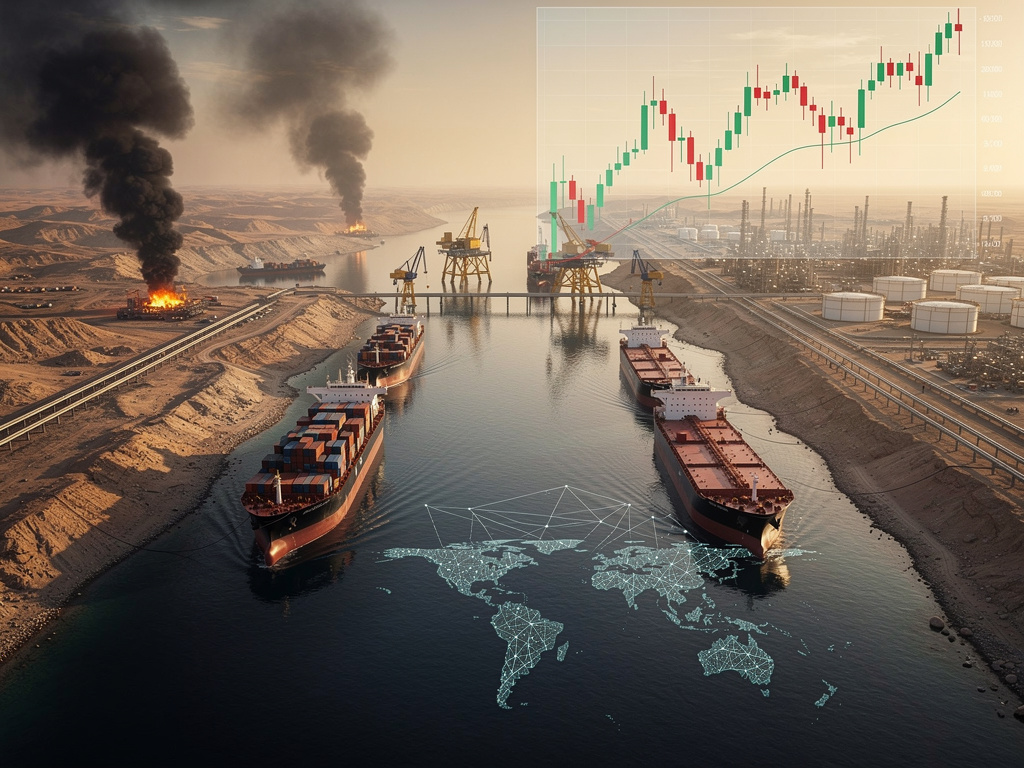
Brent crude futures climbed to $105.07 a barrel on Wednesday, up 3.1% in a fourth straight session of gains. West Texas Intermediate settled at $95.85, mirroring the surge. Traders eye the Strait of Hormuz. Iran blocks passage. The U.S. enforces a naval blockade on Iranian ports. No end in sight.
This isn’t some fleeting spike. The conflict, now nearly two months old, has erased over a billion barrels from global supply—history’s largest energy disruption. Trafigura Group’s chief economist Saad Rahim pegged the loss at that scale during the FT Commodities Global Summit in Lausanne, warning it could hit 1.5 billion if tensions drag on (Bloomberg). Peak daily losses topped 12 million barrels, per the International Energy Agency. That’s one-fifth of world oil flows choked off since U.S.-Israeli strikes hit Iran on February 28.
Prices touched $119 in March, the loftiest since the war’s outset (BBC). They dipped on ceasefire hopes in early April, only to rebound above $100 as talks collapsed. President Trump extended the truce indefinitely, but Iran’s Supreme Leader Mojtaba Khamenei vows to hold the strait shut as leverage. U.S. forces seized an Iranian tanker. Tehran fired on others. Stalemate.
And demand destruction looms. Factories in China grapple with plastic costs tripled by crude. Europe’s gas prices hit four-year peaks after strikes on Gulf fields (The Guardian). South Korea posted its sharpest import price jump in decades (Bloomberg). The IEA slashed its 2026 oil demand growth forecast, citing contractions in Asia and the Middle East (Reuters). Surveys show services weakening too. Inflation ticks up. Central banks pause cuts.
But here’s the twist. Markets haven’t fully priced the shock. Goldman Sachs notes traders demand a $14 risk premium per barrel, yet Brent hovers below peaks seen in briefer crises (Goldman Sachs). BOK Financial’s Dennis Kissler says any escalation juices prices near-term: “We’re definitely seeing a rise in tensions. The market is already in a nervous state” (Wall Street Journal). Reuters calculations show 624 million barrels lost over 52 days at 12 million daily—bigger than past shocks in output terms, though cumulative impacts from 1970s embargoes rival it (Reuters).
Supply reroutes help cap the frenzy. Saudi Arabia and the UAE pump millions via bypass pipelines skirting Iranian waters. U.S. shale ramps output. Strategic reserves—China’s especially—cushion blows. Still, refiners scramble. Diesel tops $200 a ton in spots. Aviation fuel dwindles in Europe.
Geopolitics adds layers. Russia’s Urals crude fetches 13-year highs, eased by sanctions relief amid the chaos (Bloomberg). Canada’s producers eye profit booms but hold investment, funneling cash to shareholders. Italy suspended a defense pact with Israel over the war. Trump tells allies: “Get your own oil.” Talks? Iran’s foreign ministry says no plans.
Energy Secretary Chris Wright expects prices to peak soon but stay elevated for months. Angie Gildea at KPMG warns of months-long recovery: “If this continues to play into June, we’re going to start seeing some significant demand destruction… consumers will be hit much harder” (Wall Street Journal). Over $50 billion in lost revenues since day one, per Kpler’s Johannes Rauball (Reuters).
For investors, the XLE ETF stands out. It tracks energy giants thriving on $100 oil—Exxon, Chevron, ConocoPhillips. Holdings surged 20% since February, outpacing the S&P 500. Dividends flow. Buybacks accelerate. Yet volatility reigns. A deal reopens Hormuz? Prices ease to $80s. Retaliation widens? $120 beckons. Insiders bet on persistence. Risk premiums. Insurance hikes. New baselines.
Global ripples deepen. Plastic makers hike USB cable prices in Dongguan. Airlines ground flights. Food chains strain as fertilizer costs soar. The IMF flags oil, inflation, rates as derailers to growth. Reuters tallies 21 firms slashing guidance, 32 signaling hikes since war’s start (Reuters). Europe eyes second energy crisis in four years.
So oil stays high. Not just war headlines. Structural shifts. Bypasses blunt Iran’s grip. But until Hormuz flows free—verified, enforced—premiums stick. Brent’s compass shattered, as Reuters puts it. Traders swing wildly. $90 one day. $110 the next. Recovery? Years, some say. The world adapts. Painfully.


 WebProNews is an iEntry Publication